
Last Updated on August 15, 2025 10:26 pm by INDIAN AWAAZ
AMN / Srinagar
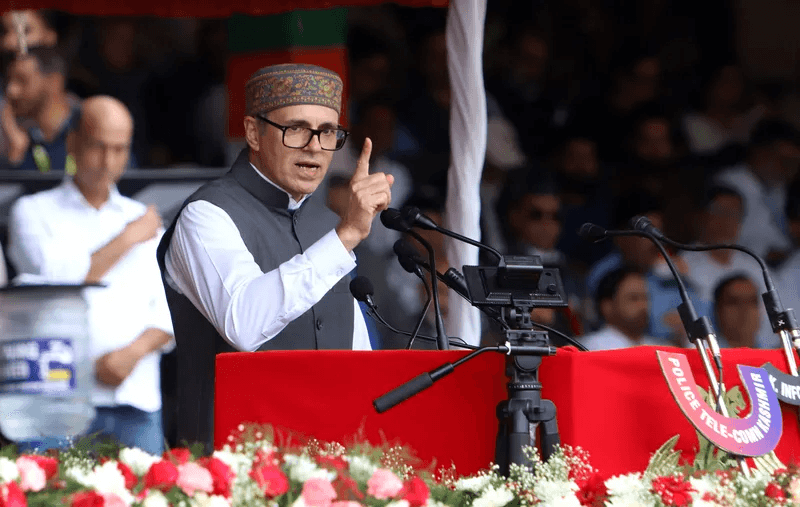
– In a charged Independence Day address from Srinagar’s Bakshi Stadium, Chief Minister Omar Abdullah launched a stinging rebuke of efforts to link terror attacks with Jammu and Kashmir’s political future. He announced a people-driven signature campaign to demand the restoration of statehood, framing it as a democratic response to a constitutional injustice.
This was Abdullah’s first Independence Day speech since Jammu and Kashmir was downgraded from a state to a union territory in 2019 — and he used the moment to forcefully reject the idea that Pakistan-sponsored terrorism should influence India’s decisions about J&K’s status.
“Will the murderers of Pahalgam and their masters across the border decide our fate?” Abdullah asked, referring to the April 22 terror attack in Pahalgam in which 26 civilians — mostly tourists — were killed. His comments came a day after a Supreme Court bench, led by Chief Justice B.R. Gavai, mentioned the Pahalgam incident while considering the timeline for restoring statehood.
Abdullah called the reference “unfortunate” and said the residents of J&K should not be punished for crimes they did not commit.
“Every time we get close to statehood, something like this happens to derail us. Why? We’ve worked hard to bring militancy under control. Elected governments — mine and others — have reduced violence over the years. We’ve never failed to govern, and we won’t fail now. But you must trust us,” he said.
Signature Campaign to Mobilise Public Voice
To push back against political and legal inertia, Abdullah announced an intensive door-to-door campaign across all 90 assembly constituencies in the union territory. Citizens will be asked to sign or give thumb impressions to answer one simple question:
“Do you want Jammu and Kashmir to be a state again?”
He promised to gather lakhs of signatures and present them before the central government and the Supreme Court as a clear public mandate for restoring statehood.
“The Supreme Court has given us eight weeks. We will use each day to take our cause to the people,” he declared.
“Not a Helpless Leader”
In an unusually candid speech, Abdullah admitted that his image has suffered in recent years due to the dual power centres in the UT setup. Choosing to depart from a prepared script, he said, “If I had read the official speech, people would think everything is fine. But it’s not.”
He also spoke of the dimming hopes for a breakthrough from Delhi, despite reassurances from political insiders that a positive announcement was in the works.
“We waited eagerly for the Prime Minister’s speech. We were told documents are being prepared. But nothing came. The ray of light has begun to fade,” he said.
Still, Abdullah was defiant: “I may be disappointed, but I am not helpless. I will not rest until we get justice.”
“A System Set Up for Failure”
Abdullah offered a reflective contrast between his previous tenure (2009–2014) as chief minister of a full-fledged state and his current role in a Union Territory.
“I’m perhaps the only person in the world who can explain the difference between leading a state and leading a union territory. This system isn’t built for success; it’s built for failure.”
He likened the current administrative model to a horse with its front legs tied and asked to gallop. “We are given a government, and yet our hands are tied behind our backs,” he said.
He criticised the breakdown of accountability between the elected government and the bureaucracy, accusing the latter of functioning without answerability. Several cabinet decisions, he claimed, have been overruled or stalled without proper explanation.
Final Message: Fight for Statehood Not Over
Abdullah ended on a firm note of resistance, saying that Jammu and Kashmir’s future cannot be defined by violence or dictated by unelected officials.
“What we need is full statehood. Without that, this so-called ‘new Jammu and Kashmir’ will never be real,” he said.
“We will get justice — and by God’s will, we will not stop until we do.”