
Last Updated on September 20, 2025 6:29 pm by INDIAN AWAAZ
Opposition unity has been a decisive factor in Bihar’s politics. If fissures between RJD and Congress widen, the NDA stands to gain. Time and again, history has proven that a divided opposition strengthens the ruling dispensation.
By Andalib Akhter / Arun Srivastava
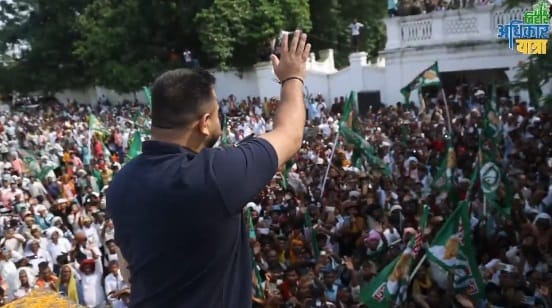
Bihar’s political landscape is currently abuzz with a series of adhikar yatras (marches for rights). Soon after Rahul Gandhi, Leader of Opposition in the Lok Sabha, launched his Voter Adhikar Yatra, RJD leader and Leader of Opposition in the Bihar Assembly Tejashwi Yadav flagged off his own Bihar Adhikar Yatra. This back-to-back political mobilization raises an important question: what is the real objective behind these yatras? Is it Tejashwi’s attempt to secure his political turf, or is it a calculated strategy to strengthen his bargaining power in the coalition politics ahead of the next Assembly elections?
Rahul’s Yatra and Congress Visibility
Rahul Gandhi’s Voter Adhikar Yatra reignited the political temperature in Bihar. Though Tejashwi Yadav accompanied him throughout, the spotlight remained firmly on Rahul. From media attention to opposition narratives, the focus was squarely on the Congress leader.
Rahul at times took the initiative single-handedly—meeting makhana farmers and interacting with locals on regional issues. The Congress machinery managed the yatra’s organization, while RJD’s role seemed somewhat subdued. This could have implications when seat-sharing talks come up, with Congress likely to cite its rising presence as grounds for demanding a greater share.
RJD’s Countermove: A Show of Strength
It is against this backdrop that Tejashwi launched his Bihar Adhikar Yatra. Unlike Rahul’s march, this one is solely an RJD affair—without Rahul Gandhi or other prominent opposition leaders on board. The message is unambiguous: RJD is the central force of opposition politics in Bihar.
Political analysts suggest that Tejashwi is using this yatra to reassure his cadre and supporters that the leadership of the coming battle lies in his hands. By projecting Congress as a junior partner, RJD wants to reinforce its position as the “big brother” in Bihar’s opposition space.
The Electoral Math and Brewing Tensions
The last Assembly results indicated that Congress, without a strong grassroots network, cannot position itself as the state’s second-largest force. Yet, Rahul Gandhi’s personal appeal is slowly gaining traction. The swelling crowds at his rallies have boosted the Congress’s morale. This could intensify the tug-of-war with RJD during seat-sharing talks.
Tejashwi’s yatra, therefore, also serves as a signal to Congress—that its influence in Bihar is limited, while RJD continues to hold the real mass base.
A Double-Edged Sword
This strategy, however, is not without risks. Opposition unity has been a decisive factor in Bihar’s politics. If fissures between RJD and Congress widen, the NDA stands to gain. Time and again, history has proven that a divided opposition strengthens the ruling dispensation.
For now, Tejashwi’s march has energized RJD’s cadre but has also left sections of the Congress camp uneasy. The big question remains: will this yatra consolidate opposition strength or deepen divisions within it?
Looking Ahead
Tejashwi’s Adhikar Yatra is not just another political roadshow; it is a crucial part of preparations for the next Assembly elections. Together with Rahul Gandhi’s earlier yatra, it is reshaping Bihar’s political discourse. Its long-term impact will extend to alliance politics, the complexities of seat-sharing, and voter sentiment. In the coming months, Bihar’s political debates are certain to revolve around the aftershocks of these yatras.