
Last Updated on October 23, 2026 10:18 pm by INDIAN AWAAZ
Foreign fund outflows, geopolitical tensions and inflation worries weigh on Dalal Street; Swiggy plunges 16.75%, while Tonbo Imaging debuts with a 62% gain
By Our Business Correspondent
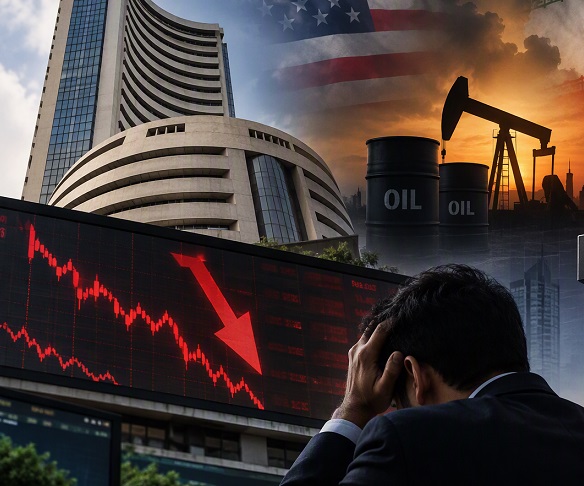
Indian equities extended their losing streak to a fourth consecutive session on Friday, as rising crude oil prices, escalating geopolitical tensions and sustained foreign fund outflows kept investors on the defensive. Selling pressure spread across sectors and market capitalisation segments, with mid-cap and small-cap stocks bearing a heavier burden than frontline shares.
The Nifty 50 managed to hold the 22,600 mark, but the broader market weakness underscored growing caution among investors amid concerns over imported inflation, corporate earnings and the outlook for global interest rates. All sectoral indices ended in the red, led by losses in consumer durables, metals, realty, energy and public sector banks (PSU banks).
The S&P BSE Sensex fell 125.56 points, or 0.17%, to close at 72,123.83. The NSE Nifty 50 declined 87.65 points, or 0.39%, to settle at 22,600.
Over the four consecutive sessions of losses, the Sensex has shed 3.49%, while the Nifty has declined 2.36%, reflecting a deterioration in near-term market sentiment.
The relatively sharper fall in the Nifty compared with the Sensex on Friday indicated that selling was not confined to a handful of heavyweight stocks. The broader indices fell substantially more than the benchmarks, pointing to a wider retreat from riskier equities.
The BSE 150 MidCap Index declined 2.10%, while the BSE 250 SmallCap Index dropped 2.68%. The declines suggest that investors were reducing exposure to smaller companies more aggressively amid heightened uncertainty and concerns over valuations.
Market breadth on the NSE was decisively negative. A total of 3,011 stocks declined, compared with 623 advances, while 90 remained unchanged. The wide gap between declining and advancing shares indicated that the selling pressure extended well beyond the headline indices.
Shriram Finance was the biggest drag among the specified Nifty constituents, falling 3.98%. Reliance Industries slipped 0.46%, while HDFC Bank declined 0.18%, adding to the downward pressure on the benchmark.
Crude oil and geopolitical risks weigh on sentiment
The rise in international crude oil prices remained a major concern for Indian markets. Brent crude futures for December 2026 delivery climbed $1.23, or 1.09%, to $114.40 a barrel.
For India, which depends heavily on imported crude, a sustained rise in oil prices can increase the import bill, put pressure on the rupee and complicate the inflation outlook. Higher energy costs can also raise transportation, logistics and manufacturing expenses, squeezing corporate margins unless companies are able to pass on the additional costs to customers.
The impact is particularly relevant for oil marketing companies, aviation, paints, chemicals and other energy-intensive industries. Higher crude prices can also weigh on household purchasing power and consumption if the increase feeds through to fuel and other prices.
Escalating geopolitical tensions have added to uncertainty over energy supplies and global economic conditions. In such an environment, investors tend to reassess earnings expectations, inflation risks and the potential direction of interest rates.
Foreign fund outflows provided another headwind. Sustained selling by overseas investors can put pressure on large-cap stocks and the domestic currency, although the extent of the market impact also depends on buying by domestic institutional investors and retail participants. No specific foreign institutional investor flow figures were provided for Friday.
The combination of expensive crude, currency weakness and broad-based selling left investors with limited sectoral support, as every sectoral index ended lower.
Rupee weakens; bond yields diverge
In the foreign exchange market, the rupee edged lower against the US dollar. The partially convertible currency was quoted at 94.9450 against the dollar, compared with the previous session’s close of 94.8100.
The weaker rupee added to concerns about imported inflation, particularly if elevated oil prices persist. A depreciating currency makes dollar-denominated imports more expensive, although exporters with substantial foreign-currency earnings may benefit from improved rupee realisations, depending on their cost structures and hedging positions.
India’s 10-year benchmark government bond yield eased to 7.456%, from 7.462% in the previous session. The yield movement was modest and did not, by itself, indicate a decisive change in the market’s assessment of inflation or monetary policy.
In the United States, the 10-year Treasury yield rose 0.63% to 4.980%, according to the supplied market data. Higher US yields can make dollar-denominated assets more attractive relative to emerging-market investments, potentially complicating capital flows into markets such as India.
The US Dollar Index, which measures the greenback against a basket of major currencies, gained 0.16% to 101.77.
MCX gold futures for delivery on December 4, 2026, declined 0.42% to Rs 1,42,700. The decline suggested that gold did not attract uniform buying despite geopolitical uncertainty, although movements in bullion can also reflect currency changes, bond yields and profit-taking.
Global markets remain under pressure
Global equities presented a mixed picture, with technology stocks facing renewed selling pressure in the United States, while European markets declined amid energy-price and inflation concerns. Dow futures were down 299 points, signalling a weaker start for US equities at the time of reporting.
European investors weighed escalating tensions in the Middle East, volatile crude oil prices and the implications of potentially persistent inflation for interest rates. Brent crude trading near $114 a barrel heightened concerns about energy supply disruptions and the effect of higher input costs on businesses and consumers.
Investors were also assessing corporate earnings and whether the substantial investment by technology companies in artificial intelligence infrastructure would generate adequate returns.
UK retail sales volumes fell 0.4% in September, worse than the 0.1% decline expected by economists. Warmer weather weighed on online clothing sales, while supermarket volumes declined. However, retail sales volumes increased 0.7% over the three months, and fuel volumes rose 2.2%.
Asian markets, meanwhile, recovered from early losses and ended higher, despite concerns over AI spending triggering a sell-off in technology shares and encouraging some investors to move towards safer assets.
Japan’s September inflation figures also attracted attention. Core consumer prices, excluding fresh food, rose 2.1% year on year, accelerating from 1.7% in August. An underlying measure that also excludes fuel increased 2.4%, compared with 1.9% in the previous month. The acceleration strengthened the case for further monetary tightening by the Bank of Japan, although the timing and pace of any policy move remain dependent on subsequent economic data.
The divergence between Asian markets and Indian equities highlighted the importance of domestic factors, including crude oil exposure, currency movements and foreign investment flows, in shaping individual market performance.
Wall Street hit by technology sell-off
US stocks finished mixed on Thursday, October 22, as a sharp decline in technology shares weighed on the S&P 500 and Nasdaq Composite.
The Dow Jones Industrial Average edged up 11.89 points, or 0.02%, to 52,867.98. The S&P 500 fell 93.74 points, or 1.21%, to 7,663.43, while the Nasdaq Composite dropped 694 points, or 2.6%, to 26,008.86. The Nasdaq’s decline was its steepest daily percentage fall since early June, according to the supplied market data.
The Philadelphia Semiconductor Index plunged 6.7%, marking its biggest daily percentage decline since June 23. Despite the technology-led weakness, most US stocks advanced, suggesting that the sell-off was concentrated in high-growth companies rather than reflecting an equally broad retreat across the market.
Investors also moved into US government bonds amid concerns over AI expenditure and the outlook for economic growth, although Treasury yields can move in response to several competing factors.
Meta Platforms fell about 7% despite reporting third-quarter revenue above analysts’ expectations. Investors focused on rising AI-related expenditure and plans to issue non-voting shares to help finance investment, renewing concerns about the capital requirements of large-scale AI infrastructure and the returns those investments may ultimately generate.
Tesla declined 3.1%, even after reporting positive free cash flow and reducing its projected 2026 capital expenditure to $20 billion from $25 billion. The lower spending forecast did little to ease concerns about the company’s growth prospects and the profitability of future investments.
Elsewhere, Spotify gained 11% after reporting higher revenue and an increase in premium subscribers. Comcast advanced 3.4% after its adjusted earnings per share exceeded expectations, despite a decline in revenue.
US labour market data offered a more resilient signal. Initial jobless claims fell by 6,000 to 194,000 in the week ended October 17, below the market consensus of 200,000. The previous week’s figure was revised upwards to 200,000 from 199,000.
Continuing claims, however, rose by 25,000 to 1.728 million in the week ended October 10. The figures suggested that new applications for unemployment benefits remained relatively low, even as the number of people continuing to receive benefits increased.
For global investors, the combination of a resilient labour market, elevated bond yields and questions over AI investment returns complicated expectations for interest-rate policy and equity valuations.
New listings deliver mixed returns
Newly listed stocks recorded divergent performances, with Tonbo Imaging India emerging as the strongest performer among the four counters in the supplied data, while Zetwerk Manufacturing Business ended below its issue price.
Tonbo Imaging India closed at Rs 1,133.65, a premium of 61.95% over its IPO price of Rs 700. The stock had debuted on the BSE at Rs 1,182, representing a 68.86% premium. It touched an intraday high of Rs 1,209.85 and a low of Rs 1,013.95. Trading volume on the exchange exceeded 22.78 lakh shares.
Sahajanand Medical Technologies ended at Rs 378.20, up 9.94% over its issue price of Rs 344. The stock opened at Rs 368.05, a premium of 6.99%, and moved between Rs 347.50 and Rs 409.95 during the session. More than 13.02 lakh shares changed hands on the BSE.
Bonfiglioli Transmissions closed at Rs 576.35, a discount of 1.65% to its issue price of Rs 586. The stock touched a high of Rs 607 and a low of Rs 527.40, with more than 37.36 lakh shares traded on the BSE.
Zetwerk Manufacturing Business ended at Rs 138.30, down 8.41% from its issue price of Rs 151. The stock had initially listed at Rs 159, a premium of 5.30%, before slipping to an intraday low of Rs 127.20. It touched a high of Rs 160.50, while trading volume exceeded 54.33 lakh shares.
The contrasting performances underline the importance of post-listing demand and investor expectations in determining short-term returns. A strong debut does not necessarily guarantee that a stock will sustain its initial premium, particularly during a broader market downturn.
Corporate earnings drive sharp stock-specific moves
Sterlite Technologies, also known as STL, rose 2.39% after reporting a substantial increase in consolidated revenue and net profit for the September quarter of FY27.
Revenue from operations surged 144.6% year on year and 32.4% quarter on quarter to Rs 2,529 crore in the second quarter. Net profit after minority interest and the share of joint ventures increased to Rs 517 crore, compared with Rs 4 crore in the corresponding quarter of the previous financial year.
Profit also rose 161.9% sequentially from Rs 197 crore in the June quarter. The company’s open order book stood at Rs 35,274 crore at the end of September.
The sharp improvement in reported earnings and the substantial order book provided a positive signal for investors. However, the sustainability of profit growth will depend on execution, margins, cash flows and the conversion of orders into revenue.
Rallis India fell 5.21% after reporting weaker standalone earnings. Net profit declined 16.67% year on year to Rs 85 crore in the September quarter, from Rs 102 crore a year earlier. Revenue from operations slipped 0.35% to Rs 858 crore, compared with Rs 861 crore in the corresponding quarter of FY26.
The combination of lower profit and nearly flat revenue suggested pressure on earnings growth, prompting a negative reaction in the stock.
Swiggy was among the session’s steepest losers, plunging 16.75% after its second-quarter results raised concerns about the pace of profitability, particularly in its quick-commerce business, Instamart.
The company’s consolidated net loss narrowed year on year to Rs 922 crore in Q2 FY27, from Rs 1,092 crore in the same quarter last year. However, the loss widened sequentially from Rs 791 crore in the June quarter.
Revenue from operations rose 36.1% year on year and 11.1% quarter on quarter to Rs 7,571 crore.
The figures highlighted the challenge facing fast-growing online delivery and quick-commerce businesses: expanding revenue while containing fulfilment costs, customer-acquisition expenses and other operating expenditure. The sequential increase in Swiggy’s net loss appeared to weigh on investor sentiment despite the improvement in year-on-year revenue and losses.
Jio Platforms IPO subscribed 18.49 times
The initial public offering of Jio Platforms attracted strong demand on its final day, with bids received for 3,65,31,22,704 shares against 19,75,25,934 shares on offer, according to stock exchange data at 4:54 pm IST on October 23. The issue was subscribed 18.49 times.
The offering opened on October 21 and closed on October 23. The price band was fixed at Rs 1,065–1,119 per share, with a minimum application of 12 shares and multiples thereafter.
Paras Healthcare’s IPO was subscribed 2.23 times by the same reporting time. Investors bid for 2,69,12,403 shares against 1,20,83,331 shares on offer.
The issue also opened on October 21 and closed on October 23. Its price band was Rs 660–693 per share, with a minimum application of 21 shares and multiples thereafter.
Subscription figures indicate the demand received during the bidding period, but they do not guarantee listing gains or future share-price performance. Final allotment, valuation and subsequent market conditions remain important considerations for investors.
Market outlook: Oil, earnings and foreign flows in focus
The immediate outlook for Indian equities is likely to remain sensitive to crude oil prices, geopolitical developments, movements in the rupee and foreign institutional investment flows. The continuation of the market decline for four sessions, coupled with the sharper losses in mid-cap and small-cap indices, points to a cautious investment environment.
Elevated oil prices could complicate the inflation outlook and increase pressure on companies with high energy and transportation costs. A weaker rupee may add to imported inflation, while movements in US Treasury yields and the dollar could influence overseas investment flows into emerging markets.
Corporate earnings will remain another important determinant of stock-specific performance. The contrasting reactions to the results of Sterlite Technologies, Rallis India and Swiggy demonstrate that revenue growth alone may not be sufficient to support valuations when investors are concerned about profitability, margins and future expenditure.
The sharp divergence in new-listing performances also suggests that investors are differentiating between companies rather than treating all IPO stocks alike. However, the wider market correction could increase volatility even in stocks that have delivered strong initial gains.
For investors, the key variables to monitor are the sustainability of crude oil prices, the direction of foreign fund flows, currency movements, corporate earnings and the ability of the broader indices to stabilise after the recent losses. Any recovery will need to be assessed against these underlying factors rather than a single session’s movement.
Disclaimer: This report is for informational and educational purposes only and should not be construed as investment advice or a recommendation to buy or sell any security. Market prices and data are time-sensitive and may be revised. Investors should conduct independent research and consult a qualified financial adviser before making investment decisions.