
Last Updated on May 29, 2026 10:08 pm by INDIAN AWAAZ
Markets Sink for Third Straight Session as Geopolitical Tensions, Weak Monsoon Outlook Shake Investor Confidence
Our Business Correspondent
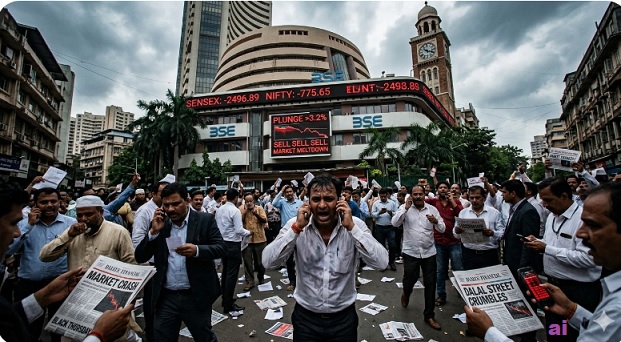
Indian equity markets ended sharply lower on Friday, extending losses for a third consecutive trading session as rising geopolitical tensions in the Middle East, concerns over a weaker monsoon forecast and MSCI related portfolio adjustments triggered heavy selling across sectors.
The benchmark indices witnessed intense pressure during the final hour of trading, with investors turning increasingly risk averse amid uncertainty surrounding crude oil prices, inflation and global stability.
The BSE Sensex plunged 1,092.06 points, or 1.44%, to close at 74,775.74, while the NSE Nifty50 dropped 359.40 points, or 1.50%, to settle below the psychologically important 23,550 mark at 23,547.75. Over the last three sessions, the Sensex and Nifty have declined more than 2%.
Energy, metals and automobile stocks led the decline, dragging the broader market into negative territory.
Middle East Tensions Fuel Investor Anxiety
Market sentiment remained fragile as investors closely monitored developments in the Middle East following reports of fresh missile and drone activity linked to the ongoing US-Iran conflict.
Although reports suggested that Washington and Tehran were moving toward a temporary ceasefire arrangement, traders remained cautious about the possibility of disruptions in global crude oil supplies through the strategically vital Strait of Hormuz.
Analysts said volatility in crude prices continues to pose a major risk for India, one of the world’s largest oil importers, especially at a time when inflationary concerns are already resurfacing globally.
“Investors are unwilling to take aggressive positions until there is greater clarity on the geopolitical situation and oil price trajectory,” a Mumbai based market strategist said.
Monsoon Forecast Adds to Economic Concerns
Investor sentiment was further dampened after the India Meteorological Department (IMD) projected monsoon rainfall at around 90% of the long period average, indicating a slightly below normal monsoon season.
While the forecast does not indicate a severe drought scenario, economists warned that uneven rainfall distribution could affect agricultural production in several regions, potentially increasing food inflation and weakening rural demand.
A weaker rural economy could impact consumption driven sectors ranging from FMCG and automobiles to fertilizers and consumer durables.
However, analysts noted that the overall macroeconomic impact may remain manageable due to stable industrial output and resilience in the services sector.
MSCI Rebalancing Triggers Late Sell-Off
Selling pressure intensified sharply in the final half hour of trade after the latest MSCI Global Standard Index rebalancing came into effect.
MSCI announced the inclusion of Federal Bank, MCX, NALCO and Indian Bank in its Global Standard Index, a move expected to attract passive foreign inflows into these counters.
At the same time, Hyundai Motor India, Jubilant FoodWorks, Kalyan Jewellers and Rail Vikas Nigam Ltd. (RVNL) were removed from the index, resulting in heavy institutional selling.
The changes became effective from May 29, 2026.
Heavyweights Drag Market Lower
Among the biggest contributors to the market decline were Reliance Industries, HDFC Bank and ICICI Bank, all of which witnessed sharp selling pressure.
Broader markets also remained weak, though losses there were relatively moderate compared to frontline indices. The BSE MidCap index fell 1.25%, while the SmallCap index declined 0.61%.
Market breadth remained decisively negative, with declining stocks significantly outnumbering advancing shares on the BSE.
The India VIX — often referred to as the market’s “fear gauge” — surged more than 8% to 16.19, reflecting heightened nervousness among traders.
Rupee Weakens, Bond Yields Edge Higher
In the currency market, the rupee weakened against the US dollar amid riskoff sentiment and concerns over oil prices. Bond yields also edged slightly higher as investors reassessed inflation risks.
Gold prices slipped marginally despite global uncertainty, while Brent crude prices remained volatile amid ongoing geopolitical developments.
Wall Street Optimism Fails to Lift Domestic Markets
Indian markets largely ignored positive cues from global equities.
Asian and European markets ended mostly higher after reports emerged that the United States and Iran were nearing a temporary agreement to pause hostilities. Overnight, Wall Street also extended gains, with the Nasdaq and S&P 500 touching fresh record highs led by technology stocks.
However, strong US inflation data continued to worry global investors. America’s Personal Consumption Expenditures (PCE) inflation — the Federal Reserve’s preferred inflation measure — accelerated to 3.8% in April, reinforcing concerns that interest rates may remain elevated for longer.
Delta Corp Crashes After Supreme Court GST Verdict
Among individual stocks, Delta Corp emerged as one of the biggest losers of the day, plunging more than 14% after the Supreme Court upheld the government’s retrospective 28% GST levy on the full face value of bets placed on gaming platforms.
The ruling dealt a major blow to online gaming companies, many of which had challenged the tax demand arguing that online gaming should not be treated on par with gambling activities.
Pharma and Specialty Stocks Shine Despite Weak Market
Despite the broader market weakness, several stocks witnessed strong buying interest following positive earnings and regulatory developments.
Wockhardt surged nearly 15% after receiving regulatory approval for its breakthrough antibiotic “Zaynich,” developed in India.
Supriya Lifescience rallied 20% after posting robust quarterly earnings, while Ashapura Minechem and Banco Products also gained sharply on strong revenue growth.
PC Jeweller advanced after reporting a significant jump in quarterly profit, while Wipro edged higher following the announcement of an expanded partnership with ServiceNow focused on agentic AI workflows.
Market Outlook: Volatility Likely to Continue
Analysts expect market volatility to remain elevated in the near term as investors track developments in the Middle East, monsoon progress and inflation trends in major global economies.
Foreign institutional flows, crude oil movement and domestic macroeconomic indicators are expected to remain key drivers for market direction in the coming weeks.
With uncertainty dominating global markets, traders are likely to remain cautious ahead of fresh economic data and geopolitical developments.