
Last Updated on October 2, 2026 10:09 pm by INDIAN AWAAZ
Our Correspondents
New Delhi/Mumbai /Kolkata
Protests against Chief Election Commissioner Gyanesh Kumar spread across several parts of the country on Friday, with major demonstrations in Mumbai and Delhi bringing together opposition parties, student organisations, youth groups and civil-society activists. The protesters raised questions over the Election Commission’s functioning and the ongoing Special Intensive Revision (SIR) of electoral rolls, with several groups demanding Kumar’s resignation or removal.
The two principal centres of mobilisation were Mumbai’s Shivaji Park, where the Cockroach Janta Party (CJP) held its agitation, and Delhi’s Jantar Mantar and adjoining areas, where opposition parties and student organisations attempted to demonstrate despite police restrictions.
Mumbai: CJP leads Shivaji Park protest
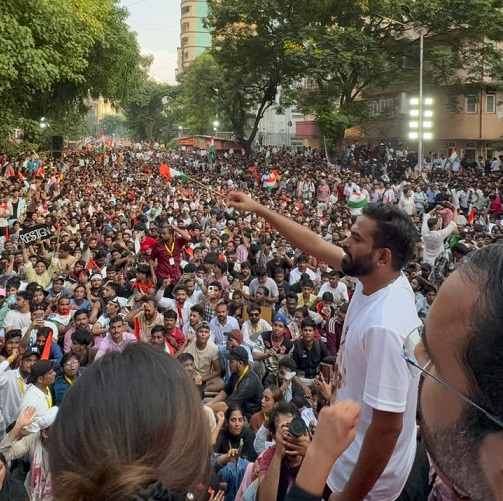
In Mumbai, the Cockroach Janta Party (CJP) organised a major protest at Shivaji Park demanding the resignation of CEC Gyanesh Kumar. The gathering went ahead despite police denying permission for the proposed programme. Hundreds and, according to some reports, thousands of young protesters gathered at the venue, carrying the national flag, placards and satirical posters targeting the Election Commission.
CJP founder Abhijeet Dipke has announced that the Mumbai protest is the beginning of a wider campaign. The group has said it will take its agitation to Goa, Bengaluru and Kolkata, among other cities, and continue the campaign until Kumar resigns.
The CJP’s demands go beyond Kumar’s resignation. They include greater transparency in the appointment of the Chief Election Commissioner and a demand that the 2025 electoral roll be frozen, amid allegations that the voter list is being altered through the SIR process.
The Mumbai mobilisation also received support from sections of the opposition. Reports said Shiv Sena (UBT) and Maharashtra Navnirman Sena (MNS) extended support to the agitation. Student activists, including members of the Students’ Federation of India (SFI), were also present.
Several film personalities were also associated with the Mumbai protest. Naseeruddin Shah and composer-singer Vishal Dadlani joined the demonstration, while Shabana Azmi and Prakash Raj were reported to have expressed support.
A separate group calling itself Gen Next Mumbai organised a counter-protest at Shivaji Park, opposing the CJP’s position, according to reports.
Delhi: Opposition and student groups confront police
Delhi witnessed a separate and broader mobilisation around Jantar Mantar, Parliament Street, Janpath and Connaught Place. The mobilisation involved Aam Aadmi Party (AAP) leaders and workers, along with student and youth organisations including All India Students’ Association (AISA), Students’ Federation of India (SFI), National Students’ Union of India (NSUI) and Indian Youth Congress (IYC). The Democratic Youth Federation of India (DYFI) also participated, while Left leaders joined the protest.
Among the political leaders who participated or were detained were AAP Delhi president Saurabh Bharadwaj, former Delhi chief minister Atishi, Rajya Sabha MP Sanjay Singh and AAP MLA Sanjeev Jha. RJD Rajya Sabha MP Manoj Jha was also among those detained, according to reports.
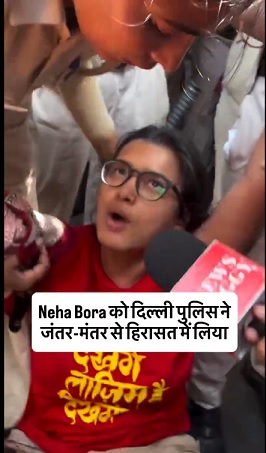
From the Left, CPI(M) general secretary M.A. Baby and senior leader Brinda Karat joined the mobilisation. AISA national president Neha Bora, RTI activist Nikhil Dey and activist Yogendra Yadav were also detained while attempting to reach the protest area.
Police had denied permission for the proposed Jantar Mantar demonstration and imposed restrictions under Section 163 of the Bharatiya Nagarik Suraksha Sanhita (BNSS) in the New Delhi area. Barricades were put up around Jantar Mantar and Parliament Street, while Rapid Action Force and other security personnel were deployed.
By afternoon, police said more than 700 people had been detained, although reports at different points in the day cited different figures. Protesters were taken in buses to various police stations after being stopped from reaching Jantar Mantar.
Delhi Police also imposed traffic restrictions and several Metro stations in central Delhi temporarily closed entry and exit gates because of the security arrangements.
Kolkata: Left parties take to the streets
A separate demonstration was reported in Kolkata, where Left parties held a march from Rani Rashmoni Road towards Gandhi statue protesting against the CEC and demanding changes relating to the electoral rolls.
The mobilisation was led by Left leaders, with Sujan Chakraborty among those addressing protesters. Slogans focused on removing Gyanesh Kumar and restoring voters whose names had allegedly been excluded from electoral rolls.
Goa and Bengaluru next targets of CJP
The CJP has indicated that the October 2 Mumbai protest is part of a month-long campaign, with demonstrations planned in Goa, Bengaluru and Kolkata, besides further mobilisation in Delhi and other cities. Reuters reported that CJP spokesperson Saurav Das said the campaign would continue until Kumar resigns.
What is behind the protests?
The immediate issue is the controversy surrounding the Special Intensive Revision (SIR) of electoral rolls and allegations concerning the manner in which decisions have been taken within the Election Commission.
The protests intensified after reporting that Election Commissioners Sukhbir Singh Sandhu and Vivek Joshi had raised objections on multiple occasions over decisions and orders relating to SIR, voter registration and the Commission’s digital systems. Opposition parties and activists have used these reports to question the functioning of the poll panel and demand accountability from the CEC.
The Election Commission has rejected allegations of wrongdoing, maintaining that decisions were taken through due process and that differences during internal deliberations do not necessarily indicate institutional wrongdoing.
The protests therefore combine two related demands: accountability over the functioning of the Election Commission and opposition to aspects of the SIR exercise. The CJP is focusing particularly on Kumar’s resignation, while the opposition parties and student organisations are also demanding electoral-roll safeguards and changes in the way the Commission operates.