
Last Updated on August 14, 2026 12:37 am by INDIAN AWAAZ
Opposition Signals Battle Beyond Parliament
Andalib Akhter
The Monsoon Session of Parliament, which began on July 20 and concluded on August 13, has ended in unprecedented turmoil, raising serious questions about the political standing of Prime Minister Narendra Modi and his government. What should have been a forum for debate on pressing national issues instead became a battleground of slogans, adjournments, and confrontation, leaving the session virtually paralyzed.
From the very first day, the government was confronted by the Cockroach Janata Party and its “Chalo Sansad March,” a youth-led protest that echoed the intensity of the farmers’ agitation and the Shaheen Bagh movement. Unlike earlier protests, however, this one forced the government to retreat. During the turbulent 2026 Monsoon Session of Parliament A Union minister was compelled to resign and Prime Minister Narendra Modi and Home Minister Amit Shah remained largely absent from the House for nearly the entire duration, sparking heavy protests and criticism from opposition parties. They only made their first appearance together on the final day of the session, shortly before both houses were adjourned sine die This absence has been interpreted as a sign of shrinking confidence and eroding authority.
The deadlock began on July 20, when police cracked down on students marching from Jantar Mantar to Parliament. The opposition alleged excessive force, including lathicharge, tear gas, and even pellet guns, which left several students injured. Congress leader Rahul Gandhi demanded that Home Minister Amit Shah explain who authorized such measures against peaceful demonstrators. He went further, presenting a wounded student, Sahil Lochab, to the media, claiming his eye was damaged by pellets. The opposition insisted that the Prime Minister himself should apologize for the brutality.
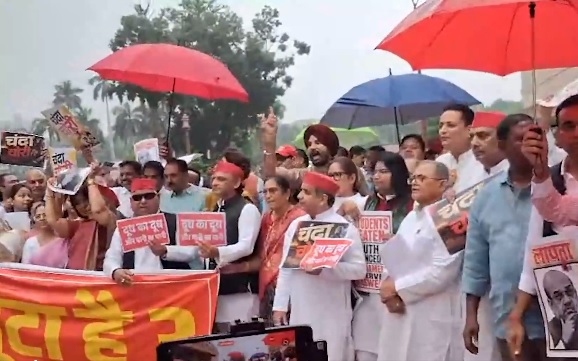
Beyond the student issue, the opposition also pressed for discussion on the Ram Mandir donation theft, arguing that Modi bore direct responsibility given his central role in the temple’s foundation, inauguration, and trust formation. Congress, the Samajwadi Party, and other INDIA bloc allies disrupted proceedings throughout, demanding accountability from both Modi and Shah.
The government, meanwhile, accused the opposition of politicizing the July 20 incident and insisted that official records should be examined before drawing conclusions. On August 12, Amit Shah finally offered to discuss the matter and promised to respond in Parliament. But the opposition dismissed this as too little, too late, continuing to demand his resignation.
In terms of legislative work, the session was almost barren. The only substantive debate was on the NEET paper leak, which lasted two days. Other bills were passed hurriedly by voice vote amid uproar, reinforcing the perception that Parliament had been reduced to a rubber stamp.
The broader implications of this session are significant. For the first time, Modi’s government saw a minister resign under public pressure. The student agitation at Jantar Mantar has signaled a shift in public mood: the aura of fear surrounding Modi and Shah appears to be fading, emboldening citizens to challenge the government more openly.
Meanwhile, the Cockroach Janata Party announced its next move—a nationwide “Fix the Schools” campaign starting August 15, coinciding with the 80th anniversary of Independence. Its activists plan to highlight the poor state of government schools through peaceful protests and community monitoring. The INDIA bloc, too, has vowed to take the fight from Parliament to the streets, ensuring these issues remain alive in public discourse.
With the Monsoon Session now ending amid political confrontation, both sides are preparing for the next phase of the battle.
The government will seek to portray the Opposition as responsible for disrupting parliamentary proceedings, while Opposition parties are likely to argue that the government avoided accountability on issues they consider important.
The coming months will determine whether the student protests and other issues raised during the session translate into a broader political movement or remain largely confined to Parliament and political campaigns.
For Prime Minister Modi and Home Minister Amit Shah, the session has certainly presented a difficult political challenge. Whether it represents a temporary parliamentary impasse or the beginning of a broader shift in public sentiment will ultimately be tested on the ground—and, most importantly, in the electoral contests ahead.
Looking ahead, the political impact of this session will likely be felt in the 2027 assembly elections. With double-engine BJP governments in most states, the party faces tough battles, particularly in Uttar Pradesh, where the Ram Mandir donation scandal is already inflaming public sentiment. The Monsoon Session’s collapse is being read as a warning sign: Modi’s once unassailable political base is showing cracks, and the opposition is determined to exploit them.