
Last Updated on September 12, 2026 11:44 am by INDIAN AWAAZ
R. Suryamurthy
India is heading into the most politically sensitive negotiations of the BRICS summit with an increasingly difficult question hanging over the table: whether the expanded grouping will directly challenge the United States over the West Asia war or settle for language on de-escalation that can keep its sharply divided members together.
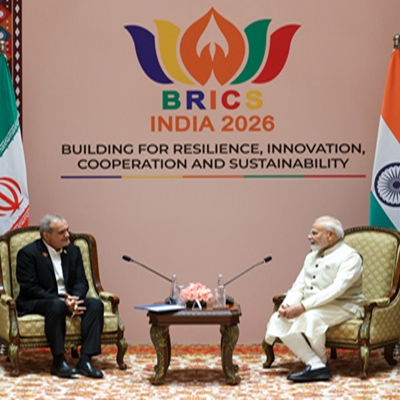
Prime Minister Narendra Modi’s meeting with Iranian President Masoud Pezeshkian on Friday, a day before BRICS leaders begin negotiating their final declaration, underscored the dilemma facing New Delhi as summit host.
India wants BRICS to emerge as a stronger voice for the Global South, but has little interest in allowing the grouping to become defined as an anti-American bloc. Iran, meanwhile, is seeking political support from a grouping that now includes Tehran as a full member, while the United Arab Emirates, another new member, has its own security interests in a region increasingly caught between Iran and its Gulf rivals.
The wording of the summit declaration could therefore become the clearest test yet of whether BRICS expansion has increased its geopolitical influence or simply made consensus harder.
Modi’s message after meeting Pezeshkian was carefully framed. He said the two countries should pursue a “long-term and win-win strategy”, while the regional situation was discussed and India remained committed to “enduring peace”.
The Indian readout said Modi reiterated New Delhi’s position that disputes should be resolved through dialogue and diplomacy and stressed the need for lasting regional stability, freedom of navigation and commerce and the safety of seafarers.
There was no public condemnation of Washington, Tehran or Israel.
That omission is likely to matter as negotiators work on the declaration.
A tougher test than Bishkek
The stakes have risen since the Shanghai Cooperation Organisation summit in Bishkek at the end of August, where India joined other members in condemning U.S. and Israeli military strikes against Iran.
Repeating that language in New Delhi would carry greater political weight.
BRICS includes major emerging economies that maintain extensive economic and strategic ties with Washington, while India itself has spent years building a closer U.S. partnership in defence, technology, investment and the Indo-Pacific.
At the same time, Russia and China have strategic reasons to challenge aspects of U.S. dominance, while Iran has a direct interest in ensuring that the grouping does not respond to the conflict with a neutral formula that treats all sides equally.
The result is a diplomatic equation in which almost every word matters.
An explicit condemnation of U.S. action could strengthen Iran’s position but risk making BRICS look increasingly like a geopolitical counterweight to the West.
A declaration that avoids naming the United States or Israel could preserve consensus but leave Tehran dissatisfied and raise questions about whether BRICS can act collectively on major international crises.
The compromise most consistent with India’s current position would focus on de-escalation, dialogue, protection of civilians and the security of international shipping rather than assigning blame.
That may be the language New Delhi will seek to build into the final text.
India’s interests go beyond diplomacy
India’s emphasis on maritime security is driven by immediate economic and human costs.
The West Asia conflict has put Indian seafarers at risk, with 10 Indians among 16 Indian nationals reported killed in the conflict, according to reports cited in the run-up to the summit.
New Delhi has protested attacks involving merchant vessels carrying Indian crew and raised concerns with both Iranian and U.S. authorities.
The Strait of Hormuz adds a broader economic dimension.
The waterway is critical to global oil and gas flows, and prolonged disruption would expose India to higher energy and shipping costs while affecting supplies of crude, gas, fertilisers and other commodities.
India therefore has an interest in a BRICS position that strongly defends freedom of navigation without necessarily endorsing either Tehran’s or Washington’s wider geopolitical narrative.
That distinction could be crucial in the final negotiations.
For India, the issue is also about preserving access and relationships.
Iran remains important to New Delhi because of the Chabahar port project and its potential role in providing access to Afghanistan and Central Asia. But the United Arab Emirates and other Gulf states are equally important economic and strategic partners, while millions of Indians live and work across the region.
A prolonged regional conflict would therefore hit India through several channels at once — energy, trade, shipping, investment and its overseas workforce.
The Iran factor inside an expanded BRICS
Pezeshkian’s presence makes the negotiations fundamentally different from previous BRICS debates over West Asia.
Iran is no longer merely a country whose crisis the grouping can discuss. It is now sitting at the table as a member, seeking recognition of its security concerns and a political response to military action against it.
Modi’s decision to meet Pezeshkian twice within less than two weeks — first in Bishkek and now in New Delhi — reflects the importance India attaches to keeping communication open.
The prime minister also thanked Iran for maintaining high-level participation in BRICS despite the difficult circumstances and highlighted cooperation between the two countries in multilateral institutions.
For New Delhi, that engagement serves two purposes.
It protects bilateral interests while also giving India a channel through which it can try to moderate Tehran’s expectations of what BRICS should say.
The UAE presents the opposite challenge.
Its presence means that a declaration written primarily around Iran’s position could encounter resistance from another member with substantial economic and security interests in the Gulf.
That makes consensus less a question of ideology than of competing national interests.
What BRICS can — and cannot — say
Three broad outcomes appear possible.
The strongest would be an explicit condemnation of U.S. and Israeli military action. Such a statement would give Iran a major diplomatic victory and reinforce the perception of BRICS as a platform challenging Western power.
But it would put India in a difficult position and potentially deepen the divide between BRICS rhetoric and the interests of members that maintain close ties with Washington.
A second option would condemn military escalation without identifying the perpetrators. That would allow the group to register opposition to the conflict while keeping the United States out of the centre of the declaration.
The third would be a broad appeal for an immediate end to hostilities, dialogue and diplomacy, protection of civilians and infrastructure, and freedom and safety of commercial navigation.
That would be the least politically dramatic option but potentially the most useful for India.
It would allow BRICS to claim a collective position on the conflict without forcing every member to endorse the same geopolitical interpretation.
The danger is that excessive caution could make the declaration appear deliberately ambiguous.
India’s balancing act
The larger issue for Modi is whether India can preserve its strategic autonomy while hosting a summit at a moment when global power rivalries are becoming harder to compartmentalise.
New Delhi has repeatedly resisted pressure to choose sides between competing power centres. Its relationships with Washington, Moscow, Tehran, Beijing and the Gulf states are built around different interests and cannot easily be reduced to a single geopolitical alignment.
BRICS tests that strategy because the organisation is itself becoming more politically consequential.
If its declaration directly targets Washington, India will face questions about whether BRICS is moving towards an anti-Western identity.
If it avoids the U.S. role altogether, critics could argue that an expanded grouping claiming to represent the Global South lacks the political weight to confront a major international crisis involving one of its own members.
That is why the Modi-Pezeshkian meeting matters.
It was not simply another bilateral encounter on the margins of a summit. It came at a point when India needs Iran to remain engaged, the UAE to accept a common position and the wider BRICS membership to agree on language that does not fracture the grouping.
The final declaration will provide the clearest answer to the question now facing New Delhi: can BRICS become a stronger independent voice in global affairs without turning its growing influence into an explicit confrontation with Washington?
India’s preferred answer is likely to be diplomacy, de-escalation and maritime security rather than a direct political assault on the United States.
Whether Iran, Russia, China, the UAE and the other members accept that formula will determine how far India can translate its balancing act into a BRICS consensus.