
Last Updated on December 11, 2025 9:42 pm by INDIAN AWAAZ
Lalit Gargg
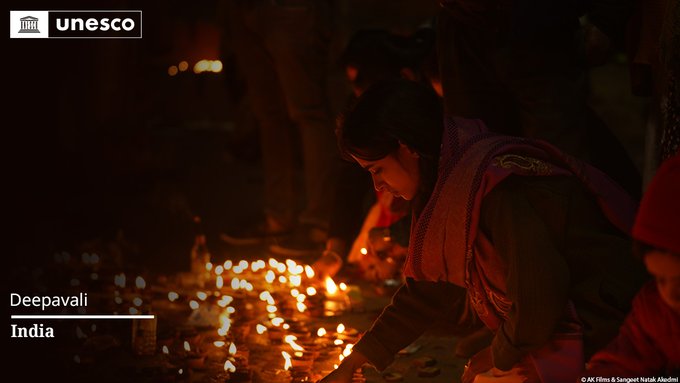
UNESCO’s decision to declare Diwali as an Intangible World Heritage is a historic moment for India’s cultural consciousness. It not only fills every Indian with pride but also reaffirms that the soul of Indian civilization still possesses the power to guide humanity. Diwali is not merely a festival—it is a scripture of light that celebrates life, spirit, relationships, harmony, and universal brotherhood. For thousands of years, this heritage has led humanity from darkness to light, from ignorance to wisdom, from jealousy to love, and from fear to faith. To understand the grandeur of Diwali is to understand the depth of Indian culture. This culture does not reside only in temples, rituals, scriptures, or festivals, but flows through human memory, emotion, belief, and conduct. That is why it is called “intangible”—not visible in form, yet profoundly alive. Diwali is the highest celebration of this living essence.
When 26.17 lakh earthen lamps illuminated Ayodhya’s Ram Ki Paidi in a single radiant moment, the spectacle was not just a sea of lights; it was the global proclamation of India’s cultural luminosity. The world saw that India’s traditions continue to be a universal source of inspiration. UNESCO’s recognition is the natural outcome of this wonder. At its core, Diwali is not merely about worship but about the philosophy of life. The festival reminds mankind that within every difficulty lies the possibility of light. Hindu, Jain, Buddhist, and Sikh traditions may celebrate Diwali for different reasons, but the message remains one—the path of light is the path of humanity. Today, this eternal message is receiving global recognition.
India’s intangible cultural heritage has always served the larger good of humanity. Traditions like the Kumbh Mela, Vedic chanting, Ramlila, Yoga, and Durga Puja are already part of UNESCO’s heritage list. With Diwali added, the list grows even more luminous. Diwali fulfills UNESCO’s purpose: to protect traditions that carry humanity’s highest wisdom across time. Diwali also carries profound economic, social, and human lessons. The small potter who molds a simple clay lamp brings light into crores of homes. The small shopkeeper’s livelihood becomes as important as that of a large business. The festival teaches that society becomes truly radiant when every individual receives light. Thus, Diwali is a celebration of community consciousness, equality, and shared opportunities.
In a world burdened with division, war, anxiety, material greed, and emotional darkness, Diwali’s message becomes even more relevant—one small flame can challenge the deepest darkness. India has always taught that moral courage, harmony, peace, and spiritual energy are what make civilizations sustainable. Diwali is the living symbol of this truth. Prime Minister Narendra Modi’s modern vision and cultural diplomacy have carried India’s timeless concepts to the global stage. Whether it is the worldwide acceptance of Yoga, the rising interest in Ayurveda, international Ramayana conferences, or the global celebration of Indian festivals—this is India’s soft power in action. UNESCO’s recognition of Diwali marks the next beautiful milestone on this journey. Modi’s philosophy of Vasudhaiva Kutumbakam has now become not only India’s foreign policy but a global viewpoint. From G20 to international forums, this vision has strengthened India’s global identity. The world honouring Diwali is an extension of the same principle—it reminds humanity that the world is one family, pain is shared, and joy must be shared too.
Diwali is not merely a spiritual festival—it is also a profound cultural psychology. It does not empty the mind; it fills it. It does not extinguish the self; it awakens it. Diwali is an occasion to dust the mind, awaken new hope, and recognize the inner light. Declaring it a world heritage acknowledges the spiritual future of humanity. Globalization may have connected the world technologically, but emotional fragmentation has also increased. In this scenario, India’s cultural diversity—especially traditions like Diwali—serve as philosophical bridges between civilizations. They remind the world that life is not only consumption but compassion; not only progress but harmony; not only development but values.
After UNESCO’s announcement, the world will no longer see Diwali merely as an Indian religious festival. It will be regarded as a global ethical consciousness. This honour celebrates a heritage rooted in the past yet guiding the future. It validates India’s spiritual strength, respected across centuries. Now it becomes our responsibility to preserve and elevate this radiant heritage—not just as a festival, but as a philosophy of life. When we light a lamp within, the world finds a direction in its glow. This is the power of Indian culture. This is the glory of Diwali. Undoubtedly, Diwali’s global recognition is the triumph of India’s cultural soul. It proves that India is not merely a geopolitical power but also a spiritual guide for humanity. May this light reach every corner of the world in the years to come—this is the message of Diwali, and India’s cultural responsibility. The festival of lamps is no longer only India’s; it now belongs to all of humanity. And this light of India will rise as a new sun of global consciousness in times ahead.