
Last Updated on August 12, 2026 1:30 pm by INDIAN AWAAZ
Dr. Aniket Oswal
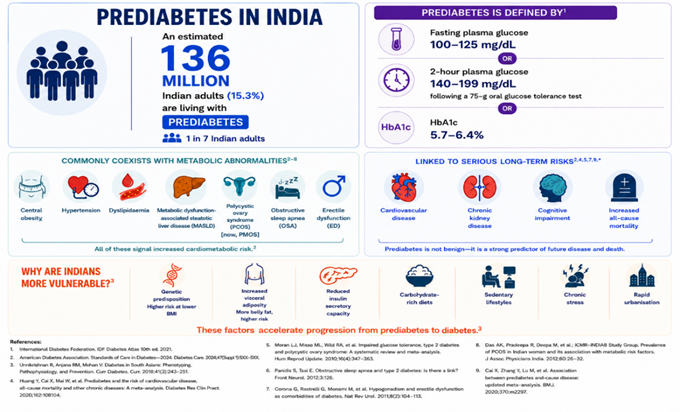
India has the second-highest diabetes burden in the world, but an even larger and often overlooked health challenge is emerging in the form of prediabetes. According to the Indian Council of Medical Research-India Diabetes (ICMR-INDIAB) study, an estimated 136 million Indian adults, or 15.3% of the adult population, are living with prediabetes—a figure that is higher than the number of people already diagnosed with diabetes.
Prediabetes refers to a metabolic state in which blood glucose levels are higher than normal but remain below the threshold required for a diabetes diagnosis. It can occur as impaired fasting glucose (IFG), impaired glucose tolerance (IGT), or a combination of both.
The condition is particularly concerning because it often develops without noticeable symptoms. Despite the absence of obvious warning signs, prediabetes reflects ongoing metabolic dysfunction and can increase the risk of progressing to type 2 diabetes and related complications. Early identification therefore provides an important opportunity to intervene before the condition advances.
A major challenge is that many people with prediabetes remain unaware of their condition. Routine screening is still not common enough among people at higher risk, allowing elevated blood glucose to go undetected for years.
The American Diabetes Association (ADA) defines prediabetes as a fasting plasma glucose level of 100–125 mg/dL, a 2-hour plasma glucose level of 140–199 mg/dL during a 75-g oral glucose tolerance test, or an HbA1c level of 5.7–6.4%.
With millions of Indian adults estimated to have prediabetes, greater awareness, timely screening and early lifestyle interventions could play a crucial role in preventing or delaying the onset of type 2 diabetes.
Deciphering the high burden of prediabetes in Indians
Compared to their Western counterparts, South Asians tend to develop insulin resistance and β-cell dysfunction earlier in life and at a lower body mass index. This is due to a genetic predisposition toward greater visceral fat and lower insulin secretory capacity.3 Carbohydrate-rich meals, sedentary lifestyles, chronic stress, and rapid urbanization, hasten the progression to diabetes.3
What’s most worrying isnot just how common prediabetes is, but how quickly it progresses. Each year, an estimated 5-10% of people with prediabetes go on to develop type 2 diabetes, and that risk climbs sharply in those who have both IFG and IGT together, or have several metabolic risk factors.4 But on the flip side, the condition is reversible i.e., with timely lifestyle changes,individuals can bring their blood glucose levels to normal.5
The case for early detection of prediabetes
The biggest hurdle with prediabetes is its silent nature. Unlike full-blown diabetes, it typically doesnot come with the classic warning symptoms of excessive thirst, frequent urination, and unexplained weight loss. This allows the condition to quietly persist for years without being detected. Prediabetes often co-occurswith other metabolic problems: central obesity, high blood pressure, dyslipidemia, metabolic dysfunction-associated steatotic liver disease (MASLD), polycystic ovary syndrome (PCOS) – now known as polyendocrine metabolic ovarian syndrome (PMOS), obstructive sleep apnea (OSA), and erectile dysfunction (ED), all markers of heightened cardiometabolic risk.2,6-8
It is pertinent here to emphasize that prediabetes is not simply a condition characterized by “slightly high blood sugar”. Research shows that metabolic and vascular changes can begin well before a diagnosis of diabetes is made, and prediabetes itself is linked to cardiovascular disease, chronic kidney disease, cognitive decline, and a higher risk of death from any cause.2,4
Early recognition of these dangers early gives clinicians a critical window for screening, risk stratification, and intervention aimed at slowing or preventing progression to type 2 diabetes and its complications.
The associated cardiovascular risk is particularly striking. A meta-analysis pooling 129 prospective studies and more than 10 million participants found that, compared with normal glucose levels, prediabetes raises the risk of cardiovascular disease by 15%, coronary heart disease by 16%, and stroke by 14%, alongside a 13% rise in all-cause mortality.10 Individuals with prediabetes exhibit insulin resistance, chronic low-grade inflammation, endothelial dysfunction, and atherogenic dyslipidemia – features that precede the diagnosis of diabetes by several years. These contribute to early vascular damage and greater cardiovascular risk.4This evidence makes it clear that prediabetes is not just a warning sign to keep an eye on, it’s an active disease state that merits clinical attention.
Are lifestyle interventions alone enough to prevent diabetes?
Lifestyle changes remain the first-line approach to prevent progression from prediabetes to type 2 diabetes. In the Diabetes Prevention Program (DPP), intensive lifestyle intervention decreased the incidence of diabetes by 58%, proving just how effective it can be under structured, and closely supported conditions.11 Guidelines currently recommend losing 5-10% of body weight, getting at least 150 minutes of moderate-intensity activity per week, eating a high-fiber diet low in refined carbohydrates, and quitting smoking.2,9
However, adhering to these lifestyle changes is not easy. Sustained lifestyle change demands ongoing motivation, behavioral support, and consistency, all of which are difficult to maintain without the support of a structured programme.
India’s own data well illustrate this gap. The ICMR-INDIAB study found that 54.4% of adults were physically inactive, and <10% took part in recreational physical activity, indicative of the difficulty in achieving population-level behavior change.12 So while lifestyle modification continues to be the cornerstone of managing prediabetes, many high-risk patients will also likely need further individualized interventions.2,9
Figure: Prediabetes- Burden, risks and vulnerabilities in Indian context
Changing the trajectory of diabetes through early prediabetes intervention
Prediabetes may well be the last real chance to avert a lifetime of diabetes and its complications. Every diagnosis that is delayed raises the odds of vascular damage that cannot be undone.
Lifestyle intervention should always come first, but metformin can be a reasonable option for certain high-risk patients: younger adults with obesity, women with a history of gestational diabetes, and those with worsening glucose control despite lifestyle efforts. The ADA, Indian expert consensus, and a recent review of the evidence support this approach.2,9,13 Metformin is already approved for preventing or delaying type 2 diabetes in people with prediabetes in close to 66 countries.14
Routine testing, fasting blood glucose or HbA1c as part of an annual health check-up, can flag high-risk individuals much before they develop diabetes. Early detection also enables early recognition and control of hypertension, dyslipidemia, obesity, and fatty liver disease, cutting long-term cardiovascular risk in the process.
| Prediabetes: At a glance 136 million Indians have prediabetes, which is more than the number of people diagnosed with diabetes.Prediabetes is not a benign precursor to diabetes; it is an active cardiometabolic disease.Screen high-risk individuals early with fasting glucose and/or HbA1c.Lifestyle modification is the first-line intervention; consider starting metformin in eligible high-risk patients.Early detection and intervention can delay or prevent type 2 diabetes and its complications. |
Expert perspective
Every visit with a high-risk patient is a chance to prevent diabetes, and not diagnose later on. Detecting prediabetes early, along with structured lifestyle support and, where appropriate, evidence-based use of metformin in selected patients, could significantly reshape the trajectory of diabetes in India.
Practice points
- India’s prediabetes burden now exceeds 136 million people, making it one of the country’s largest preventable public health challenges.
- Prediabetes is silent, reversible, yet often ignored, despite its association with cardiovascular disease and several other chronic disorders.
- Screening high-risk individuals earlier, increasing public awareness and implementing evidence-based lifestyle interventions could prevent millions of future diabetes cases.
- Prediabetes should no longer be viewed as “borderline diabetes” instead it should be regarded as a critical window for prevention that healthcare systems cannot afford to miss.
References
- Anjana RM, Unnikrishnan R, Deepa M, et al; ICMR-INDIAB Collaborative Study Group. Metabolic non-communicable disease health report of India: the ICMR-INDIAB National Cross-sectional Study. Lancet Diabetes Endocrinol. 2023;11(7):474-489.
- American Diabetes Association Professional Practice Committee. 2. Diagnosis and Classification of Diabetes: Standards of Care in Diabetes—2026. Diabetes Care. 2026;49(Suppl 1):S27-S49.
- Misra A, Sattar N, Ghosh A, et al. Type 2 diabetes in South Asians. BMJ. 2025;390:e079801.
- Tabák AG, Herder C, Rathmann W, et al. Prediabetes: a high-risk state for diabetes development. Lancet. 2012;379(9833):2279-2290.
- Knowler WC, Barrett-Connor E, Fowler SE, et al; Diabetes Prevention Program Research Group. Reduction in the incidence of type 2 diabetes with lifestyle intervention or metformin. N Engl J Med. 2002;346(6):393-403.
- Livadas S, Anagnostis P, Bosdou JK, et al. Polycystic ovary syndrome and type 2 diabetes mellitus: A state-of-the-art review. World J Diabetes. 2022;13(1):5-26.
- Muraki I, Wada H, Tanigawa T. Sleep apnea and type 2 diabetes. J Diabetes Investig. 2018;9(5):991-997.
- Defeudis G, Mazzilli R, Tenuta M, et al. Erectile dysfunction and diabetes: A melting pot of circumstances and treatments. Diabetes Metab Res Rev. 2022;38(2):e3494.
- Das AK, Mohan V, Ramachandran A, et al. An Expert Group Consensus Statement on approach and management of prediabetes in India. J Assoc Physicians India. 2022;70(Suppl):11-12.
- Cai X, Zhang Y, Li M, et al. Association between prediabetes and risk of all cause mortality and cardiovascular disease: updated meta-analysis. BMJ. 2020;370:m2297.
- Diabetes Prevention Program Research Group. Long-term effects of lifestyle intervention or metformin on diabetes development and microvascular complications over 15-year follow-up: the Diabetes Prevention Program Outcomes Study. Lancet Diabetes Endocrinol. 2015;3(11):866-75.
- Anjana RM, Pradeepa R, Das AK, et al; ICMR-INDIAB Collaborative Study Group. Physical activity and inactivity patterns in India: results from the ICMR-INDIAB study (Phase-1) [ICMR-INDIAB-5]. Int J Behav Nutr Phys Act. 2014;11(1):26.
- Lim BSY, Chen M, Li HY, et al. Metformin use in prediabetes: A review of evidence and a focus on metabolic features among peri-menopausal women. Diabetes Obes Metab. 2025;27 Suppl 3(Suppl 3):3-15.
- Singh AK, Singh A, Gangopadhyay KK. Metformin in prediabetes: opportunity or over-treatment? Int J Diabetes Dev Ctries. 2025;45(1):13-23.
Dr. Aniket Oswal, is Consultant Physician & Diabetologist, CEO – Oswal Clinic, Pune