
Last Updated on January 11, 2026 12:53 am by INDIAN AWAAZ
AMN / BIZ DESK
India and Oman have signed a Comprehensive Economic Partnership Agreement (CEPA), marking a significant milestone in their rapidly expanding economic ties. The pact establishes a comprehensive framework covering trade in goods and services, investment, professional mobility and regulatory cooperation, moving well beyond conventional tariff cuts to enable long-term economic integration, predictable market access and a more facilitative business environment.
The agreement comes against the backdrop of steadily rising bilateral trade. Merchandise trade between the two countries touched USD 10.61 billion in FY 2024–25, up from USD 8.94 billion in FY 2023–24. Services trade has also gained momentum, with India’s exports increasing from USD 397 million in 2020 to USD 617 million in 2023, creating a strong foundation for a deeper and more structured trade arrangement.
A major highlight for India is 100 percent duty-free access in Oman across 98.08 percent of tariff lines, covering 99.38 percent of India’s exports by value, effective from day one of implementation. This marks a sharp improvement from the earlier Most Favoured Nation (MFN) regime, under which only 15.33 percent of Indian export value entered Oman duty-free. Key beneficiary sectors include minerals, chemicals, machinery, plastics, textiles, agricultural and marine products, and gems and jewellery. With Oman’s import market exceeding USD 28 billion, Indian exporters are well placed to expand their footprint.
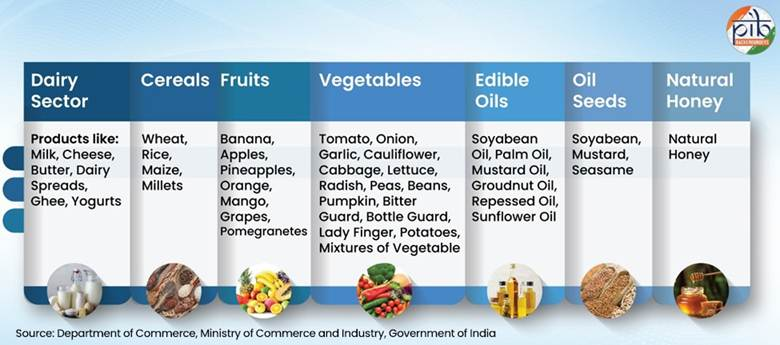
India, in turn, has offered tariff liberalisation on 77.79 percent of tariff lines, accounting for 94.81 percent of imports from Oman, while safeguarding sensitive sectors. An exclusion list has been retained for dairy, cereals, spices, petroleum products, rubber, textiles, leather, select chemicals and certain agricultural items, reflecting a calibrated approach aimed at protecting farmers, MSMEs and labour-intensive industries.
| Key Gains in Agricultural Products Boneless meat of bovine animals – Duty-free access reinforces India’s dominant supplier position, with a 94.3% share in Oman’s USD 68.27 million import market. Fresh eggs – Zero-duty access consolidates India’s 98.3% share, making Oman India’s largest export destination for eggs. Sweet biscuits – Duty-free entry strengthens India’s position in Oman’s USD 8.05 million biscuits market, improving competitiveness against Turkey, UAE and Saudi Arabia. Butter – Elimination of the 5% tariff improves India’s price competitiveness in Oman for exports valued at USD 5.75 million, giving India an edge over Denmark, Saudi Arabia and New Zealand. Natural honey – Tariff elimination improves India’s price competitiveness in Oman’s USD 6.61 million honey market, where India holds a 19.2% share, giving India an edge over Australia, China and Saudi Arabia. Mixed condiments & seasonings – Duty-free access strengthens India’s 14.1% share in Oman’s USD 40.02 million market, placing India at par with the USA and ahead of Saudi Arabia and the UAE. |
Sector-wise assessments point to sizeable gains. Engineering exports to Oman, valued at USD 875.83 million in FY 2024–25, are projected to rise to USD 1.3–1.6 billion by 2030 following tariff elimination. The pharmaceutical sector stands to benefit from binding zero-duty access and fast-track approval mechanisms for products cleared by stringent regulators such as the USFDA and EMA, reducing compliance costs and speeding up market entry.
Marine products receive immediate duty-free access, improving competitiveness for shrimp and fish exports. Agricultural and processed food exports—ranging from bovine meat and eggs to biscuits, butter, honey and condiments—are expected to consolidate India’s role as a key supplier, while phased tariff reductions protect domestic food security interests. Textiles, plastics, electronics, chemicals and gems and jewellery are also set to gain, with Oman emerging as a potential gateway to GCC and East African markets.
Services constitute another strong pillar of the CEPA. In 2024, bilateral services trade stood at USD 863 million, with India enjoying a surplus of USD 447 million. Oman has undertaken liberal commitments across 127 sub-sectors, including professional, IT, education, R&D, health, tourism and other business services. Notably, provisions on professional mobility raise the ceiling for intra-corporate transferees from 20 percent to 50 percent and, for the first time in an FTA with Oman, formally recognise defined professional categories such as engineering, medical, IT, education and consulting. The agreement also opens the door for future negotiations on a Social Security Agreement to avoid dual contributions.
On the regulatory side, the CEPA strengthens cooperation on Technical Barriers to Trade (TBT) and Sanitary and Phytosanitary (SPS) measures, aiming to reduce non-tariff barriers through transparency, mutual recognition and alignment with international standards. Acceptance of certificates issued by India’s Export Inspection Council (EIC) is expected to streamline inspections, while faster pharmaceutical approvals, and recognition of halal and organic certification systems, will ease export processes.
The geographic and employment impact of the pact is expected to be broad-based. Agricultural and food-processing gains span states such as Uttar Pradesh, Punjab, Haryana, Andhra Pradesh, Maharashtra, Gujarat, Tamil Nadu and Telangana, while labour-intensive sectors like textiles, leather, plastics, gems and jewellery and marine products are likely to generate jobs across major industrial clusters. With many of these sectors driven by MSMEs, preferential access strengthens India’s competitiveness against suppliers from China, Türkiye, Italy, Thailand and GCC economies.
Overall, the India–Oman CEPA is positioned as a balanced and strategic agreement—expanding market access while preserving domestic safeguards. By facilitating trade, investment, skilled mobility and regulatory cooperation, the pact is expected to boost exports, create employment, strengthen supply chains and anchor sustained bilateral economic engagement over the long term.
References
Ministry of Commerce & Industry
https://www.pib.gov.in/PressReleasePage.aspx?PRID=2205889®=3&lang=2
Ministry of External Affairs