
Last Updated on October 12, 2026 10:25 pm by INDIAN AWAAZ
By Andalib Akhter / New Delhi
The INDIA bloc has taken its campaign against Chief Election Commissioner Gyanesh Kumar from the streets to the courtroom, marking a new phase in the Opposition’s confrontation with the Election Commission of India (ECI).
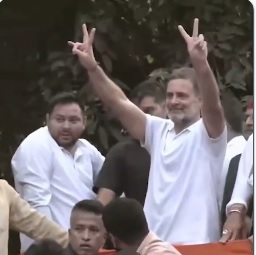
In a show of Opposition unity, leaders of several INDIA bloc parties assembled at the Constitutional Club before marching towards the Supreme Court from the Barakhamba Road area. Leader of the Opposition in the Lok Sabha Rahul Gandhi, Congress president Mallikarjun Kharge and nine other INDIA bloc leaders filed a petition in the Supreme Court challenging alleged irregularities in the ongoing Special Intensive Revision (SIR) of electoral rolls.
The petition alleges large-scale deletion of voters’ names and procedural irregularities in the revision exercise. It also questions the exercise of powers by Chief Election Commissioner Gyanesh Kumar, alleging that decisions requiring collective consideration by the full Election Commission were taken unilaterally.
The petition asks the court to examine whether the disputed decisions comply with Article 324 of the Constitution, the Chief Election Commissioner and Other Election Commissioners Act, 2023, and relevant Supreme Court judgments.
Among the key reliefs sought is a direction to the ECI to produce files, meeting minutes, official notings and system access logs relating to the disputed SIR decisions. The petition also seeks the quashing of decisions allegedly taken without lawful authority.
The INDIA bloc leaders have further sought an independent audit of voter deletions by a committee headed by a retired Supreme Court judge. Other demands include the booth-wise publication of deleted voters’ names, along with the reasons for their removal, and an interim suspension of the SIR process across states.
The petition brings the Opposition’s concerns over electoral-roll revisions before the judiciary, with the INDIA bloc seeking judicial scrutiny of the Election Commission’s procedures and the legality of the disputed decisions.
The message from the streets was clear: the Opposition intends to pursue its challenge beyond public demonstrations and into the legal arena. With the Supreme Court now emerging as the next focal point of the confrontation, the political battle over the Election Commission has entered a new phase.
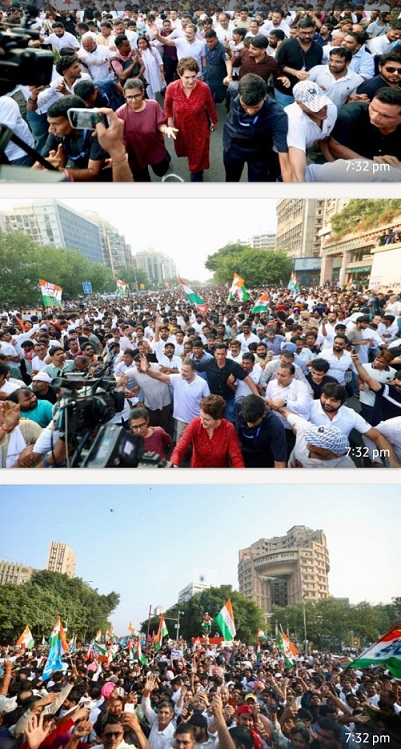
For the Congress and its INDIA bloc partners, the march was also an attempt to bring together their political campaign and their proposed legal challenge. By mobilising workers and senior leaders under a common banner, the Opposition sought to demonstrate that its concerns were not confined to Parliament or press conferences but were being carried directly to the institutions empowered to examine questions of law.
The slogan “Chalo Dilli” reverberated through the gathering as workers marched alongside senior leaders. The mobilisation reflected the Congress’s effort to convert its campaign into a broader street-level movement, drawing attention to its objections and demanding greater scrutiny of the electoral process.
The participation of Akhilesh Yadav, Mamta Banerjee, Tejaswi Yadav, Supriya Sule. MA Baby, Sanjay Raut, & D Raja reinforced the leadership’s presence at the demonstration. The party sought to use the march to consolidate its support base while bringing its concerns over the Election Commission into the national political spotlight.
Neha Bora, who has drawn attention for her confrontational stand against the Chief Election Commissioner, was also part of the march, according to the account provided. Her presence added another dimension to the protest, which brought together political leaders and workers around a common demand for accountability.
The INDIA bloc’s decision to take the issue to the Supreme Court marks an important transition in its campaign. Street protests can amplify political demands, but proceedings before the judiciary require specific legal grounds, supporting material and arguments that can be examined under the law. The next stage will therefore depend on the nature of the petition, the relief sought and the court’s response.
The Election Commission, as a constitutional authority responsible for conducting elections, occupies a central position in India’s democratic framework. Any challenge concerning its functioning carries implications beyond party politics, making the legal questions raised by the Opposition particularly consequential for the wider debate over electoral transparency and institutional independence.
For the INDIA bloc, the immediate challenge will be to translate the momentum generated by the march into a coherent legal strategy. The Opposition will have to establish its grounds before the court while sustaining its political campaign outside it.