
Last Updated on November 15, 2026 2:51 pm by INDIAN AWAAZ
Historian Danish Moin traces evolution of Deccan coinage at Salar Jung Museum
Our Correspondent / Hyderabad
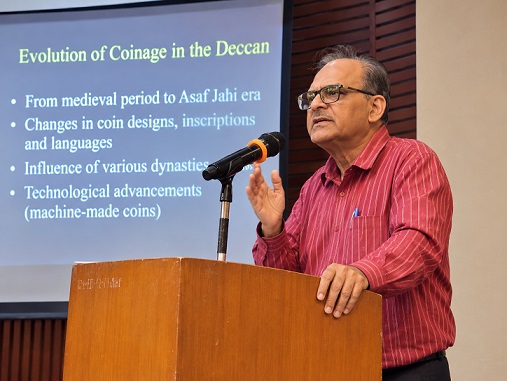
The rich history of Deccan coinage, reflecting the region’s changing political powers, cultural influences and technological advancements, came into focus at a lecture organised at the Salar Jung Museum here on Saturday.
Prof Danish Moin of Maulana Azad National Urdu University (MANUU) delivered a lecture on the evolution of coinage and minting traditions in the Deccan, tracing developments from the medieval period to the Asaf Jahi era. He explained how successive dynasties brought changes in coin designs, inscriptions, languages and manufacturing techniques, making coins an important source of historical information.
Discussing two distinct coinage traditions, Prof Moin highlighted the contrast between the Vijayanagara Empire and the Deccan Sultanates. While the Vijayanagara rulers largely continued the ancient Indian tradition of coinage, dating back to the sixth century BC, their coins frequently carried pictorial representations of gods, goddesses, animals, trees and other symbols.
The Deccan Sultanates, on the other hand, including the Bahmanis, Adil Shahis, Nizam Shahis and Qutb Shahis, followed Islamic coinage traditions. These introduced Arabic language and script on coins, a development that began in India around the early 12th century and became more widespread by the 13th century.
Prof Moin also examined the coinage practices of the Asaf Jahi dynasty, pointing to two significant developments during its rule. Initially, the early Nizams continued the Mughal practice of issuing coins in the name of the Mughal emperor. Gradually, this practice was discontinued, and the emperor’s name was replaced by the title ‘Asaf Jah Nizam-ul-Mulk Bahadur’, a designation subsequently retained by the Nizams.
Another major development was the introduction of machine-made coins in Hyderabad. The speaker noted that Hyderabad was the first Indian princely state to adopt this technology, marking an important transition in the region’s minting history.
Explaining the terminology used on the coins, he said the title ‘Farkhanda Bunyad’, meaning ‘city of auspicious foundation’, was widely used as an epithet for Hyderabad on coins issued during the Asaf Jahi period.
The lecture also covered various traditional and modern coin-production methods, including punching, casting, repousse work, die-striking and fine machining. These techniques reflected the technological evolution of minting across different periods.
Highlighting the importance of mint centres under the Deccan kingdoms, Prof Moin listed Ahsanabad (Gulbarga), Muhammabad (Bidar), Daulatabad and Goa among the prominent mints during the Bahmani period.
The session offered an insight into the region’s rich numismatic heritage, demonstrating how coins, beyond their monetary value, serve as historical records of political authority, religious influences, cultural practices and technological change.
….