Last Updated on June 21, 2026 5:43 pm by INDIAN AWAAZ
By Andalib Akhter
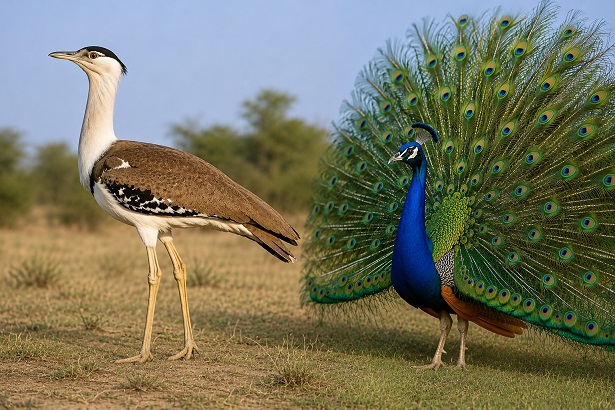
India’s national bird is instantly recognisable—the dazzling peacock with its iridescent feathers, graceful display and deep roots in mythology. But few people know that before the peacock earned that distinction, another remarkable bird had once been seriously proposed for the honour: the Great Indian Bustard.
The Great Indian Bustard derives its name from its presence across the Indian subcontinent and its large, imposing body size. It is popularly known as Sohan Chidiya (Sohan Chiraiya) because of its golden-toned feathers and the slate-grey colour of its body.
Across different regions, the bird is known by several traditional names inspired by its appearance and behaviour. It is called “Gurayin” because its call during cloudy weather is said to resemble the growl of a tiger. Since it produces a deep, resonant “hook” sound, it is also known as “Hookna.” Its crest-like appearance has led some communities to call it “Mal Moradi,” drawing a comparison with the peacock. Because of its ability to run swiftly like a horse, it is also referred to as “Ghorad.” In Maharashtra, where the bird’s characteristic call is pronounced as “hoom,” it is sometimes called “Hoomna.” The call of the Great Indian Bustard can reportedly be heard from as far as 500 metres away.
The story resurfaced recently through an X post by Congress leader Jairam Ramesh, who recalled a little-known episode linking former Prime Minister Indira Gandhi, Rajasthan’s desert landscape and one of India’s most endangered species.
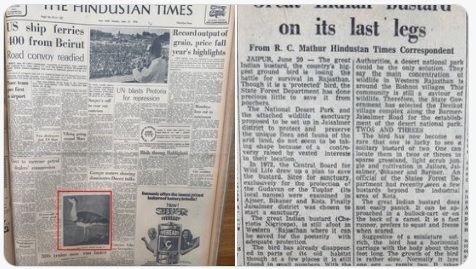
According to the account, on June 21, 1976—exactly 50 years ago—Indira Gandhi was travelling to Udaipur to mark the 400th anniversary of the historic Battle of Haldighati that made Maharana Pratap an enduring symbol of courage and resistance. During the morning flight, she reportedly came across a front-page photograph in Hindustan Times showing the Great Indian Bustard, accompanied by a report highlighting its alarming decline.
The image appears to have left an impression. After landing in Udaipur, she met bird enthusiasts led by Harsh Vardhan, then associated with the Rajasthan Wildlife Board. That encounter helped trigger greater conservation attention for the Great Indian Bustard and eventually contributed to initiatives that led to the creation of the vast Desert National Park across Rajasthan’s Jaisalmer and Barmer regions.
But the bustard’s connection with India’s national identity goes back even further.
In 1961, celebrated Indian ornithologist Salim Ali had proposed the Great Indian Bustard as India’s national bird. At the time, the choice carried symbolic and ecological significance. The bird was native to India, represented the country’s unique grassland ecosystems and possessed an imposing presence.
So why did it lose?
Two years later, in 1963, the Indian Board for Wild Life selected the peacock instead.
The decision was influenced by what were described as compelling historical, mythological, cultural and religious considerations. The peacock occupies a special place across Indian traditions—it is associated with deities, appears in classical art and literature, and is widely recognised across regions and communities. Unlike the bustard, whose habitat is limited and whose appearance is relatively understated, the peacock had broad public familiarity and strong cultural resonance.
Yet the Great Indian Bustard remains one of India’s most extraordinary birds.
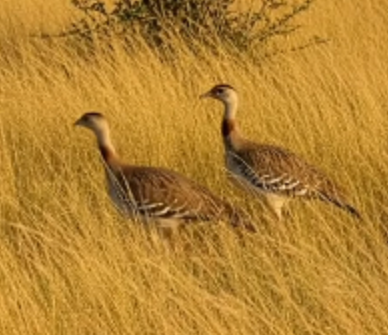
Among the heaviest flying birds in the world, the Great Indian Bustard is known for its tall stature, long legs and measured, elegant movements across open grasslands and semi-arid landscapes. Adult males can stand over a metre tall and are famous for dramatic courtship displays in which they inflate a white neck pouch to attract mates. Despite its size, the bird is alert, elusive and remarkably adapted to harsh desert conditions.
The United Nations Environment Programme (UNEP) brings together 138 countries from around the world. In 2020, a UNEP meeting was held in Gandhinagar, Gujarat, where the Great Indian Bustard (Godawan) was chosen as the official mascot symbol.
Once found across large parts of India, the species today survives in only a few pockets and remains critically endangered due to habitat loss, power-line collisions and shrinking grassland ecosystems.
The peacock may have become India’s official national bird—but the Great Indian Bustard remains a powerful reminder that national symbols are not only chosen for beauty and culture; they can also reflect the landscapes and species a nation chooses to protect.