
Last Updated on October 9, 2026 12:23 am by INDIAN AWAAZ
Council Eases Enforcement: Arrest Powers Scrapped, Prosecution Threshold Raised to Rs 5 Crore
BIBHUDATTA PRADHAN / NEW DELHI
The Goods and Services Tax (GST) Council on Thursday recommended a major overhaul of GST enforcement provisions, including complete removal of the power of arrest under the GST law and a five-fold increase in the threshold for prosecution from Rs 1 crore to Rs 5 crore.
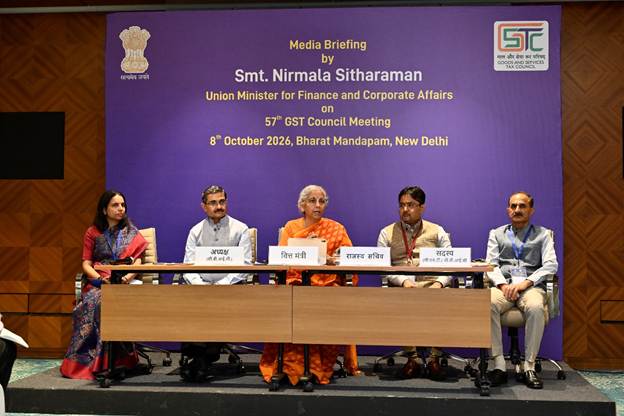
The decisions were taken at the 57th meeting of the GST Council, chaired by Union Finance and Corporate Affairs Minister Nirmala Sitharaman in New Delhi. The meeting focused largely on simplifying GST compliance, rationalising enforcement and reducing litigation and taxpayer-officer interface.
The Council also recommended that no GST show-cause notice should be issued where the tax amount involved is below Rs 10,000. Pending notices and appeals involving amounts below the proposed threshold would also be dealt with under the new threshold once the provision comes into force.
Sitharaman said the Council had not made any changes to GST rates at Thursday’s meeting and that the focus was on process reforms and improving the functioning of the tax system.
Arrest provision to be removed
The most significant recommendation is the proposed complete withdrawal of arrest powers under GST through the omission of Section 69 of the Central GST Act.
The move is intended to shift the emphasis of GST enforcement towards recovery of legitimate tax dues and proportionate penalties rather than criminal action in cases that do not warrant such treatment.
The government said the objective is to create a more progressive and trust-based tax regime while retaining effective deterrence against serious tax fraud and evasion.
The recommendation does not mean that taxpayers will be free from financial consequences for non-compliance. Tax dues, applicable interest and penalties will continue to be recoverable under the GST framework.
Prosecution threshold raised from Rs 1 crore to Rs 5 crore
The Council also recommended raising the monetary threshold for launching prosecution under GST from Rs 1 crore to Rs 5 crore.
It further recommended changes to the offences covered under Section 132 and rationalisation of punishment for various GST offences.
The changes are aimed at ensuring that criminal prosecution is focused more squarely on serious cases rather than relatively smaller tax disputes.
The Council also proposed changes to provisions relating to fraudulent availment of input tax credit, with the relevant offence to cover fraudulent ITC claims where goods or services have not been received or where the required invoice or bill is absent.
No notices below Rs 10,000
Another important decision concerns small-value GST disputes. The Council recommended a minimum monetary threshold of Rs 10,000, combining CGST, SGST, IGST and cess, for issuing show-cause notices.
As a result, no GST notice would be issued where the amount involved is less than Rs 10,000.
The Council has also recommended that pending notices and appeals involving amounts below Rs 10,000 should be dealt with as though the new threshold had been applicable when those proceedings were initiated, once the statutory provision comes into force.
The measure is expected to reduce administrative work for tax officers as well as compliance and litigation costs for taxpayers over very small amounts.
General penalty proposed to be reduced
The Council recommended reducing the maximum general penalty under Section 125 from Rs 25,000 to Rs 10,000.
It also proposed removing the minimum penalty requirement in non-fraud cases.
For taxpayers who accept an adjudicated liability and pay the tax and interest within the prescribed period, the Council recommended a substantially lower penalty of 5% in non-fraud cases.
The proposed window would be 30 days under Section 73 and 60 days under Section 74A from the date of the adjudication order.
Common standards for GST notices and proceedings
The Council also recommended introducing common standards for demand notices, adjudication orders and appeal orders.
The proposed guidelines would cover the quality of notices and orders, timely issuance of proceedings, proper invocation of provisions relating to fraud, wilful misstatement or suppression of facts, and adherence to principles of natural justice.
The Council specifically emphasised the need for personal hearings in appropriate cases.
The move is aimed at reducing differences in the way GST provisions are interpreted and enforced by different field formations.
Appeal burden to be capped
The Council also recommended an upper limit of Rs 40 crore on the pre-deposit payable for filing an appeal before the Appellate Authority or Appellate Tribunal in cases where the order involves only a penalty and no tax demand.
The government expects the measure to reduce the financial burden on taxpayers seeking appellate remedies.
Easier movement of goods
The Council recommended changes to GST provisions governing the interception of goods-carrying vehicles.
Under the proposed framework, a vehicle would generally be intercepted only on the basis of specific intelligence and with authorisation from an officer not below the rank of Joint Commissioner.
The Council also recommended that inspection and further action for detention or seizure should generally be undertaken where the supplier or recipient is located or registered in the state in which the interception takes place.
This is intended to reduce unnecessary interception of goods merely because they are passing through another state.
However, where there is no e-way bill or the vehicle does not carry documents establishing the origin or destination of the goods, inspection, detention or seizure could still be undertaken irrespective of jurisdiction.
Relief for small taxpayers
The Council also recommended waiver of late fees on delayed filing of returns for taxpayers with annual turnover of up to Rs 5 crore in the preceding financial year, provided the delayed return is filed by the end of the month in which it was due.
The move is expected to provide relief to small businesses facing occasional delays in return filing.
The Council also approved, in principle, an optional Annual Return Quarterly Payment (ARQP) scheme for taxpayers with turnover up to Rs 5 crore who are exclusively engaged in supplies to unregistered persons.
GST registration for small e-commerce sellers
The Council recommended a simplified registration mechanism for small suppliers selling goods through e-commerce operators in states where they do not have a physical business presence.
Eligible suppliers would be able to declare the warehouse of an e-commerce operator as their principal place of business, subject to prescribed conditions.
The mechanism would apply to suppliers intending to pass on input tax credit of up to Rs 2.5 lakh per month.
The government said the measure would allow small sellers to expand into other states through e-commerce without establishing a separate physical place of business in every state.
More automated refunds
The Council also recommended measures to make GST refunds faster and reduce manual intervention.
Among the proposals is greater automation in refund processing, including automated sanction of eligible refunds in specified cases.
The Council also recommended that the time limit for issuing an acknowledgement or deficiency memo be reduced from 15 days to 10 days.
For eligible refunds relating to zero-rated supplies and inverted duty structures, the Council recommended provisional sanction of 90% of the claimed amount through an automated, risk-based system, subject to prescribed conditions.
No GST rate change
A key point from Thursday’s meeting was that there was no change in GST rates.
The 57th meeting concentrated primarily on enforcement, registration, returns, refunds, adjudication and trade facilitation, following the broader rate-rationalisation exercise undertaken earlier.
Sitharaman said the rate structure was settled and that GST rate-related matters would be considered at a dedicated annual meeting.
Focus shifts to compliance reform
The recommendations of the 57th GST Council meeting represent a shift towards reducing punitive enforcement for routine or smaller compliance issues while retaining stronger action against serious fraud and evasion.
For businesses, the immediate significance lies in the proposed removal of arrest powers, higher prosecution threshold, lower general penalty, minimum threshold for notices and greater standardisation of tax proceedings.
At the same time, the reforms do not eliminate the obligation to pay GST correctly and on time. Taxpayers who default can still face tax recovery, interest and proportionate penalties.
The recommendations will require the necessary amendments to the GST law, rules and related notifications before they acquire legal force.