
Last Updated on December 29, 2025 1:08 am by INDIAN AWAAZ
Staff Reporter
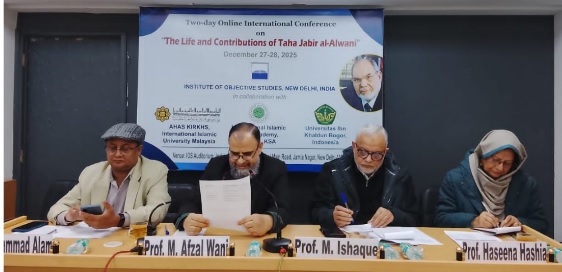
A two-day international conference examining the life and scholarly contributions of renowned Islamic thinker Dr. Taha Jabir al-Alwani concluded on Sunday at the Institute of Objective Studies (IOS). The event brought together leading scholars, academics and researchers from different parts of the world to reflect on Dr. Alwani’s enduring influence on contemporary Islamic thought.
The conference was jointly organised by IOS in collaboration with the AbdulHamid AbuSulayman Kulliyyah of the International Islamic University Malaysia (IIUM), Ibn Khaldun University (UIKA), Bogor, Indonesia, and the International Islamic Fiqh Academy, Jeddah, Saudi Arabia. Participants engaged in in-depth discussions to reassess Dr. Alwani’s intellectual legacy and its relevance in addressing modern challenges faced by the Muslim world.
Sessions focused on his pioneering work in Islamic jurisprudence, his innovative approach to Quranic methodology, and his efforts to harmonise classical Islamic scholarship with contemporary realities. Speakers highlighted Dr. Alwani’s role in promoting ijtihad (independent reasoning) and renewing Islamic legal thought in a way that responds to changing social and intellectual contexts.
Scholars noted that Dr. Alwani’s ideas continue to inspire academic inquiry and reformist thinking across universities and research institutions worldwide. The conference also provided a platform for young researchers to engage with senior academics and explore new perspectives rooted in his scholarship.
The inaugural session opened with the recitation of the Holy Quran by Hammad Kaleem Alam, followed by welcome remarks from IOS Secretary General Mohammad Alam. Professor Mohammad Ishaq introduced the theme, stressing the urgent need to engage with the intellectual heritage of scholars like Dr. Alwani in an age marked by ideological confusion and moral crises. Dr. Nakhat Hussain Nadvi read out a message from Dr. Alwani’s family, while a message from IOS Chief Patron and Founding Chairman, Dr. Mohammad Manzoor Alam was also presented.
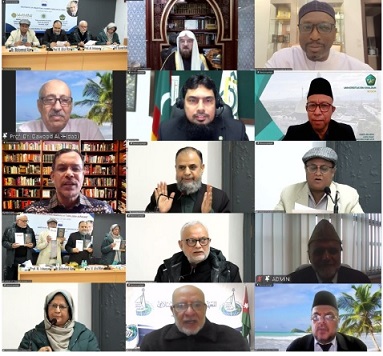
Speakers consistently emphasized that “Dr. al-Alwani was not just a jurist or a scholar, he was a reformer.” They highlighted his life-long efforts to bridge classical Islamic wisdom with contemporary global challenges and to create a meaningful dialogue between Islamic scholarship and modern social sciences.
A comprehensive overview of Dr. Alwani’s life and scholarly journey was presented by Professor Hamidullah Marazi. The opening address was delivered by Dr. Ali Mohiuddin Qaradaghi, Qatar, while the keynote address by Professor Dawood Abdul Malik Yahya al-Hidabi, IIUM, Malaysia, provided deep insights into Dr. Alwani’s reformist vision.
Eminent guests, Dr. Qutb Mustafa Sano, Secretary General, International Islamic Fiqh Academy, Jeddah, KSA, Dr. Ali Zahir, Vice Chancellor, Islamic University, Maldives, Professor Badi Sosityo, Ibn Khaldun University Bogor, Indonesia, and Professor Rafiqul Islam, Vice Chancellor, Aliah University, Kolkata, praised IOS for hosting the conference and called the initiative timely and essential. They underlined Dr. Alwani’s role in shaping the modern Islamic discourse, particularly through the Institute of Objective Studies, which continues to influence contemporary scholarship.
In his presidential address, Prof. M. Afzal Wani, Chairamn, IOS, highlighted Dr. Alwani’s relevance in the modern era and urged the younger generation to study his works. He noted that the conference itself served as a crucial link in encouraging renewed scholarly engagement.
A key focus of the conference was Dr. Alwani’s concept of “Fiqh al-Aqliyat”, a principled yet adaptable framework for Muslims living as minorities. The keynote speakers explained how Alwani sought to harmonize Islamic principles with the lived realities of diverse Muslim communities, without compromising ethical and doctrinal foundations. Speakers also discussed his critique of rigid literalism and uncritical traditionalism, emphasizing his call for ijtihad rooted in the objectives of Sharia (Maqasid al-Shariah).
Across seven thematic sessions, more than fifty researching papers were presented. Scholars examined Dr. Alwani’s advocacy for revisiting Usul al-Fiqh to make it more responsive to contemporary challenges. Many highlighted his insistence on a Quran-centric approach, arguing that distancing academic discourse from the Quran had weakened Muslim intellectual traditions. Papers also explored Alwani’s broader civilizational vision, which linked the objectives of Shariah to social justice, governance, education, and ethics.
Several participants addressed Dr. Alwani’s strong opposition to academic rigidity and ideological extremism, noting his belief that imbalanced religious interpretations lead to social fragmentation. His work, they stressed, offered a balanced, ethically grounded pathway for renewal.
Closing the conference, Dr. Mustafa Ceric, Bosnia and Herzegovinia and Dr. Eidos Rafikoff, Maqasid Institute, USA, shared reflective remarks, followed by a valedictory address from Professor Mohammad Ishaq. Professor Arshi Khan, Vice Chairperson read out the 7-point resolution adopted by the conference. Professor Z.M. Khan delivered his presidential address, while Professor Afzal Wani presented a detailed summary on the outcome of the conference. The vote of thanks was offered by Professor Hasina Hashia.
Speakers unanimously concluded that Dr. Taha Jabir Alwani’s thought remains profoundly relevant amid contemporary challenges such as identity crises, social polarization, and moral decline in Muslim societies. The organizers emphasized the need for further research, translations, and deeper engagement with his works to carry forward his transformative intellectual legacy.
Posted by Andalib Akhter