
Last Updated on September 24, 2026 4:30 pm by INDIAN AWAAZ
As India’s compliance carbon market opens for trading this October, industry, farmers and exporters all start feeling the weight of a new kind of accounting.
By Ajay Joshi
India is entering the final stretch before the country’s first compliance carbon market begins trading in October, turning carbon emissions into a new financial and business consideration for industry. Nearly 490 large industrial units have already reported their emissions intensity against government-set targets, laying the groundwork for a market in which companies that outperform their targets can earn carbon certificates while those falling short will have to buy them.
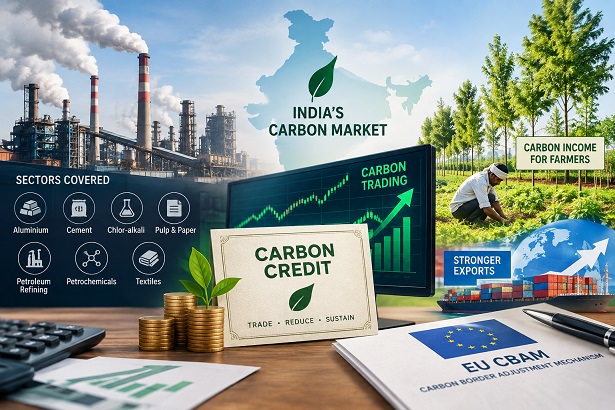
The scheme is called the Carbon Credit Trading Scheme, and it replaces the older Perform, Achieve and Trade programme, which measured energy savings rather than carbon itself. The change sounds small on paper. In practice it means an aluminium plant or a cement kiln now carries a carbon liability the way it carries a tax liability, something to be planned for, budgeted against, argued over with accountants. Seven sectors are covered so far, aluminium, cement, chlor alkali, pulp and paper, petroleum refining, petrochemicals and textiles. Iron, steel and fertiliser targets are still pending, though officials have floated reductions of two to six percent for those as well.
Miss the target and a firm must buy certificates to cover the shortfall, or pay a fine set at twice the average market price of a certificate. That penalty structure is deliberate. It is meant to make buying a certificate cheaper than paying the fine in nearly every case, so companies actually go looking for reductions instead of treating the whole scheme as a line item to absorb. Current estimates put the compliance price somewhere between six hundred and nine hundred rupees a tonne, though nobody will know the real number until trading actually starts and buyers and sellers show up.
There is also a trade policy angle to this, and it may turn out to be the more pressing one. From this January, the European Union’s carbon border tax moved out of its reporting phase into the phase where it actually charges money, on steel, aluminium, cement, fertiliser and a few other goods, based on the carbon locked into them during manufacture. Indian steel and aluminium, made with a heavy dependence on coal fired power, carry more embedded carbon than their European counterparts typically do. Exporters can claim a deduction against that European tax if they can show they already paid a carbon price back home. So a scheme that looked, until recently, like a domestic industrial policy question turns out to double as a shield for exporters. Money that might otherwise leave the country as a tariff stays home instead, assuming exporters can actually prove what they paid.
Away from the smokestacks, a quieter story is unfolding in the fields. Farmers, most of them working under two hectares, are being pulled into this market too, mainly through agroforestry and through rice and livestock management practices that cut methane. This year’s Union Budget set aside twenty thousand crore rupees for carbon capture and farmer linked carbon projects, and the numbers being floated are striking: a rice wheat farmer switching to a poplar based agroforestry system could see returns rise from a little over three lakh rupees a hectare over seven years to close to nine lakh, once carbon income gets added in. Whether that math survives contact with actual markets is another question. It depends on aggregators, usually Farmer Producer Organisations, doing the unglamorous work of bundling thousands of small plots into something a verifier will accept, and on those aggregators not simply pocketing most of the money themselves.
None of this is guaranteed to work as cleanly as the projections suggest. Verifying carbon on a smallholder farm, at scale, across land records that are often incomplete or disputed, costs real money, and it is not obvious who pays for that once the initial funding runs out. The wider voluntary carbon market has already been through one round of trouble, with global transaction volumes dropping by roughly a quarter in 2024 after a string of stories about credits that did not represent real reductions on the ground. Buyers now pay more for projects that can prove their claims, which works in India’s favour since it can produce nature based credits fairly cheaply, but it also raises the bar for what counts as proof. A compliance price that turns out too low will not push any factory to change how it operates. One that turns out too high risks a backlash from industry loud enough to weaken the scheme before it gets a real chance.
What India has built, on paper, is unusually deliberate. Rather than opening its carbon exports to anyone willing to pay, it has restricted international sales under the Paris Agreement’s Article 6 to a specific list of thirteen capital heavy activities, green hydrogen, offshore wind, aviation fuel and similar, so that foreign money goes toward financing the hardest and most costly stretch of this change, rather than buying up cheap nature based credits India may need for its own targets later. A bilateral deal with Japan, signed last August, already tests this approach in practice. Whether the logic holds will depend on things well outside Delhi’s control, whether Brussels eventually treats the domestic scheme as an equivalent carbon price, whether enough verifiers can be trained in time to keep pace with 490 companies all reporting at once, whether farmer cooperatives resist the temptation to let easy money change hands without much oversight. The market opens in October. What it becomes after that is still an open question, and will probably stay that way for a few years yet.

Ajay Joshi is a Climate & Carbon Markets Professional.