
Last Updated on October 7, 2026 3:15 pm by INDIAN AWAAZ
AMN / NEWS DESK
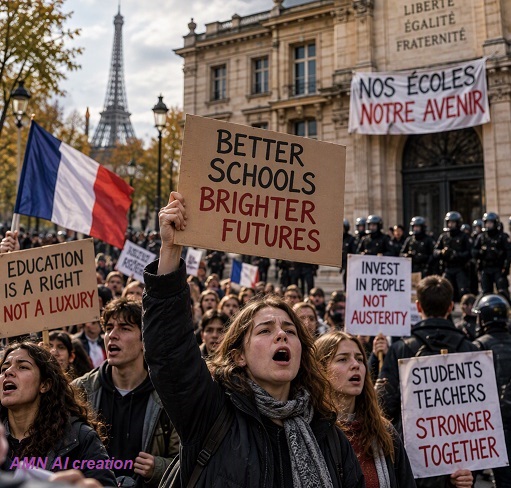
What began as a local protest over teacher shortages and overcrowded classrooms in the suburbs of Paris has rapidly evolved into one of France’s largest student movements in recent decades, drawing hundreds of thousands of students, teachers, parents and trade unionists into nationwide demonstrations and placing fresh pressure on President Emmanuel Macron’s government ahead of the 2027 presidential election. The movement first emerged in late September at schools in the Créteil region near Paris, where students protested against unfilled teaching positions, deteriorating infrastructure, overcrowded classes and long school hours. Within days, demonstrations spread across France, affecting more than a thousand high schools and several universities.
On October 6, the protests reached their biggest scale yet. France’s Interior Ministry estimated that more than 250,000 people participated in demonstrations nationwide, while organizers put the figure closer to 450,000. Marches were held in Paris, Marseille, Lyon, Nantes, Strasbourg, Rennes, Toulouse and dozens of other cities. Teachers’ unions, university students and parents joined the protests, transforming what had started as a student-led campaign into a broader movement about public services and government priorities.
Education at the Heart of the Anger
Students say France’s education system is suffering from years of underinvestment, particularly in working-class and suburban areas. Their complaints include a lack of teachers, classrooms with more than 35 students, outdated facilities, inadequate equipment and school days stretching from early morning until evening. Many protesters also point to aging buildings that struggled during recent heatwaves, with some classrooms reportedly reaching temperatures close to 40 degrees Celsius.
The university admissions platform Parcoursup has also emerged as a major source of frustration. Students argue that the system creates uncertainty and anxiety about future educational opportunities. Protest leaders say the movement is fundamentally about equality in education and ensuring that a student’s future is not determined by where they live.
Le Monde reported that the protests have been remarkable for both their speed and scale, describing them as one of the most significant youth mobilizations France has seen in years. Unlike previous student movements that often originated in central Paris, this movement began in the capital’s disadvantaged suburbs before spreading nationwide through social media networks.
Budget Debate Fuels Protests
The unrest coincides with intense national debate over France’s proposed 2027 budget. The government is attempting to reduce public spending and rein in a large fiscal deficit while simultaneously pledging increases in certain sectors, including education. Critics argue that the promised increases are insufficient when adjusted for inflation and fail to address longstanding structural problems within schools.
Reuters reported that the education budget is scheduled to rise by only about 1.7%, a figure many teachers and students consider inadequate given rising costs and growing needs. Protesters contend that official budget figures fail to reflect realities in schools where staff shortages, overcrowded classrooms and delayed maintenance remain commonplace.
The demonstrations have also merged with broader concerns over public-sector spending cuts, declining public services and living costs. Several trade unions have openly supported the students, arguing that the crisis in schools reflects wider challenges facing French public institutions.
Rising Tensions and Clashes
While most demonstrations have remained peaceful, parts of the movement have been marked by violence. School blockades, burning barricades, damaged property and confrontations with police have resulted in thousands of arrests and hundreds of injuries.
According to Reuters and other reports, a particularly controversial incident occurred in northern France when a 15-year-old protester lost a hand during clashes involving police dispersal grenades. The episode intensified criticism of law-enforcement tactics and became a rallying point for human rights groups and student organizations.
Government officials insist that while many of the students’ concerns are legitimate, extremist groups and violent elements have infiltrated some demonstrations. Authorities have deployed riot police in several cities, arguing that public safety must be maintained. Education Minister Édouard Geffray acknowledged the legitimacy of many initial demands while condemning acts of vandalism and violence.
Prime Minister Sébastien Lecornu has promised measures aimed at addressing key student grievances, including efforts to replace absent teachers more quickly and improve dialogue with schools. However, protest leaders say concrete commitments and funding increases remain insufficient.
Political Reverberations
The crisis has quickly become a major political issue. Coming only months before France’s next presidential election campaign begins in earnest, the protests have highlighted growing public frustration with government institutions. Analysts suggest the demonstrations reflect wider anxieties about economic inequality, declining trust in political leadership and concerns over the future prospects of younger generations.
Political parties across the spectrum have sought to position themselves in relation to the movement. Left-wing groups have voiced support for the students’ complaints about public investment and educational inequality, while government officials have accused some opposition groups of attempting to capitalize on the unrest.
The international dimension of the debate has added another layer of controversy. Comments by U.S. President Donald Trump linking the unrest to migration and Islam drew criticism from many observers who argued that the protests are rooted in education policy rather than religious or immigration issues. Reuters noted that the stated demands of the protesters focus overwhelmingly on schools, staffing, infrastructure and educational opportunities.
A Movement Beyond the Classroom
Many observers now view the protests as more than a dispute over school conditions. They have become an expression of broader concerns about social mobility, public investment and the responsiveness of government institutions.
Students participating in the demonstrations frequently describe feelings of neglect and uncertainty about the future. Parents and teachers who have joined the movement say the protests raise fundamental questions about what kind of public education system France wants to maintain and whether current policies are sufficient to meet those ambitions.
Despite clashes and political controversy, the central message of the movement has remained largely consistent: better schools, more teachers, improved facilities and greater investment in the country’s youth. Whether the government can respond effectively to these demands may determine not only the future of the protests but also the broader political climate in France over the coming year.
As demonstrations continue across the country, France faces a challenge that extends well beyond classrooms. The student movement has evolved into a national debate over public services, economic priorities and the relationship between citizens and the state, making it one of the most significant social protests confronting the Macron administration in recent years.