
Last Updated on July 3, 2026 11:17 pm by INDIAN AWAAZ
Lok Sabha Speaker Inaugurates Orientation Programme for Newly Elected Members of West Bengal Legislative Assembly At Kolkata
Shoib Moin | Kolkata
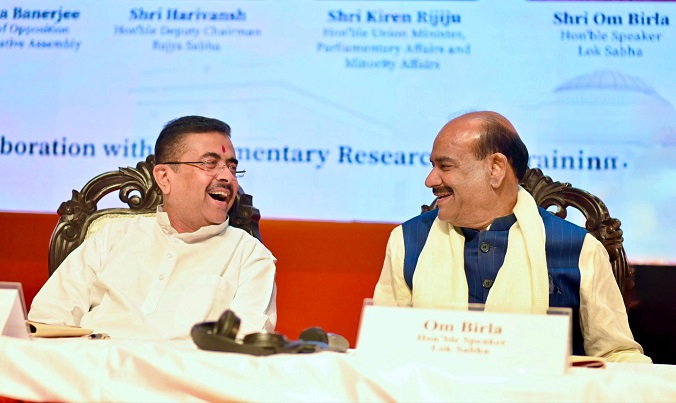
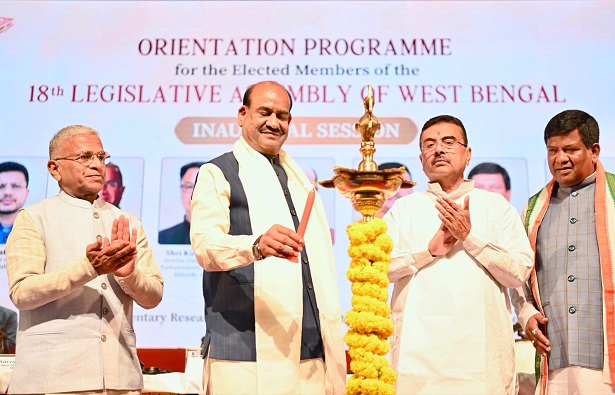
Democracy flourishes not merely through elections but through meaningful dialogue, consensus-building and the ability to accommodate respectful dissent. Reaffirming these core democratic values, Lok Sabha Speaker Mr Om Birla on Friday urged newly elected members of the West Bengal Legislative Assembly to uphold the highest standards of legislative conduct by engaging in informed debate, constructive criticism and solution-oriented policymaking. Addressing the inaugural session of a two-day Orientation Programme for newly elected legislators in Kolkata, Birla said vibrant legislatures must remain forums where diverse opinions are expressed with dignity and where disagreements strengthen rather than weaken democratic institutions.
Calling elected representatives the custodians of the people’s aspirations, Birla stressed that democracy demands far more than political contestation. It requires lawmakers to deliberate on public issues with facts, reason, research and a commitment to finding practical solutions. He observed that while criticism is an indispensable element of parliamentary functioning, it should always be accompanied by workable alternatives that contribute to better governance and improved public welfare.
The Speaker said every Member of the Legislative Assembly carries a dual responsibility — representing the interests of his or her constituency while also safeguarding the broader developmental aspirations of the entire state. Legislative responsibilities, he noted, extend well beyond local issues, as every law, policy and debate influences the future of millions of citizens.
Congratulating the newly elected legislators, Birla said the electorate has placed immense trust in them and expects responsive, accountable and visionary leadership. He urged the members to ensure that every legislative intervention is guided by the principles of public welfare, constitutional values and long-term development. According to him, meaningful democratic discourse should not remain confined to criticism of policies but should actively contribute to practical and implementable solutions for the challenges faced by citizens.
Emphasising the importance of continuous learning, Birla encouraged legislators to regularly study landmark parliamentary debates, historic legislation and best legislative practices from across India as well as other democratic systems around the world. Effective lawmakers, he said, are lifelong learners who constantly update their knowledge, remain receptive to new ideas and strive for continuous self-improvement.
He described the composition of the present West Bengal Assembly, which includes a large number of first-time legislators and young representatives, as a significant opportunity to infuse fresh thinking into governance. Birla also welcomed the increasing participation of youth and women in public life, observing that their growing presence would strengthen democratic institutions and make policymaking more inclusive.
The Lok Sabha Speaker advised members to spend as much time as possible inside the Assembly, even on days when they are not scheduled to participate in debates. Listening carefully to discussions, he said, is equally important as speaking because it broadens perspectives, enhances legislative understanding and helps build informed leadership capable of addressing complex governance challenges.
Birla reminded legislators that the decisions taken during the current Assembly’s tenure would shape not only the present but also future generations. He urged members to discharge their constitutional responsibilities with wisdom, integrity and a long-term vision, while ensuring that governance remains focused on the welfare of ordinary citizens, particularly the poor, marginalised and vulnerable sections of society.
Highlighting the role of technology in strengthening democratic institutions, Birla said the digital era has transformed legislative functioning by making parliamentary knowledge more accessible than ever before. Referring to the Digital Sansad platform, he said legislators can now access parliamentary debates, legislative documents, policy papers and comparative practices from Parliament and various state legislatures, enabling them to make more informed contributions during legislative proceedings.
The Speaker reiterated that differences of opinion are a natural and healthy feature of every democracy. However, he underlined that disagreements must always be expressed through reasoned, dignified and respectful debate. Legislatures, he said, should remain institutions where ideas compete vigorously but democratic values, constitutional principles and mutual respect always prevail.
Reflecting on West Bengal’s historical legacy, Birla described the state as one of the foremost centres of India’s intellectual, cultural and nationalist awakening. He said Bengal has consistently shaped the country’s democratic and social consciousness by producing visionary thinkers, reformers and national leaders whose contributions continue to inspire generations.
Recalling the legacy of Raja Rammohan Roy, Swami Vivekananda, Bankim Chandra Chattopadhyay, Rabindranath Tagore, Netaji Subhas Chandra Bose and Dr Syama Prasad Mookerjee, Birla said their ideas and sacrifices laid the foundation for India’s social reform, cultural renaissance and national resurgence. He expressed confidence that West Bengal possesses the intellectual capital and cultural strength to once again emerge as a leading centre of innovation, education, industry and economic growth.
India, he remarked, continues to look towards Bengal with great expectations. Preserving its rich heritage while embracing technological advancement and modern development would enable the state to play a pivotal role in the country’s journey towards becoming a developed nation by 2047 under the vision of Viksit Bharat.
Concluding his address, Birla expressed confidence that the orientation programme would equip legislators with a deeper understanding of parliamentary practices, constitutional principles and legislative procedures. He urged all members to work collectively, rise above partisan differences whenever required and dedicate themselves to fulfilling the aspirations of the people of West Bengal through effective governance and responsible lawmaking.
The two-day orientation programme, organised by the Parliamentary Research and Training Institute for Democracies (PRIDE) of the Lok Sabha Secretariat in collaboration with the West Bengal Legislative Assembly, includes technical sessions on effective legislative functioning, parliamentary conventions, executive accountability, committee systems, legislative procedures, financial business, parliamentary ethics and the National e-Vidhan Application (NeVA). Experts, constitutional authorities, senior parliamentarians and presiding officers from across the country are participating in the programme, which concludes on July 4 with the valedictory address by West Bengal Governor Mr R.N. Ravi.