

Last Updated on September 12, 2026 2:37 pm by INDIAN AWAAZ
PM Modi hosts Putin, Xi and Pezeshkian as the grouping pushes ahead on trade and technology, even as splits over Ukraine, West Asia and US-China rivalry threaten to overshadow the summit.
By Bibhudatta Pradhan / New Delhi
Leaders of the BRICS nations gathered in New Delhi on Saturday for a summit expected to focus on trade, technology and economic cooperation, as widening geopolitical rifts threaten to complicate efforts to project unity within the expanded bloc.
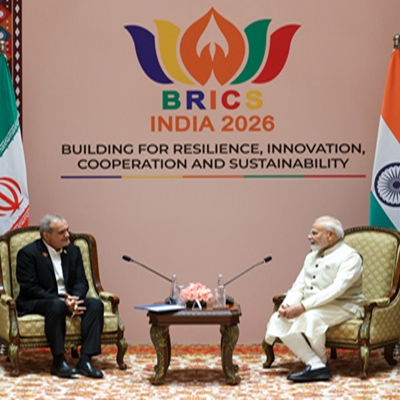
Prime Minister Narendra Modi is hosting Chinese President Xi Jinping, Russian President Vladimir Putin, Iranian President Masoud Pezeshkian and other leaders at a time when wars in Ukraine and West Asia, concerns over energy security and tensions between the United States and China are reshaping the global political and economic landscape.
Trade, energy, technology and reform of global institutions are expected to dominate discussions. The leaders may also consider ways to strengthen supply chains, expand cooperation in artificial intelligence and reduce their dependence on the US dollar by encouraging the use of local currency for trade and payments.
But the summit is taking place against a difficult geopolitical backdrop. The wars in Ukraine and West Asia, continuing uncertainty in global trade and concerns over energy supplies have exposed the competing interests within the expanded grouping.
US President Donald Trump’s policies are also likely to influence discussions, despite Washington not being a BRICS member. The grouping’s growing emphasis on reducing dependence on Western-led financial and economic systems has acquired greater significance amid tensions over trade, sanctions and the global balance of power.
The member countries are seeking outcomes centred on four broad areas: resilience, innovation, cooperation and sustainability. These could include new frameworks and action plans on trade, technology, energy and development.
A joint declaration, however, may be difficult to finalise. Differences between Iran and the United Arab Emirates over the conflict in West Asia are among the issues that could complicate efforts to present a united position.
Russia and Iran criticised the United States and other Western countries on Friday over sanctions and what they described as acts of aggression. They urged BRICS members to develop stronger mechanisms to withstand external pressure and respond to challenges facing the developing world.
For India, the summit is also an exercise in strategic balancing. New Delhi continues to maintain close ties with Russia and Iran while strengthening its relations with the United States and Europe.
Modi on Friday reiterated India’s position that the war in Ukraine should end through dialogue and diplomacy. He also called for greater trade within BRICS and urged members to lower barriers to commerce and investment. India, he said, has signed free trade agreements with about 40 countries since 2014 as part of efforts to widen its economic partnerships.
BRICS was formed in 2006 by Brazil, Russia, India and China. South Africa joined the grouping in 2010. Egypt, Ethiopia, Iran, Saudi Arabia and the United Arab Emirates became full members in 2024, while Indonesia joined in 2025.
The 11-member grouping represents about half of the world’s population, 40% of global gross domestic product and a quarter of global trade. It has also been pressing for greater representation for developing countries in international institutions.
Ten countries — Belarus, Bolivia, Cuba, Kazakhstan, Malaysia, Nigeria, Thailand, Uganda, Uzbekistan and Vietnam — became BRICS partner countries in 2025.
New Delhi is under tight security for the summit, with thousands of security personnel deployed around the venue and at key locations across the capital. Traffic restrictions and diversions are in force. BRICS-themed displays, illuminated buildings and decorated roundabouts have been installed across the city.
Xi’s visit is attracting particular attention. It is his first visit to India in seven years and is expected to include talks with Modi on bilateral ties and cooperation among countries of the Global South.
The visit follows a gradual improvement in India-China relations after the deadly military clash along their disputed Himalayan border in 2020. The two countries have since restored some flights and visa services and resumed high-level diplomatic contacts.
For India, the summit offers an opportunity to demonstrate that it can engage simultaneously with rival powers and still push for cooperation on issues affecting the wider developing world. For BRICS, the summit will test whether its increasingly diverse membership can agree on a coherent political and economic agenda.