
Last Updated on March 6, 2026 11:34 pm by INDIAN AWAAZ
West Asia Tensions Trigger Sharp Market Rout
Photo AI
AMN BIZ DESK
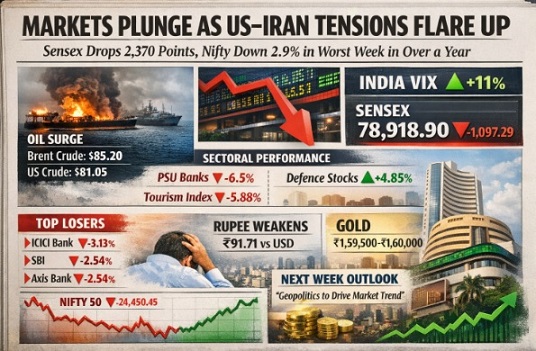
Indian equity markets witnessed a brutal sell-off this week, culminating in a “Black Friday” as escalating tensions in the US-Iran conflict sent shockwaves through global financial hubs. Benchmark indices recorded their most significant weekly decline in over 14 months, with the Nifty 50 plunging 2.9% and the Sensex eroding 2,370 points of investor wealth over the five-day period.
On Friday alone, the Sensex settled at 78,918.90, down 1,097 points (1.37%), while the Nifty closed at 24,450.45, shedding 315.45 points (1.27%).
The Geopolitical Trigger: Crude and Chaos
The primary catalyst for the rout was the near-total halt of shipping activity through the Strait of Hormuz, a vital maritime artery for global energy. This supply threat pushed Brent crude above $85 per barrel, while US crude witnessed an 8.5% spike—its largest single-day jump since the 2020 pandemic era.
Market volatility, as measured by the India VIX, surged over 11% to finish at 19.88, indicating heightened fear among traders. Analysts warn that if crude prices sustain at these levels, India’s “twin deficits” (current account and fiscal), inflation trajectory, and the RBI’s hawkish monetary stance could all come under severe pressure.
Sectoral Performance: Winners and Losers
While the broader market was painted red, the conflict created a stark divide in sectoral fortunes:
The Gainers: Defence and Energy
- Defence (+4.85% Weekly): The sector was the lone bright spot as geopolitical instability fueled expectations of increased government spending. Bharat Electronics (BEL) led the Nifty gainers on Friday, rising 2.52%.
- Energy & Oil Producers: Stocks like ONGC (+1.28%) and Reliance Industries (+1.27%) benefited from the surge in global oil prices, providing some cushion to the index.
The Losers: Banking and Tourism
- PSU & Private Banks: The banking sector faced a “double whammy.” Apart from the geopolitical stress, the RBI’s proposal for tighter norms on bundling insurance with loans sparked a sharp decline. PSU Banks crashed 6.5% over the week.
- Tourism & Aviation: The India Tourism index plummeted 5.88% as rising fuel costs and travel uncertainties in West Asia deterred investors.
| Top Gainer (Friday) | % Change | Top Loser (Friday) | % Change |
| BEL | +2.52% | ICICI Bank | -3.13% |
| ONGC | +1.28% | Eternal | -2.96% |
| Reliance | +1.27% | Shriram Fin | -2.77% |
| NTPC | +0.82% | SBI | -2.54% |
Currency and Commodities
The Indian Rupee weakened by ₹0.13 to close at 91.71 against the US Dollar, weighed down by a ballooning import bill. Experts anticipate a near-term trading range of 91.25–92.50. Meanwhile, Gold continues to trade at historic highs, hovering near ₹1,60,000, as investors flee to the safety of the yellow metal.
Outlook: Sell-on-Rise Strategy
Technical analysts remain bearish, suggesting that the Nifty could slide further toward 24,000 if global tensions do not ease over the weekend. “The trend favors a ‘sell-on-rise’ strategy until the 25,000 mark is decisively reclaimed,” noted Rupak De of LKP Securities.
The market’s direction on Monday will depend entirely on weekend developments in the Persian Gulf and the US response to Iranian maneuvers.
Gold Holds Firm Amid Uncertainty
Amid market volatility, investors maintained a cautious stance toward safe-haven assets. Domestic gold prices hovered between ₹1,59,500 and ₹1,60,000, while international gold traded near $5,100 per ounce on the Chicago Mercantile Exchange.
Analysts identified ₹1,58,000 as key support and ₹1,62,000 as immediate resistance for bullion prices.
Market Outlook: Bearish Bias Persists
Market experts warn that the near-term outlook remains cautious, with geopolitical developments likely to dominate investor sentiment.
Rupak De, Senior Technical Analyst at LKP Securities, noted that the Nifty continues to trade below its previous swing low, indicating persistent bearish momentum.
According to him, the index could potentially slide toward 24,000 levels or lower unless it decisively crosses 25,000.
Amol Athawale, VP Technical Research at Kotak Securities, identified 24,300–24,000 as immediate support for the Nifty, while 24,500 remains the near-term resistance level.
For the Nifty Bank, the 200-day moving average near 57,500 will be a crucial support zone. A breach below this level could push the index toward 56,800–56,500.
Key Factor for Next Week
Analysts say weekend geopolitical developments in West Asia will likely determine the tone of trading when markets reopen on Monday.
If crude prices continue to surge or shipping disruptions worsen in the Strait of Hormuz, Indian equities could face further downside pressure, particularly in energy-sensitive sectors such as aviation, logistics, and financial services.
However, any signs of diplomatic de-escalation could trigger short-covering rallies in the near term.