
Last Updated on June 9, 2026 12:33 am by INDIAN AWAAZ
Will Mamata Reinvent TMC or Witness Its Fragmentation?
By Aafreen Hussain and Andalib Akhter
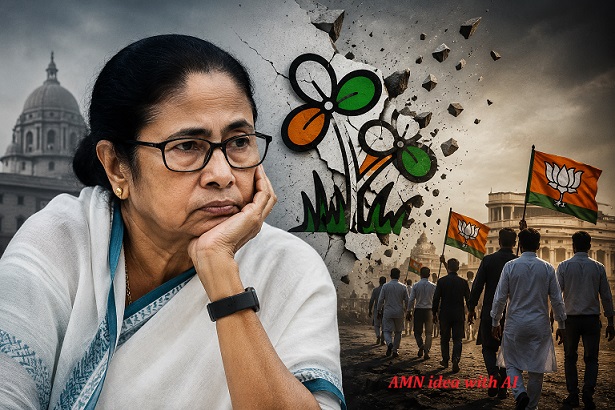
Following its recent debacle in the Assembly elections, the Trinamool Congress (TMC) is facing one of the most serious political crises in its history, with internal dissent now spilling onto the national stage. What began as an electoral defeat in West Bengal has rapidly evolved into a wider struggle over leadership, political direction and the party’s future.
The centre of political turbulence appears to have shifted from Kolkata to New Delhi after a significant section of the party’s parliamentary wing reportedly moved away from the leadership’s line. According to emerging developments, 20 of the party’s 28 Lok Sabha MPs, led by Kakoli Ghosh Dastidar, have signalled support for the BJP-led National Democratic Alliance (NDA), marking a dramatic moment in contemporary opposition politics.
If formalised, the move would represent more than a parliamentary realignment—it would raise fundamental questions about the cohesion of regional parties and the durability of opposition alliances in India’s changing political landscape.
The scale of the reported breakaway is also politically significant because it crosses the two-thirds benchmark generally associated with protection from disqualification under the Tenth Schedule of the Constitution, commonly known as the anti-defection law. Political observers say the development illustrates how parliamentary arithmetic, internal power struggles and strategic repositioning increasingly shape India’s competitive political environment.
For the TMC, the challenge now extends beyond recovering lost electoral ground. The larger test may be whether the party can rebuild organisational discipline, retain its political identity and restore confidence among its cadre at a moment when its influence faces scrutiny both inside and outside West Bengal.
The Cacophony of Comments: A Divided Spectrum
The massive structural collapse of the state’s former ruling party, mirrored by the “Maharashtra-style” split of 58 rebel MLAs alongside the 20 Lok Sabha MPs, has drawn sharp, calculated reactions from the top leadership of the West Bengal BJP. While the BJP views this as the absolute end of the TMC’s political hegemony, a fascinating internal divide has emerged between senior leaders regarding how to handle the sudden influx of defectors.
1. Tapas Roy: “The Maharashtra Model Has Come to Bengal”
Senior BJP leader Tapas Roy did not mince words, pointing out that the complete unwinding of the TMC was entirely inevitable. He framed the collapse not just as an internal party dispute, but as a total rejection of the authoritarian leadership of Mamata and Abhishek Banerjee. “Trinamool Congress is crumbling into pieces. The situation is exactly like Maharashtra. TMC is now split in two, and the leaders are openly defying and denying both Ms. Mamata and Abhishek Banerjee. This was bound to happen. I am very happy—the TMC will soon cease to exist altogether.”
2. Swapan Dasgupta: A Warning against “False Friends”
Taking a much more cautious and critical stance, veteran BJP leader Swapan Dasgupta issued a stern warning to his own party. While expressing zero sympathy for Mamata Banerjee’s crumbling empire, he demanded a strict “political detox” rather than welcoming opportunists with open arms.
“We in the BJP have to be always wary of false friends who are today cozying up to us because they need to wash away their past sins. Welcoming former TMC leaders without scrutiny risks importing their culture of corruption, violence, and intimidation into the BJP. The detox of Bengal cannot be left incomplete for short-term political gains.”
3. The Central BJP Perspective: “The Disintegration of an Attitude”
Reflecting the sentiments of the central leadership, BJP leaders like Prakash Reddy asserted that the collapse marks the literal historic end of the Trinamool Congress as a political entity. “Following their debacle in the West Bengal elections, the complete disintegration of the TMC has begun. It is a direct result of Mamata Banerjee’s stubborn attitude and her nephew Abhishek Banerjee’s disastrous corporate-style political decisions. The party will not survive to contest the next elections—TMC will soon be history in West Bengal.”
Echoes from the Opposition and Inner Circles
Adhir Ranjan Chowdhury (Congress): Viewing this as structural cowardice, the veteran Congress leader wasted no time calling out the optics. To him, the rebel faction’s elaborate maneuvers to stay technically outside the BJP while acting as its proxy are just a legal shield.
His perspective is simple: if they lost the ideological battle, they should stop beating around the bush, resign, and merge with the BJP outright. There was no need for maneuvers like forming a separate faction while staying outside just to shield themselves from the Tenth Schedule. Since they speak of the country’s progress, a direct merger would have been more appropriate than remaining separate.
Mohammad Salim (CPIM): For the Left, this mass defection is the predictable, inevitable conclusion of a political entity built on shifting sands. CPIM leaders view the collapse not as an ideological realignment, but as an opportunistic migration of leaders who find their survival threatened after the TMC’s crushing defeat in the state assembly elections.
Mamata Banerjee: Caught in New Delhi attending an INDIA bloc meeting alongside her nephew Abhishek Banerjee while her parliamentary house collapsed down the street, the TMC supremo has chosen defiance mixed with strategic legal maneuvers. By immediately dispatching letters to the Speaker naming Kalyan Banerjee as the official Chief Whip, her camp is desperately attempting to assert organizational control, even as the arithmetic of 20 rebel MPs slips through her fingers.
Abhishek Banerjee: As the National General Secretary and the primary target of the rebels’ parliamentary rejection, Abhishek’s camp views this as a targeted betrayal masterminded by the BJP. His stance underscores the systemic nature of the coup, framing it as an undemocratic subversion of the public mandate engineered through central pressure.
Mahua Moitra: Characteristically blazing and fiercely loyal, Moitra cut through the legal jargon with sharp rhetoric. Her message to the rebels was scathing: the 2024 mandate was won explicitly on an anti-BJP ticket. Calling the defectors “greedy, self-serving traitors,” she threw down a direct challenge: “Resign your seats and contest on a BJP ticket. Let’s see what big heroes you are.”
Is Mamata Banerjee Carrying the Corpse of Trinamool?
The phrase “Kya Mamata Banerjee ab Trinamool ki laash utha rahi hain?” (Is Mamata Banerjee now carrying the corpse of Trinamool?) has become a hauntingly precise metaphor among political analysts and the public alike. It raises biting questions about the structural integrity of a party that for over two decades was defined entirely by the fierce charisma of a single street-fighting leader.
1 The Perils of a Personality-Centric Model
For years, the TMC’s greatest strength was that Mamata Banerjee was the party. Every vote cast for a local candidate was implicitly a vote for “Didi.” However, when that central authority loses its regional grip—as it did with the historic loss of the state assembly to the BJP and the subsequent fracturing of 58 MLAs—the vacuum created is catastrophic. Without a cohesive institutional ideology to bind them, the MPs are fleeing because the umbrella of her protection no longer guarantees their political survival.
2. The Legal Maneuver vs. Political Morality
The rebels are deliberately executing a clinical, legal coup. By gathering 20 MPs, they mathematically clear the two-thirds barrier of the anti-defection law. This highlights a jarring irony: a law created to protect the sanctity of the voter’s mandate is being weaponized via precise math to completely flip that mandate on its head.
3. A Fractured Legacy
By refusing to expel the rebels immediately, Mamata and Abhishek are trying to force them into a prolonged legal battle over whips and parliamentary recognition. But this feels less like a counter-offensive and more like a rear-guard action to delay the inevitable. When nearly three-quarters of your parliamentary faction shifts allegiance while you are sitting in an opposition alliance meeting, the blow isn’t just logistical it is profoundly psychological.
The unfolding crisis suggests that the political currency of Bengal has drastically revalued. Mamata Banerjee is not just fighting to keep her remaining MPs; she is fighting a desperate, exhausting battle against political gravity to keep the very idea of the Trinamool Congress alive.