
Last Updated on December 30, 2025 1:54 pm by INDIAN AWAAZ
Zakir Hossain / Dhaka
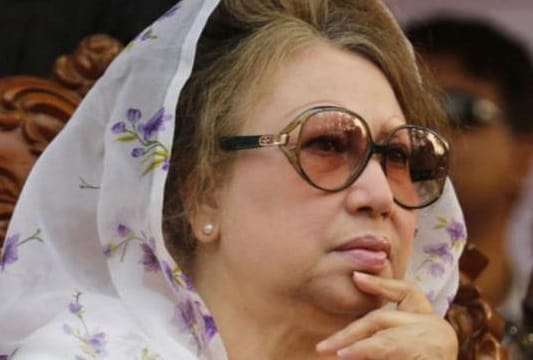
Begum Khaleda Zia, Bangladesh’s first woman prime minister, three-time premier, chief of the Bangladesh Nationalist Party (BNP) and one of South Asia’s most formidable democratic leaders, died early Tuesday after a prolonged illness. She was 80. Widely known as the “Uncompromising Leader of the East”, Khaleda Zia passed away around 6am while undergoing treatment at Dhaka’s Evercare Hospital, the BNP said.
“Khaleda Zia passed away at around 6:00am, just after Fajr prayer,” the BNP said in a post on its official Facebook page. “We pray for the forgiveness of her soul and request everyone to offer prayers for her departed soul.”
Her funeral (Namaz-e-Janazah) will be held at Manik Mia Avenue in the capital after Zuhr prayers on Wednesday (December 31). Further funeral prayer schedules will be announced later, the BNP said.
According to her doctors, Khaleda Zia had been in a critical condition for several days. On the night of December 12, as her health sharply deteriorated, she was placed on ventilator support. “Her breathing difficulties increased, her oxygen level fell, and carbon dioxide levels rose,” said Professor Dr Shahabuddin Talukder, cardiologist and head of the medical board overseeing her treatment. He said she had earlier been on high-flow nasal cannula and BiPAP support, but was shifted to an elective ventilator “to give rest to her lungs and other vital organs” after her condition failed to improve.
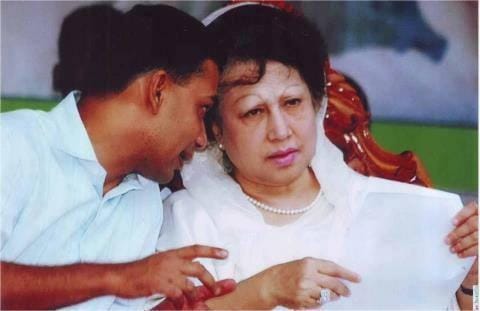
with son Tariqrahman
Khaleda Zia was admitted to Evercare Hospital on November 23 with infections in her heart and lungs and later developed pneumonia. She had long been battling multiple ailments, including advanced liver cirrhosis, diabetes, arthritis, and chronic complications affecting her kidneys, lungs and heart. Her treatment was supervised by a multinational medical board comprising specialists from Bangladesh, the UK, the US, China and Australia. An attempt to take her abroad for further treatment earlier this month was abandoned due to her fragile condition.
Family members were present at her bedside in her final hours, including her elder son and BNP Acting Chairman Tarique Rahman, daughter-in-law Dr Zubaida Rahman, granddaughter Zaima Rahman, younger daughter-in-law Sharmila Rahman Sithi, elder sister Selina Islam, younger brother Shamim Iskander, and senior party leaders such as BNP secretary general Mirza Fakhrul Islam Alamgir. Funeral prayer schedules will be announced later, the party said.
Khaleda Zia, widow of former president and army chief Ziaur Rahman (Bir Uttam), was a towering presence in Bangladeshi politics for more than three decades. She served as prime minister twice: first from 1991 to 1996 and again from 2001 to 2006, after leading the BNP to electoral victories. She was the first woman to head the government of Bangladesh and only the second woman elected prime minister in a Muslim-majority country.
Born in 1945 in Jalpaiguri, then part of Bengal Province, British India (now West Bengal, India), Khaleda Zia came from a modest Bengali Muslim business family and did not pursue formal higher education. Married at the age of 15 to a Pakistan Army officer, she led a largely private life until the assassination of her husband, Ziaur Rahman (Bir Uttam), in 1981. During the 1971 Liberation War, when her husband joined the independence struggle, Khaleda Zia went into hiding with her children and was later detained by Pakistani forces until the war’s end.
Her political journey began in earnest after the assassination of President Ziaur Rahman in 1981. Initially seen as an unlikely leader, she emerged as the BNP’s focal point of resistance against military ruler Hussain Muhammad Ershad. Her refusal to compromise with the regime earned her the reputation of being the country’s “uncompromising leader,” a label that followed her throughout her career.
Khaleda Zia rose to power in the landmark 1991 election, restoring parliamentary democracy after years of military rule. During her first term, her government reinstated the parliamentary system, introduced the caretaker government mechanism to ensure free and fair elections, and presided over a relatively liberal political environment marked by a freer press and academic space.
Despite her conservative image and reliance on Islamist allies, particularly Jamaat-e-Islami, Khaleda Zia pushed through several reforms that expanded women’s rights. Her government made girls’ education compulsory up to eighth grade with stipends, took a tough stance against child marriage, and strengthened domestic violence legislation by establishing a dedicated tribunal—moves that supporters say were transformative in a deeply conservative society.
Her rivalry with Sheikh Hasina, leader of the Awami League and daughter of Bangladesh’s founding president Sheikh Mujibur Rahman, came to define the country’s politics. While the two women once shared public platforms, their relationship deteriorated into bitter personal and political enmity, fuelling a street-centric and confrontational political culture.
Khaleda Zia lost power in 1996 after mass opposition protests over election credibility and returned to office in 2001 at the head of a coalition that formally included Islamist parties. Her second term was marred by allegations of corruption, rising militancy, political violence and attacks on minorities. It was also during her tenure that the Rapid Action Battalion (RAB) was formed, later widely criticised for extrajudicial killings.
In 2007, an army-backed caretaker government arrested both Khaleda Zia and Sheikh Hasina amid a political crisis. Although she contested the 2008 election after her release, the BNP suffered a crushing defeat. The subsequent years saw Khaleda increasingly sidelined as the Awami League entrenched its rule.
In 2018, Khaleda Zia was jailed in a corruption case involving misappropriation of orphanage funds, a conviction the BNP consistently described as politically motivated. Her health deteriorated sharply in prison. In 2020, the Sheikh Hasina government suspended her sentence on humanitarian grounds, effectively placing her under house arrest and repeatedly denying her permission to travel abroad for treatment.
The political landscape shifted dramatically after the mass uprising of 2024 that led to Sheikh Hasina’s ouster and flight from the country. The interim government moved swiftly to quash the cases against Khaleda Zia, and in January this year, the Supreme Court acquitted her, overturning her 10-year sentence. She was allowed to travel to London for treatment and reunited with her son Tarique Rahman, who had spent 17 years in exile before returning to Bangladesh on December 25.
In her final public remarks, Khaleda Zia avoided attacking her long-time rival, maintaining a restraint that contrasted sharply with years of personal vilification she had endured. Frail and wheelchair-bound in her last months, she nonetheless expressed, in private, a desire to contest another election.
Khaleda Zia’s legacy is both complex and profoundly significant. As a nationalist icon, she stood resolutely against military rule, expanded the space for democratic discourse, and subtly promoted women’s rights from a conservative platform. She passed away at a time when Bangladesh is poised on the threshold of another crucial political transition. Often seen as rigid and inscrutable, Khaleda Zia leaves behind a layered legacy, one defined by resilience, steadfast conviction, and an enduring imprint on the nation’s turbulent journey toward democracy.