
Last Updated on February 12, 2026 6:24 pm by INDIAN AWAAZ
As one of the largest and most consequential elections in Bangladesh’s history draws to a close, the country now waits to see who will form the next government — and whether the referendum will usher in a new constitutional chapter.
Zakir Hossain from Dhaka
Bangladesh on Thursday concluded voting for its 13th National Parliamentary Election alongside a historic nationwide referendum on constitutional reforms, bringing to an end a day-long polling exercise marked by steady voter participation, tight security and largely peaceful conditions, barring a few isolated incidents of violence.
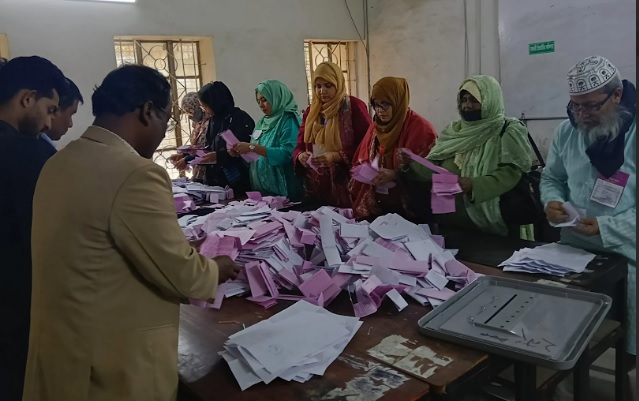
Polling began simultaneously at 7.30am across 299 parliamentary constituencies and continued uninterrupted until 4.30pm. Voters who were inside polling centres at the official closing time were allowed to cast their ballots. With voting completed, ballot counting began at polling centres under the supervision of election officials and in the presence of candidates’ agents, as the country now waits for results.
The Election Commission (EC) reported that 47.91% of voters had cast their ballots by 2pm, based on data received from 36,031 polling centres out of a total 42,651 nationwide. EC officials estimate that final turnout may range between 55% and 60%.
This election marks Bangladesh’s return to the ballot box nearly a year and a half after the July 2024 popular uprising that led to the fall of the Awami League government and ended more than 15 years of Sheikh Hasina’s rule. It is also the first time since independence that a parliamentary election and a referendum have been held simultaneously.
Festive mood, isolated violence
Voters in both urban and rural areas were seen lining up at polling stations throughout the day, with turnout increasing notably after noon. Election authorities said that apart from a few isolated incidents, the overall polling process remained peaceful and no polling centre had to suspend voting.
However, grenade explosions were reported in two districts, and several parties alleged irregularities. Six deaths were reported on polling day. Five individuals reportedly died after falling ill, while one death was linked to pushing during a confrontation. A polling officer died while on duty in Brahmanbaria, while two voters died after falling ill while coming to vote in Manikganj and Chattogram. Despite these incidents, the Election Commission maintained that “no alarming situation arose”.
Contest and political landscape
A total of 50 political parties contested the election, with 2,028 candidates in the fray. Voting was held in 299 constituencies, with polling in Sherpur-3 postponed due to the death of a candidate.
The Awami League did not participate, as its political activities remain suspended. The principal contest is between the BNP-led alliance and the Jamaat-e-Islami–led 11-party alliance.
According to EC data, Bangladesh has 127,711,793 registered voters, including 62.88 million women, 64.83 million men and 1,232 transgender voters. More than 50 million voters are aged between 18 and 37.
Referendum and postal voting
Alongside the parliamentary election, voters also cast ballots in a referendum under the “July Charter” on 48 proposed constitutional reforms. A majority ‘Yes’ vote would bring sweeping constitutional changes into effect. For the first time, an IT-supported postal voting system was introduced for expatriates, government officials on duty, voters outside their constituencies and prisoners. Around 1.528 million voters registered through the “Postal Vote BD” mobile app.
As of 2pm, 543,751 overseas voters had completed voting, with 498,266 expatriate ballots already reaching Bangladesh. Domestically, 674,376 registered voters completed postal voting, according to the EC. Ballots received by 4.30pm will be included in the count.
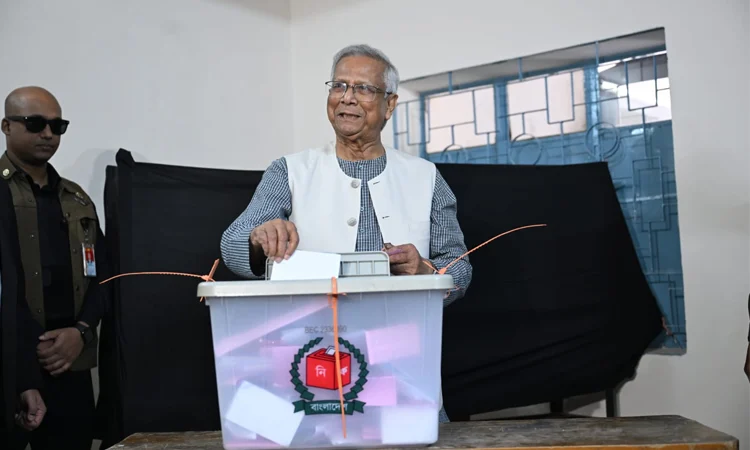
Yunus: ‘Birthday of a new Bangladesh’:
Interim government Chief Adviser Muhammad Yunus described the election and referendum as a moment of national renewal. “This is a day of great joy. Today is the birthday of a new Bangladesh. We will celebrate this birthday throughout the day,” Yunus told reporters after casting his vote at 10.26am at Gulshan Model High School and College.
“Through today’s process, people have rejected the past. Whatever nightmarish past existed, we have completely discarded it. From today, at every step, we have gained the opportunity to build a new Bangladesh,” he said.
Emphasising the importance of the referendum, Yunus added, “Voting for a candidate is important, but the referendum is very important. The whole of Bangladesh will change.”
Jamaat chief raises concerns, calls for neutrality
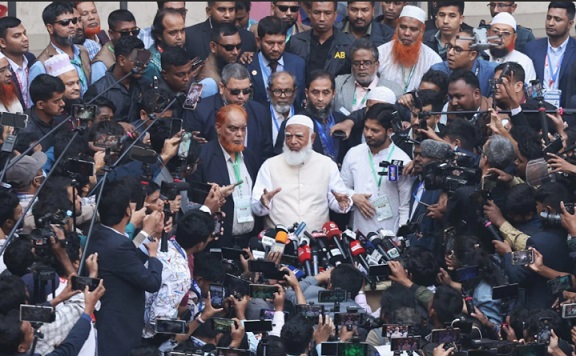
Jamaat-e-Islami chief Shafiqur Rahman expressed hope that the country would witness a credible election outcome, while alleging sporadic incidents of violence and irregularities.
Speaking at a briefing at his main election office in the Dhaka-15 constituency after 2.00pm, Shafiqur said, “If the armed forces carry out their duties with sincerity, we hope that by the end of the day the nation will get good voting and a good election.”
He warned, “If a good election is held, a good government will be formed—a government that will think about the people of this country. But if any government is formed through fraud and forgery, that government will not understand people’s sufferings and will not have any bond with them.”
Describing his visits to polling centres, he said voter turnout was “quite satisfactory” at most locations. However, he alleged that supporters of a rival candidate forcibly entered the Monipur High School (Girls’ Section) polling centre in Dhaka-15 and intimidated voters.
“We saw that an army officer was handling the situation with great responsibility. He assured us that the situation was under control,” Shafiqur said, adding that he had urged authorities to prevent outsiders from gathering near centres after polling hours.
He further alleged that activists and supporters of BNP candidates had created problems in several areas and warned that disorder during vote counting could undermine public trust.
NCP alleges vote rigging
The student-led National Citizen Party (NCP) alleged vote rigging and irregularities at multiple polling centres since noon. At an emergency press briefing in Dhaka’s Bangla Motor area around 2.30pm, Monira Sharmin, secretary of the party’s election management committee, said the party had received complaints from various parts of the country.
She alleged that individuals carrying party identity cards were present inside several polling centres in Dhaka-18, including Uttara High School and College, attempting to influence voters. Other allegations included harassment of female voters in Nikunja, the presence of multiple agents from a single party at certain centres, obstruction or removal of rival polling agents, crude bomb explosions, attacks on candidates and journalists, and injuries to Ansar members and civilians, including incidents reported in Noakhali’s Hatia.
Tarique Rahman seeks timely results
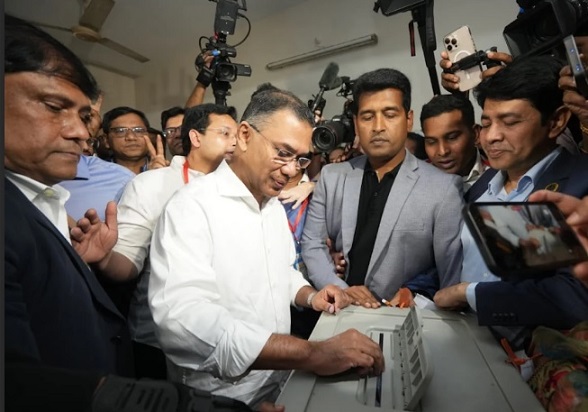
BNP Chairman Tarique Rahman said his party would accept the election results if the polls were conducted in a free, fair and controversy-free manner.
“If the election is free, if it is fair, if it is without controversy, then why would we not accept it? Of course we will accept it,” he told journalists at the party’s Gulshan office. “But there is one condition. The election must be neutral. The election must be peaceful.”
Referring to reports of irregularities, Tarique said such incidents were unacceptable and could create negative public perception against those involved. He expressed hope that higher voter turnout would help thwart any attempts at manipulation.
“When people across the country are casting their votes quickly, they will also want the results quickly,” he said, adding that he expected the Election Commission to announce results within a normal timeframe, similar to elections held in 1991, 1996 and 2001.
After visiting several polling centres in Dhaka, he said public participation appeared strong and added, “We are very hopeful about our party’s victory.”
Observers and results timeline
The European Union’s election observation mission described the voting situation as positive until noon. “The level of participation and interest shown by the people of Bangladesh in voting has been positive,” mission chief Ivars Ijabs said. The mission is expected to release its preliminary report on February 14.
Vote counting began after polling ended. As parliamentary and referendum ballots, along with postal votes, are being counted together, the process may take longer than usual. The Election Commission said preliminary results could be announced by Friday morning, though former officials indicated that full results may take until the afternoon.
As one of the largest and most consequential elections in Bangladesh’s history draws to a close, the country now waits to see who will form the next government — and whether the referendum will usher in a new constitutional chapter.