
Last Updated on August 24, 2025 11:53 pm by INDIAN AWAAZ
Zakir Hossain from Dhaka
Bangladesh has firmly rejected Pakistan’s assertion that long-standing disputes stemming from the 1971 Liberation War— including Dhaka’s demand for a formal apology for genocide— were “settled twice” in the past.
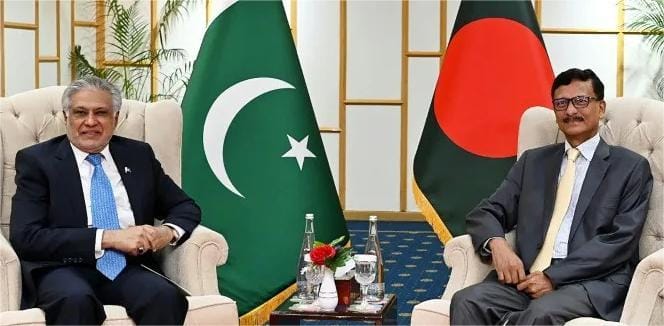
Speaking after talks with Pakistan’s Deputy Prime Minister and Foreign Minister Ishaq Dar in Dhaka on Sunday, Bangladesh’s Foreign Affairs Adviser Md Touhid Hossain said: “Of course I don’t agree. If we agreed, the problem would have been resolved in the way they claim, right? We stated our position, they stated theirs.”
Dar, who is on a two-day official visit to Bangladesh— the first by a Pakistani foreign minister in 13 years— had earlier told reporters that the outstanding issues between the two countries were no longer unresolved. He insisted that “in 1974, the issue was resolved in writing. The document is historic and both countries have it. Later, when General Pervez Musharraf came here [in the early 2000s], he actually addressed the issue in a very open and candid manner. So the issue was resolved twice.” The minister added that “between brothers, once something is resolved, it is done,” calling on both sides to “clean our hearts” and move forward.
Dhaka, however, maintains that critical matters remain unsettled. Bangladesh has repeatedly pressed Islamabad for a formal apology for the atrocities committed by the Pakistan Army in 1971, when an estimated three million people were killed and more than 300,000 women raped. The government has also demanded repayment of nearly USD 4.5 billion in assets owed to Bangladesh since independence, along with the repatriation of thousands of Pakistanis stranded in Bangladesh for over five decades.
Touhid Hossain confirmed that all these matters were brought up during the ministerial-level dialogue, though he cautioned that no quick breakthrough should be expected. “You surely don’t expect that a problem that has lasted 54 years will be solved in a one-hour meeting,” he said at a press briefing in the Foreign Service Academy, adding that while both sides agreed the issues must eventually be resolved through dialogue, their positions remain far apart.
Despite the differences over history, Dhaka and Islamabad sought to highlight areas of cooperation. On Sunday, the two countries signed one agreement abolishing visas for holders of diplomatic and official passports, alongside five Memoranda of Understanding. These covered the creation of a Joint Working Group on Trade and Commerce, cultural exchange, collaboration between the foreign service academies of both countries, cooperation between Bangladesh Sangbad Sangstha and the Associated Press of Pakistan, and institutional ties between the Bangladesh Institute of International and Strategic Studies in Dhaka and the Institute of Strategic Studies Islamabad. A 3-year Cultural Exchange Programme for 2025 to 2028 was also finalised.
Dar described the outcome of the talks as “a great beginning” and stressed that there was “tremendous potential” to increase economic engagement. Bilateral trade between the two countries currently stands at just USD 865 million, which he said could “easily cross USD 1 billion.” He pointed out that Pakistan considers trade a priority in its relationship with Bangladesh, noting that 16 trade delegations from Pakistan have already visited Dhaka this year. He also welcomed the revival of direct shipping links between Karachi and Chittagong and announced that direct flights between the two countries would soon be launched.
For its part, Bangladesh sought wider access to Pakistani markets under the South Asian Free Trade Area framework, particularly in the sectors of textiles, medicines, agriculture, fisheries, livestock and information technology. Dhaka also emphasised cooperation in higher education, scholarships for Bangladeshi students, and collaboration in medical sciences, engineering and technology. The Rohingya refugee crisis was also raised, with Bangladesh requesting Islamabad’s support for ensuring the safe repatriation of Rohingyas to Myanmar.
Dar’s visit also included political outreach. He called on Bangladesh’s interim Chief Adviser Professor Muhammad Yunus, held a breakfast meeting with Commerce Adviser Sheikh Bashir Uddin, and separately met leaders of BNP, Jamaat-e-Islami and NCP. On Saturday evening, he visited the Gulshan residence of former prime minister and BNP chairperson Begum Khaleda Zia to enquire about her health.
Throughout his engagements, Dar struck a conciliatory note, emphasising that the two countries should not remain “fixated on the past” but adopt a forward-looking approach. “Today, the younger generations in both countries aspire to stronger bonds of friendship and cooperation,” he said, while acknowledging that sensitive historical disputes would require “sustained engagement.” He also highlighted that both countries shared common ground on regional cooperation, particularly the need to revitalise SAARC, and on humanitarian crises such as Gaza, where both Dhaka and Islamabad opposed the use of starvation as a weapon of war.
“Pakistan believes that our bilateral ties should be guided by goodwill and mutual respect, working for the benefit of our two peoples,” Dar concluded, expressing hope that his Dhaka visit, after more than a decade, would mark the beginning of a more constructive and regular pattern of engagement between the two South Asian neighbours.