
Last Updated on June 16, 2026 11:52 pm by INDIAN AWAAZ
Zakir Hossain from Dhaka
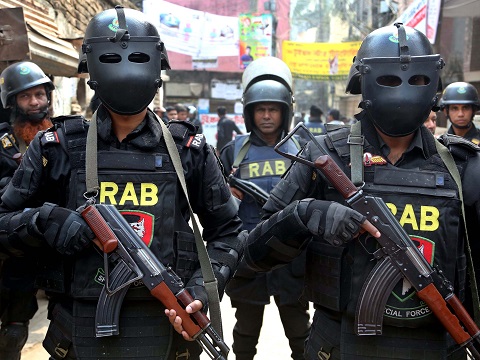
Bangladesh’s Rapid Action Battalion (RAB), long criticised over allegations of human rights abuses, may be renamed the People’s Protection Forces (PPF) under a new law aimed at strengthening accountability and oversight.
RAB Director General Md Ahsan Habib Palash said the draft People’s Protection Forces (PPF) Act, 2026 has been submitted to Police Headquarters and will be forwarded to the Home Ministry for approval.
“The ministry will finally decide whether Rab will be renamed as PPF,” Palash told The Daily Star. “The new proposal has been formulated to ensure that members of the specialised force act in accordance with human rights standards and remain accountable.”
The reform proposal was prepared following the 2024 uprising and comes against the backdrop of international scrutiny. In December 2021, the United States imposed sanctions on RAB and several current and former officials over alleged serious human rights violations. Rights groups have accused the force of enforced disappearances, extrajudicial killings and torture, and have called for major reforms or its dissolution.
A key feature of the draft law is the creation of a five-member Complaint Redress Committee to handle complaints from both citizens and force personnel. The body would be headed by an additional director general and include representatives from the Home Ministry and Finance Division, a human rights activist with at least 10 years’ experience, and a senior journalist nominated by the president of the Jatiya Press Club.
Officials said the inclusion of a human rights representative and journalist is intended to address concerns over the lack of independent oversight. The committee would be empowered to launch preliminary inquiries, form investigation teams, recommend disciplinary measures, and submit quarterly reports to the Home Ministry. It would also have powers similar to those of a civil court, including summoning witnesses and seeking documents.
The committee would examine allegations of misconduct, undue influence, harassment, unfair promotions or postings, and unlawful interference in the force’s operations. It would also oversee internal grievances.
A senior RAB official, speaking on condition of anonymity, said the draft seeks to balance accountability with operational protection. “If we do not ensure that protection, none will work seriously,” the official said, adding that personnel would not be punished for unintended incidents during operations.
The proposed 17-point framework defines offences such as extortion, misuse of citizens’ property, negligence leading to a suspect’s escape, destruction of property, dereliction of duty, and failure by commanders to act against proven abuse by subordinates.
Under the proposal, accused personnel would continue to be returned to their parent organisations for disciplinary proceedings under existing service laws. Authorities have also decided against allowing direct recruitment, retaining RAB’s current structure comprising personnel from the police, army, navy, air force and other agencies.
The force would remain headed by a serving additional inspector general of police under the inspector general of police. Its operational powers would largely remain unchanged, including intelligence gathering, counter-terrorism operations, recovery of illegal arms, explosives and narcotics, and conducting searches and arrests without prior authorisation in specified circumstances.
The draft also proposes a dedicated research unit to analyse crime and terrorism trends and makes training mandatory for all personnel. All assets, liabilities, records, contracts and ongoing legal proceedings involving RAB would automatically transfer to the new force.
Established in March 2004 and formally launched on April 14 that year, RAB gained prominence through anti-crime operations but soon faced allegations of excessive use of force. The force currently operates under the Armed Police Battalions (Amendment) Act, 2003.
At least 15 former RAB officers, including three former chiefs, an additional director general and 11 army officers, are currently facing trial before Bangladesh’s International Crimes Tribunal on charges related to enforced disappearances, torture and killings.