
Last Updated on December 19, 2025 9:17 pm by INDIAN AWAAZ
Zakir Hossain from Dhaka
Bangladesh was plunged into widespread unrest as violent protests swept across the country following the death of July Uprising Student leader and Inqilab Moncho spokesperson Sharif Osman Hadi, who succumbed to gunshot injuries in Singapore late Thursday night. The killing of the 32-year-old youth leader has triggered a wave of demonstrations, arson attacks and political uncertainty, raising serious concerns about law and order ahead of the national elections scheduled for February 12, 2026.
Thousands of protesters poured onto the streets of Dhaka, Chattogram, Barishal and other major cities, blocking highways and key intersections and demanding the immediate arrest and punishment of those responsible for Hadi’s killing. In the capital, Dhaka University students emerged from residential halls around 10 pm on Thursday, chanting slogans such as “We are all Hadi now”, and “Golami or Azadi, Azadi Azadi”, before converging at the Anti-Terrorism Raju Memorial Sculpture. The campus turned into a sea of demonstrators, many of them in tears, as students described Hadi’s death as a symbol of resistance.
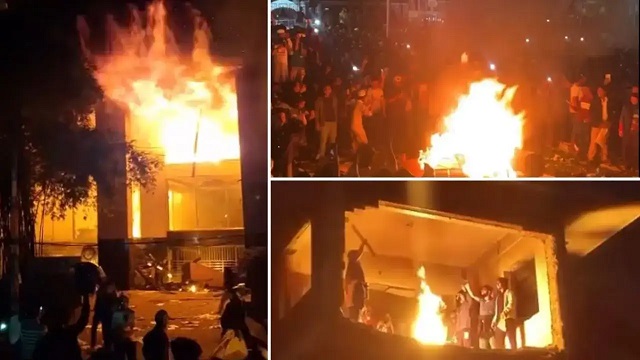
Protests soon spread to Shahbagh, Banglamotor and Karwan Bazar, where the situation took a violent turn. Unruly demonstrators attacked and set fire to the offices of the country’s two leading newspapers, Prothom Alo and The Daily Star. At The Daily Star office, flames forced 30–35 journalists and staff to flee to the rooftop before firefighters rescued them around 2 am. Army personnel were later deployed in front of the building. The fire service reached the Prothom Alo office shortly before 2.30 am and worked for hours to bring the blaze under control. Both newspapers have since suspended print and online operations.
Cultural institutions and political landmarks were also targeted. Protesters vandalised and torched the revered cultural organisation Chhayanaut in Dhanmondi, while the historic residence of Sheikh Mujibur Rahman at Dhanmondi-32 was set on fire around 1.30 am. Houses linked to former Awami League leaders, including the residence of ex-education minister Mohibul Hasan Chowdhury Nowfel in Chattogram and the brother of former Dhaka-18 lawmaker Habib Hasan in Uttara, were also attacked. Major highways, including the Dhaka–Chattogram and Dhaka–Barishal routes, were blocked for hours, stranding hundreds of vehicles, though protesters allowed ambulances to pass.
By Friday morning, protests continued, with demonstrators blocking Shahbagh once again. Separate rallies led by Dhaka University Central Students.
Law enforcement agencies were deployed around sensitive installations, including Bangladesh Medical University.
Sharif Osman Hadi, a prominent face of the July Uprising and a prospective parliamentary candidate, was shot at close range on December 12 while travelling on a rickshaw near Dhaka’s Bijoynagar area. Two assailants on a motorcycle opened fire before fleeing. He underwent emergency treatment in Dhaka before being airlifted to Singapore, where he died on December 18 despite what doctors described as “best efforts”. Police say they have identified the shooter and the driver and a reward of five million taka has been announced for information leading to their arrest.
Yunus Appeal for Calm
The interim government, led by Chief Adviser Muhammad Yunus, urged calm and restraint, warning against mob violence. “We cannot and must not allow this historic democratic transition to be derailed by those who thrive on chaos,” the government said in a statement, calling the upcoming elections and referendum a “solemn national commitment” linked to the ideals for which Hadi stood. The government also expressed solidarity with journalists affected by the attacks, promising full justice. Yunus personally spoke to the editors of Prothom Alo and The Daily Star, saying, “This is an attack on independent journalism and a major obstacle to Bangladesh’s democratic progress.”
Political leaders across the spectrum condemned the violence. BNP secretary-general Mirza Fakhrul Islam Alamgir described the attackers as “enemies of the country”, while Jamaat-e-Islami chief Shafiqur Rahman urged patience, saying restraint was essential for national unity. The Bangladeshi Journalists in International Media (BJIM) called on the government to ensure the safety of journalists and protect media freedom.
International reactions followed swiftly. The US Embassy in Dhaka said it joined the people of Bangladesh in mourning Hadi’s death and offered condolences to his family. India, meanwhile, said it was closely monitoring Bangladesh’s “fluid and evolving” internal situation but would not interfere in domestic affairs.
Political analysts warn that the unrest could jeopardise the February elections. “There are genuine mourners, political opportunists and far-right nationalists all converging on the streets,” said Mubashar Hasan, an adjunct researcher at Western Sydney University. “If the situation continues, it is highly unlikely that elections will be held on schedule.”
Hadi’s body was brought back to Bangladesh on Friday evening. As the nation mourns the slain youth leader, Bangladesh faces a critical test of whether it can honour his memory through justice and democratic stability, or slide further into chaos.