
Last Updated on September 16, 2025 12:49 am by INDIAN AWAAZ
The Doha summit marks a critical moment in Arab-Islamic diplomacy. By placing Qatar’s defense at the center, the communique signals a revival of collective security doctrine within both the Arab League and OIC.
AMN / Doha
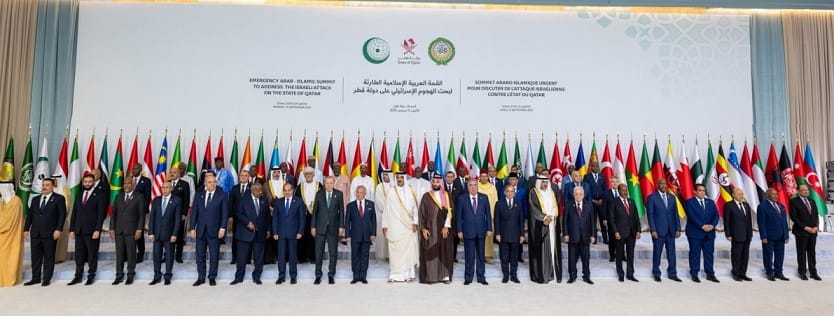
The emergency Arab-Islamic Summit in Doha on Monday issued a strong joint communique condemning Israel’s strike on Qatar, declaring it a “flagrant violation of sovereignty” and a threat to regional and global peace.
Convened under the chairmanship of Qatar’s Amir Sheikh Tamim bin Hamad Al-Thani, the meeting of Arab League and OIC leaders pledged full solidarity with Doha after the September 9 Israeli attack on a residential neighborhood in the Qatari capital that damaged schools, nurseries, diplomatic premises, and housing for mediation delegations. The strike killed civilians, including a Qatari citizen.
The leaders of the Arab League and the Organization of Islamic Cooperation (OIC), meeting under the chairmanship of Qatar’s Amir Sheikh Tamim bin Hamad Al-Thani, pledged full solidarity with Doha and laid out a wide-ranging 25-point roadmap of collective response.
Summit’s Core Message: Absolute Solidarity with Qatar
The final communique opened with a categorical reaffirmation of support for Qatar’s sovereignty, stability, and security. The leaders denounced the September 9 Israeli strike on a Doha residential neighborhood – which damaged schools, nurseries, diplomatic premises, and facilities used for mediation delegations – as “a cowardly and unlawful act” that killed civilians, including a Qatari citizen. The attack, they said, amounted to “an assault on mediation efforts themselves,” undermining Qatar’s recognized role as a neutral peace broker in Gaza and regional conflicts.
“This aggression is not just against Qatar, but against all Arab and Islamic States,” the communique declared, adding that member nations stand firmly behind Qatar in any measures it may take in response under the UN Charter.
Condemnation of Israel’s “Policy of Impunity”
The summit attributed Israel’s repeated aggressions to the “absence of international accountability” and “silence of the global community,” which have emboldened Tel Aviv to pursue genocide, ethnic cleansing, siege warfare, and settlement expansion with impunity. Such practices, leaders warned, threaten to dismantle the rules-based international order.
They called for urgent international action to stop Israel’s “full-fledged war crimes,” including starvation and denial of medicine in Gaza, and pressed for immediate, safe, and unhindered humanitarian access across occupied Palestinian territories.
Specific Decisions and Calls to Action
The communique, which ran to 25 detailed points, included several major commitments:
- Support for Mediation: Commended Qatar, Egypt, and the U.S. for efforts to mediate a ceasefire in Gaza and secure hostage releases, while warning that attacks on mediators strike at peace itself.
- Collective Security: Reaffirmed the “shared destiny” of Arab and Islamic States and urged practical mechanisms for implementing collective defense against common threats.
- Legal and Diplomatic Pressure: Urged sanctions on Israel, suspension of arms supplies (including dual-use items), downgrading of diplomatic ties, and legal actions in international courts to ensure accountability.
- UN Membership Questioned: Called on OIC states to review whether Israel’s UN membership remains valid, given its persistent violations of the Charter.
- Two-State Solution: Welcomed the upcoming Two-State Solution Conference (co-chaired by Saudi Arabia and France on September 22 in New York) and reaffirmed support for a Palestinian state on 1967 borders with East Jerusalem as capital.
- Gaza Reconstruction: Urged immediate launch of Arab-Islamic reconstruction efforts and international donor support, with Cairo set to host a Gaza Reconstruction Conference after ceasefire.
- Custodianship of Holy Sites: Reiterated support for Jordan’s Hashemite custodianship over Islamic and Christian holy sites in Jerusalem and for Morocco’s Al-Quds Committee.
- Accountability Mechanisms: Called for ICC arrest warrants against perpetrators of war crimes against Palestinians to be enforced, and urged OIC members to align legal systems with international obligations.
A Wider Regional Warning
The leaders not only rejected the Israeli attack on Qatar but also warned against broader threats:
- They condemned Israeli threats of renewed strikes against Qatar or other Arab and Islamic States as “provocative and escalatory.”
- They opposed any annexation of occupied Palestinian territories, labeling it a “crime against humanity.”
- They demanded urgent international measures to halt violations in Gaza, the West Bank, Lebanon, Syria, and Iran.
International Engagement
The summit welcomed recent global moves, including the UN General Assembly’s New York Declaration backing the two-state solution and the Security Council’s September 11 emergency session, which had condemned Israel’s attack on Qatar. The communique praised Arab and Islamic members of the Security Council – notably Algeria, Somalia, and Pakistan – for championing the Palestinian cause and convening the UNSC debate.
Praise for Qatar
In closing, the communique expressed “deep appreciation” to Qatar and its Amir, Sheikh Tamim bin Hamad Al-Thani, for hosting and steering the summit “with wisdom and strategic vision.” Leaders credited Doha’s mediation record, humanitarian initiatives, and diplomatic engagement with enhancing its stature as a trusted partner for regional peace.
Towards Unified Arab-Islamic Posture
The Doha summit marks a critical moment in Arab-Islamic diplomacy. By placing Qatar’s defense at the center, the communique signals a revival of collective security doctrine within both the Arab League and OIC. While enforcement will depend on follow-up actions – sanctions, diplomatic downgrades, or ICC cooperation – the breadth of the communique indicates intent to mobilize political, legal, and humanitarian levers simultaneously.
At the same time, the decision to tie Qatar’s case explicitly to the Palestinian cause reflects the enduring centrality of Palestine as the “core of Arab unity.” The Doha summit thus reinforced two interlinked messages: solidarity is indivisible among Arab-Islamic States, and the road to peace still runs through ending occupation and establishing a viable Palestinian state.