
Last Updated on June 24, 2026 3:10 pm by INDIAN AWAAZ
Our Correspondent / NEW DELHI
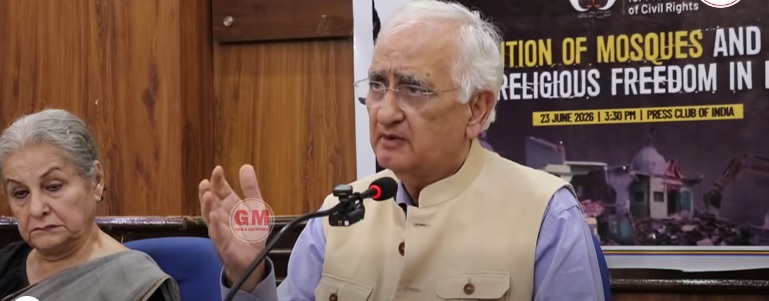
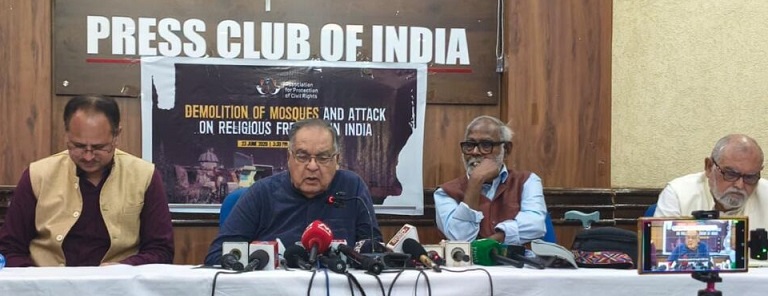
Amid growing concerns over demolition drives targeting religious structures in different parts of the country, the Association for Protection of Civil Rights (APCR) on Tuesday organised a national conference in the capital, bringing together prominent legal experts, former public representatives, human rights activists and civil society leaders to discuss what participants described as increasing challenges to religious freedom and constitutional protections.
At the conference, titled “Demolition of Mosques and Attack on Religious Freedom in India”, speakers stressed the need for a coordinated legal response, systematic documentation of alleged rights violations, greater public awareness and stronger democratic engagement to address disputes involving places of worship. The event also highlighted concerns over recent demolition actions affecting mosques in several states and called for strict adherence to constitutional safeguards and the rule of law.
The gathering was attended by senior advocate and former Union Minister Salman Khurshid, former MP Mohammad Adeeb, Jamaat-e-Islami Hind National Secretary Malik Mohtasim Khan, former Delhi Minorities Commission Chairman Zafarul Islam Khan, author and social activist Syeda Hameed, human rights activist John Dayal, APCR National Secretary Nadeem Khan and advocates Syed Sadat Ali and Riyasat Ali, among others.
Addressing the conference, senior advocate and former Union Minister Salman Khurshid said the challenges confronting minority communities and religious institutions require a patient, united and legally grounded response rather than emotional reactions. Emphasising the importance of constitutional mechanisms, he urged affected groups to make full use of available legal remedies and ensure that all documentation related to religious properties and institutions remains complete and updated.
Drawing on his experience in public life and legal practice, Khurshid said that successful legal battles depend on meticulous preparation and adherence to procedural requirements. Referring to disputes involving mosques and religious properties, he noted that many cases arise in situations where administrative actions are taken with little notice, making it essential for institutions to maintain proper records and legal compliance.
He expressed confidence in the judiciary and said that despite challenges, many judges remain committed to constitutional principles, secularism and justice. Khurshid also referred to ongoing legal debates surrounding the Places of Worship Act and disputes involving ASI-protected monuments, including matters connected with the Kamal Maula Mosque, stating that significant questions are likely to come before the Supreme Court.
Criticising demolition notices that leave residents and worshippers vulnerable, he called for fair procedures in cases involving acquisition, demolition and compensation. Khurshid urged citizens to remain patient and place their faith in constitutional institutions while preparing for what he described as a long legal struggle. He also assured participants that many lawyers were willing to provide legal assistance without fees and stressed that defending constitutional values is a collective responsibility that extends beyond any single community.
Former Delhi Minorities Commission Chairman Zafarul Islam Khan argued that mosque demolitions, house demolitions and what he described as “bulldozer politics” should be viewed as part of a larger socio-political process unfolding over the past decade. According to him, developments since 2014 reflect the gradual implementation of long-standing ideological objectives, with Muslims, Christians and Communists increasingly being portrayed as adversaries in the public discourse.
Khan urged community members, particularly young people, to remain active, organised and engaged in democratic and legal processes. He emphasised that legal battles must continue even when the chances of success appear uncertain, arguing that court proceedings help create an enduring historical record of grievances and alleged injustices.
Drawing a parallel with the Babri Masjid dispute, he said legal findings and documented evidence retain significance regardless of the final judicial outcome. He also stressed the importance of systematically documenting alleged human rights violations and presenting well-researched reports before national and international institutions, including United Nations bodies and global human rights organisations.
Calling for restraint, Khan advised communities to avoid any response that could aggravate tensions. Instead, he advocated pursuing legal remedies, documentation and international advocacy as essential tools for accountability and preserving historical records for future generations.
Malik Mohtasim Khan, National Secretary of Jamaat-e-Islami Hind and a senior APCR functionary, said the current atmosphere of hostility and demolition drives targeting Muslim institutions should not discourage the community. Describing the present situation as temporary, he urged Muslims to focus on strengthening education, economic empowerment and political awareness.
He alleged that demolitions of mosques and madrasas, along with restrictions affecting educational opportunities, were contributing to the social and economic marginalisation of Muslims. While acknowledging the importance of ongoing legal battles, Mohtasim emphasised that long-term empowerment would come through educational advancement, scholarship programmes and economic development initiatives.
He also expressed concern over future political developments such as delimitation, warning that such processes could further reduce Muslim representation unless the community becomes more politically conscious and engaged. Criticising both government policies and what he termed the inadequacies of secular opposition parties, Mohtasim called for collective efforts to protect democratic and constitutional values.
Former Member of Parliament Mohammad Adeeb demanded accountability for officials allegedly involved in unlawful demolition actions. He argued that administrative and police authorities responsible for illegal demolitions should face legal and financial consequences and urged political parties to respond more effectively to public concerns.
Author and social activist Syeda Hameed placed the issue within the broader context of minority rights and social harmony. Recalling her experiences during periods of communal violence, she emphasised the importance of interfaith solidarity and cooperation among Muslims, Hindus, Christians, Sikhs and other communities in safeguarding India’s pluralistic traditions.
Human rights activist John Dayal, speaking from the perspective of the Christian community, alleged that minority institutions were facing coordinated challenges. He also expressed concern over policy changes affecting civil society organisations and religious institutions.
Presenting APCR’s assessment, National Secretary Nadeem Khan claimed that at least 20 mosques had faced demolition-related action within a span of 15 days across Uttarakhand, Uttar Pradesh and Rajasthan. According to him, such actions were having significant psychological and social consequences for affected communities.
Advocate Syed Sadat Ali highlighted developments in Rajasthan, particularly in Barmer district, where he claimed notices had been issued to a large number of mosques. He questioned what he described as the selective targeting of one religious community.
Advocate Riyasat Ali stressed the importance of constitutional safeguards and legal accountability, urging citizens to challenge unlawful administrative actions through judicial and constitutional mechanisms.
Representatives from Barmer, Jaipur, Varanasi, Meerut, Sambhal and Ghaziabad also shared accounts of demolition drives and notices issued to religious structures in their respective areas. Among the cases discussed was the demolition of the Noorani Mosque in Jaipur’s Nandpuri locality. Community representatives alleged that the mosque, constructed in 1981 and recorded in official documents, was demolished without prior notice to its management committee.
Throughout the conference, speakers maintained that the Constitution guarantees freedom of conscience and the right to profess, practise and propagate religion. They argued that protecting places of worship of all faiths is vital for preserving India’s democratic and pluralistic character.
Concluding the event, participants called for greater accountability, transparency and adherence to due process in all administrative actions involving religious structures. They urged authorities to ensure that decisions relating to places of worship are carried out fairly, without discrimination, and in accordance with constitutional guarantees and the rule of law.