
Last Updated on October 25, 2026 12:31 pm by INDIAN AWAAZ
Sudhir Kumar
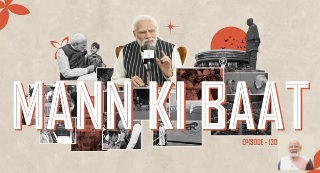
Prime Minister Narendra Modi today said Mann Ki Baat has completed 12 years and that the journey has felt like a ‘pilgrimage’ for him. Addressing the nation through his Mann Ki Baat programme on Akashvani, the Prime Minister noted that Mann Ki Baat began on the auspicious occasion of Vijayadashami 12 years ago. Since then, this journey has continued without a break.
The Prime Minister said that the listeners of Mann Ki Baat are both his fellow travellers and guides. He further said that Mann Ki Baat has been an auspicious opportunity to proudly celebrate the hard work, valour, commitment, dedication, and spirit of service of the common people of the nation. Mr. Modi added that this has been like a Teerth Yatra (pilgrimage trip) to closely understand the efforts of the people and to salute their contributions. He said people who live for society and the nation are, in themselves, like a ‘Teerth’ (Pilgrimage). He also said that through Mann Ki Baat, he is paying obeisance to the collective strength of the people of India.
The Prime Minister said that Mann Ki Baat provides him with an opportunity to connect with every family across the country. He said this deep connection and the affection shown by all of the listeners is a priceless treasure. Saying that the nation possesses many traditional skills that have been a part of its identity for generations, Prime Minister Modi highlighted an initiative underway in Punjab. An organisation called ‘Kheti Virasat Mission’ has begun to breathe new life into organic farming and traditional agricultural practices. The team aimed to promote natural cotton cultivation in the Malwa region of Punjab, with the initiative named ‘Nav-Trinjan’.
Under this project, organic cotton with natural colours is cultivated, eliminating the need for additional chemicals to dye the resulting yarn or fabric. ‘Nav-Trinjan’ also established a weaving school with the goal of passing on the craft of weaving to the next generation. Mr Modi mentioned how Ramandeep Kaur, a labourer; Suneha Devi, a domestic help and Rajni Kaur, a manual labourer are now being recognised as a skilled- weavers who are supporting their households with this new found skill. He also mentioned that a shawl woven by Rekha Rani has been presented to the President of India. He recalled meeting this team on National Handloom Day a few months ago. He extended his heartfelt wishes to the entire team for a bright future.
Speaking about conservation of Nature, Mr Modi highlighted the efforts in Tehri Garhwal region of Uttarakhand to breathe new life into the ‘Heval’ river and the natural water sources in the surrounding area. He commended the local administration and the villagers who launched a campaign to save the Heval river. Measures were undertaken to capture rainwater, facilitate groundwater recharge and plant a large number of trees. Mr Modi noted with satisfaction that due to these efforts, the Heval river has been revitalised and dozens of natural water sources have received help in their restoration.
The Prime Minister noted that cleanliness drives are being run at many places ahead of festivals like Diwali and Chhath. He stressed the need to maintain cleanliness of the places where people live. He added that small, individual efforts can bring about significant change in the surroundings.The Prime Minister expressed happiness that people are placing great importance on Swadeshi products while shopping during this festive season. He remarked that this spirit of ‘Vocal for Local’ is taking Indian products to global markets. He highlighted that Makhana from Purnia in Bihar is now reaching Greece, and Arhar Dal from Kalaburagi in Karnataka is being exported to the Maldives. He underlined that new global markets are opening up for Indian farmers.
Mr Modi emphasised that packaging of a product is just as significant as its quality. He cited the example of tribal communities in Maharashtra who have placed a strong focus on the packaging of the products they create. Through an initiative called ‘Shabari Naturals,’ products like honey, mahua, chironji and bamboo-based items are being brought to the market with packaging which reflects their tribal art. Mr Modi shared that this packaging has received Japan’s prestigious ‘Good Design Award.’ Prime Minister Modi also spoke about a ‘bamboo’ start-up in Karnataka which is creating packaging material from bamboo and agricultural residue.
Mr Modi expressed happiness that on Gandhi Jayanti this year, sales of the products of Khadi Gram Udyog crossed 28 crore rupees in a single day. This is an increase of 1.5 crore rupees over last year. He said the popularity of Khadi continues to grow, and the benefits are reaching the people who bring Khadi and various handicrafts to life. Mr Modi urged people to prioritise products made by local artisans during the festive season. He added that this will further strengthen the ‘Vocal for Local’ movement and the dream of ‘Atmanirbhar Bharat’ will be realised sooner.
Speaking about the e- Sanjeevani scheme, Prime Minister Modi expressed satisfaction that approximately 50 crore tele-consultations have been conducted through this platform so far to make people’s lives easier. Mr Modi said this serves as an excellent testament to the power of technology, dedication of doctors, and the trust placed in the system by the people. He highlighted that through its extensive network, the ‘e-Sanjeevani’ service has reached even the remotest corners of the country. He recounted some of the stories of those who have benefited from it. In the Andaman and Nicobar Islands, Oho-Tahane, from the Jarawa tribe on Baratang Island, was suffering from a high fever. Local health workers used e-Sanjeevani to consult an expert doctor. The child had pneumonia. The patient’s condition began to improve rapidly once he came under the care of the expert doctor.
In Kalpeni, Lakshadweep, a 60-year-old man named Kunhi Koya suddenly fell ill. Through e-Sanjeevani, contact was established with an experienced doctor located across the sea in Kavaratti. The experienced doctor provided guidance to the local medical team, which helped bring relief to Kunhi Koya. In Zanskar, Ladakh, Kunjang Dolma experienced complications during her pregnancy. A specialist doctor provided immediate assistance to her through e-Sanjeevani. In Peren, Nagaland, a 12-year-old boy named Mushem suffered from an ear infection and fever. With the help of e-Sanjeevani, the expert doctor was able to promptly diagnose his condition and recommend the appropriate medication.
Mr Modi said there was a time when even a simple health check-up or a visit to a doctor would take a long time and involve significant hardship. He said that today, nearly one lakh ninety thousand ‘Ayushman Arogya Mandir’ across the country have brought new facilities into people’s lives. He added that these Arogya Mandir are in a way, evolving into wellness centres for village panchayats.
Recalling his trip to Chennai earlier this month, Mr Modi said he met many of the nation’s scientists, researchers, and young talents. He said the nation’s youth are currently working on subjects that have the potential to transform the future of humanity. He cited ‘Brain Research’ as one such field. Mr Modi had inaugurated the ‘Sudha Gopalakrishnan Brain Centre’ at IIT Madras. This Centre has developed a brain-imaging technology platform that serves as a global benchmark. Through this, high-resolution, digital 3D images of the human brain are being created, with the goal of mapping and studying 100 human brains in minute detail.
The Prime Minister said that this is the first mission of its kind in the world, which utilises the ‘Param Shakti’ supercomputer. He noted that the nation’s industry has played a significant role, in collaboration with the Government, in establishing this Brain Centre. Many IIT alumni and academia have also come together to support this research centre. He highlighted the importance of this project as the human brain remains a major scientific enigma. He pointed out that even in the present day, conditions like Alzheimer’s and Dementia still lack a definitive cure. It has also been decided that this data from 100 human brains will be made available as an open-source resource for research across various fields.
Touching upon the subject of organ donation, Prime Minister Modi said it plays a vital role in such advanced research. He gave the example of Shivani from Narmadapuram in Madhya Pradesh who had met with a road accident, and her family decided to donate her organs. Mr Modi praised her family, saying such a step of humanity can bring happiness back into a family’s life, while also providing significant support to research efforts.
The Prime Minister also shared some other experiences from his visit to Chennai. The first was his interaction with young people on the metro, while another was his visit to IIT Madras. Mr Modi highlighted that one of the start-ups he met focuses on verifying the quality of gold, which can help prevent fraud in gold purchases. He added that another team is developing a platform that could enable the rapid recovery of funds lost to bank fraud. He further said that another team is exploring how AI can assist in the screening for cervical cancer.
Mr Modi said that the interaction at IIT was entirely focused on ‘deep-tech.’ These start-ups are being supported by the incubation ecosystem at IIT Madras. He noted that while one start up is developing an electric vehicle capable of flying over the sea, another start-up is developing fast-charging batteries for drones and electric vehicles. He said one team is working on the application of AI in Defence technology.
Prime Minister Modi opined that the youth are achieving such extraordinary milestones today because of the right environment and support. He said that the nation will mark the 100th birth anniversary of great Indian scientist, Narinder Singh Kapany on 31st October. The world knows him as the ‘Father of Fiber Optics.’ He was born in the Moga district of Punjab. Mr Modi said his advanced research into the technology of transmitting light through thin fibres lent a new direction to the world of communication. He paid his respects to Narinder Singh Kapany. He urged nation’s youth to read and learn about scientists like him, and draw inspiration from them.
The birth anniversary of Sardar Vallabhbhai Patel will be celebrated on the 31st of October. The nation observes ‘Ekta Diwas’ on this day. Prime Minister Modi said a ‘Run for Unity’ is organised across the country on this day. He said ‘Run For Unity’ offers the opportunity to strengthen the nation’s unity and reaffirm commitment to the nation. He urged everyone to participate enthusiastically in this year’s ‘Run for Unity’.
On this episode of Mann Ki Baat, Prime Minister Modi also spoke about millets, highlighting that 2023 was celebrated as the ‘International Year of Millets’ at India’s call. He said it received a very positive response globally. Through this initiative, people discovered how deeply millets are rooted in country’s own culture. Mr Modi said that there has been a rich tradition of millet cultivation in Northeast as well. He said that people had begun to drift away from it but that situation is changing now.
He spoke about a village called Khanduli in the West Jaintia Hills district of Meghalaya, where millets have been an integral part of food culture over many generations. The number of farmers cultivating millets had been on the decline for some time. Mr Modi said that two women from the village undertook the new initiative of creating new products from millets. Lending value addition to these grains, they developed items such as cookies, cakes, and muffins, as well as baby food. This led to an increase in the sales of millet-based products and a subsequent rise in the demand for millets themselves.
Mr Modi also mentioned Chekjing Sangma, who is a local farmer in the village of Sadolpara, located in the West Garo Hills district of Meghalaya. Recognising the importance of millets, Chekjing Sangma started cultivating them using modern methods. This has not only increased his income but has also fostered greater awareness within the village. Mr Modi also mentioned a village called Kezoma in Kohima, Nagaland, where the cultivation of millets had ceased for over a decade. In 2024, the local community resumed the cultivation of millets. In 2025, Kezoma celebrated its first-ever millet festival. Now, there is a rapidly growing demand for products made from millets in this region as well. The Prime Minister said these examples demonstrate how India’s youth are linking traditional crops with new opportunities, and how villages are advancing on the path to prosperity while preserving their heritage.
The birth anniversary of Maharishi Valmiki will be observed tomorrow, on 26th of October. Prime Minister remarked that though thousands of years have passed, Maharishi Valmiki’s Ramayan continues to offer new insights even today. He added that through Ramayan, Maharishi Valmiki has imparted profound life lessons, including the value of persistence, service, compassion and social harmony. Mr Modi said that in the Valmiki Ramayan, the character of Lord Ram serves as a beautiful embodiment of these values. He said Lord Ram embraced the love and devotion of Mata Shabari and honoured his friendship with Nishadraj.
Prime Minister stated that the spirit of taking everyone along continues to guide people even today. He said this sentiment is also reflected in the grand Ram Mandir in Ayodhya, where shrines dedicated to Maharishi Valmiki, Nishadraj and Mata Shabari as well have been built. He was pleased to note that the airport in Ayodhya has been named after Maharishi Valmiki. The Prime Minister said the nation will celebrate the 150th birth anniversary of Bhai Parmanand on the 4th of November. He said that Bhai Parmanand’s association with Arya Samaj was a major source of inspiration and ideals for him. In the very early 20th century, Bhai Parmanand traveled to South Africa for the work of Arya Samaj, where he also met Mahatma Gandhi.
He also worked among the ‘Girmitiya’ community in Guyana, which was a significant centre for Arya Samaj at that time. Mr Modi said that during his visit to Guyana, he had the privilege of visiting the Arya Samaj memorial. He said Bhai Parmanand played a major role in the freedom movement. He was also one of the founding members of the Ghadar Party. His influence on the struggle for Independence was so profound that the British authorities sentenced him to ‘Kala Pani’. He authored a book titled ‘Aapbeeti: Kaale Paani Ki Kaaraavaas Kahaani’. Mr Modi termed this book as a must-read to truly understand the sacrifices made by freedom fighters. After completing his sentence, Bhai Parmanand turned his focus towards the field of education, and even taught Bhagat Singh. In later years, he remained associated with the Hindu Mahasabha for many years. Mr Modi offered homage to Bhai Parmanand and urged the youth to learn about him and inspire others as well.
Concluding his Mann Ki Baat address, the Prime Minister extended his best wishes to the people for the upcoming festivals, including Diwali and Chhath. He hoped that people would celebrate these festivals while staying healthy and safe. He also said he is looking forward to receiving messages and suggestions from people for Mann Ki Baat.