
Last Updated on October 10, 2026 1:14 am by INDIAN AWAAZ
20-day protest and hunger strike push university to act; proctor replaced
ذرات کا بوسہ لینے کو سو بار جھکا آکاش یہاں
خود آنکھ سے ہم نے دیکھی ہے باطل کی شکستِ فاش یہاں
Our Correspondent / Aligarh
After nearly eight years without student union elections, Aligarh Muslim University (AMU) on Friday announced polls for November 5, following weeks of student protests and a hunger strike that brought demands for democratic representation back to the centre of campus affairs.
The decision marks a significant development for students seeking an elected body to represent their concerns and engage with the university administration. It came after negotiations between student representatives and Vice-Chancellor Naima Khatoon, during which the two sides reached an agreement on the protesters’ key demands. The university registrar issued the election notification on October 9.
Alongside announcing the elections, the university administration replaced proctor Mohammad Naved Khan with Mohammad Nafees Ahmed Ansari, a professor in the Department of Political Science. An office memorandum issued on October 9 said Ansari’s appointment had taken immediate effect. He will serve for two years or until further orders, while continuing his academic responsibilities.
The twin decisions address the protesters’ principal demands: restoration of the students’ union through elections and a change in the proctor’s office.
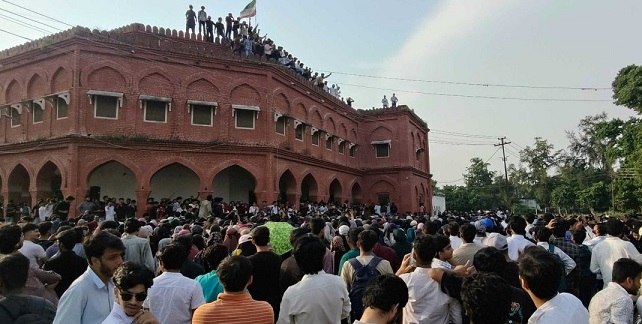
The agitation began on September 21, with students pressing the university to hold elections that had remained suspended for nearly eight years. The protest intensified as the administration faced mounting pressure to respond. Students blocked campus gates, while postgraduate student Yasir Fahad undertook a hunger strike, drawing further attention to the prolonged absence of an elected student representative body.
The announcement followed an extended period of mobilisation, with students insisting that the union was necessary to provide an organised platform for raising campus-related issues and representing the wider student community. The hunger strike became a focal point of the agitation, underlining the determination of protesters to secure a concrete commitment from the university.
Under the schedule announced by Chief Election Officer Javed Talib, the election process will begin with the display of voter lists across faculties on October 26. Students can seek corrections on October 27, when the final lists are also scheduled to be published.
Candidates will file their nomination papers on October 29, followed by scrutiny. The final list of candidates is scheduled for October 31. Candidates contesting the president’s post will deliver their speeches on November 3.
Polling will be held at the respective faculties from 9 am to 5 pm on November 5. Counting is scheduled to begin at 7 pm, with the venue to be announced later.
The immediate challenge will be to complete the election process according to the announced timetable and ensure student participation. For the university, the polls will provide an opportunity to re-establish an elected representative structure after a prolonged interruption.
For students, the announcement represents a concrete step towards restoring a formal channel for collective representation. However, the election notification alone does not establish whether the protest has formally ended.
What began as student outrage over unhygienic mess food containing insects at AMU’s Women’s College quickly snowballed into a major campus confrontation. Despite repeated appeals, authorities allegedly ignored student complaints, and protests soon broke out—during which demonstrators claimed they were physically manhandled.
With no functional student union or elected body to bridge the gap between the student body and the administration, accountability remained absent. In response, postgraduate student Yasir Fahad stepped forward to back the students, helping submit a formal memorandum demanding union elections within 48 hours.
However, instead of addressing the grievances, the university promptly suspended Fahad without issuing a prior show-cause notice, penalizing him for his role in the protests and what administration officials termed “opposition to the administration.”
The November 5 polls will now be closely watched as AMU moves towards reviving its students’ union after years of uncertainty and renewed campus mobilisation.