
Last Updated on October 10, 2026 12:48 pm by INDIAN AWAAZ
Police detain hundreds, restrict metro and rail services as CJP demands CEC Gyanesh Kumar’s resignation over voter-list revision
CJP founder Abhijeet Dipke and senior leaders Saurav Das and Ashutosh Ranka were detained by police after their flight landed at Delhi’s Indira Gandhi International Airport.
By Our Correspondents
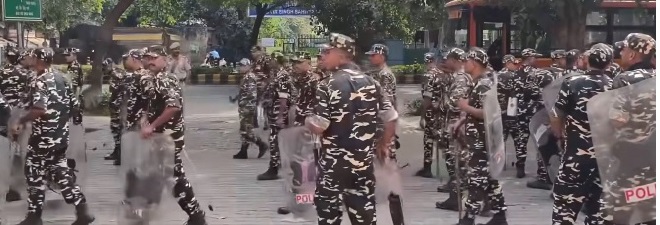
NEW DELHI: The national capital was placed under an unprecedented security lockdown on Saturday as authorities moved to prevent a planned demonstration by the Cockroach Janta Party (CJP) at Jantar Mantar, with senior movement leaders detained at the airport, protesters picked up across the city and mobile internet services suspended in parts of central Delhi.
The sweeping security measures included extensive barricading, restrictions at metro stations, disruption of some long-distance train services and the deployment of thousands of police and paramilitary personnel. The crackdown came ahead of the CJP-led protest demanding the resignation of Chief Election Commissioner (CEC) Gyanesh Kumar over alleged irregularities in the Special Intensive Revision (SIR) of electoral rolls.
CJP founder Abhijeet Dipke and senior leaders Saurav Das and Ashutosh Ranka were detained by police after their flight landed at Delhi’s Indira Gandhi International Airport. The detentions came despite the leaders’ stated intention to participate in the demonstration. Videos circulating from the airport showed them raising slogans as they were taken into custody. The movement described the action as an attempt to prevent its leadership from reaching the proposed protest site.
The action against the leadership was accompanied by a wider preventive operation. The Indian Express reported that at least 1,000 people had been detained overnight in Delhi ahead of the protest, including several hundred from the South-East district, particularly around Shaheen Bagh. The number of people detained across the country was not independently established.
Internet suspension and transport restrictions
Authorities suspended mobile internet services within a four-kilometre radius of the protest area, with the restriction scheduled to remain in force until Saturday night. The move, alongside extensive barricading and transport restrictions, was intended to prevent the mobilisation of large crowds around central Delhi.
Metro services were also affected, with restrictions or closures announced at dozens of stations. Several long-distance trains were cancelled or rescheduled, while commuters faced traffic diversions and additional security checks. Businesses and establishments in parts of the city, including Connaught Place, were advised to remain closed or adjust operations amid concerns about disruption.
The scale of the security deployment transformed the area around the proposed demonstration into a heavily guarded zone. Police erected multiple barricades and increased surveillance, while authorities warned that unauthorised gatherings would not be permitted.
The Delhi Police had denied permission for the CJP rally, citing the timing of the application, law-and-order concerns and alleged violations of conditions imposed during earlier demonstrations. Organisers, however, maintained that they intended to press ahead with their demand for accountability from the Election Commission.
Dispute over voter-list revision
The protest centres on the Election Commission’s Special Intensive Revision of electoral rolls. The CJP and other critics have raised concerns about the possible deletion of eligible voters and the transparency of the revision process. Protest organisers have claimed that more than 130 million names have been deleted nationwide, although this figure requires independent verification and should not be treated as an established count of eligible voters wrongly removed.
The Election Commission has maintained that electoral-roll revision is intended to improve the accuracy of voter lists by identifying duplicate entries, deceased electors and people who are no longer eligible to remain registered at a particular address. Critics, however, have demanded greater transparency and safeguards to ensure that eligible voters are not excluded.
The dispute has become part of a wider political debate over the conduct of elections, the independence of the Election Commission and the availability of effective remedies for people whose names may be missing from electoral rolls. The CJP has demanded Kumar’s resignation and called for accountability over the revision exercise. <Cite refs={[“turn194732search0″,”turn194732news25”]}/>
Protest rights and public order
The developments have raised questions about how authorities balance public-order requirements with the right to peaceful assembly. Police have cited the absence of permission and security concerns as reasons for restricting the gathering. The CJP, meanwhile, has criticised the detentions and restrictions as attempts to prevent its members from demonstrating.
The measures have also affected commuters, travellers and businesses operating in parts of the capital. Internet restrictions may further complicate communication for residents and visitors within the affected area.
With senior CJP leaders detained and access to the proposed protest site restricted, the immediate focus remains on whether the organisers will be able to assemble and pursue their demands through further demonstrations.
The larger dispute over electoral-roll revision remains unresolved. Its resolution will depend on transparent information about changes to voter lists, accessible procedures for correcting errors and clear responses from the authorities to concerns raised by political groups and affected voters
…….