
Last Updated on October 8, 2026 9:15 am by INDIAN AWAAZ
By Our Correspondent
LUCKNOW
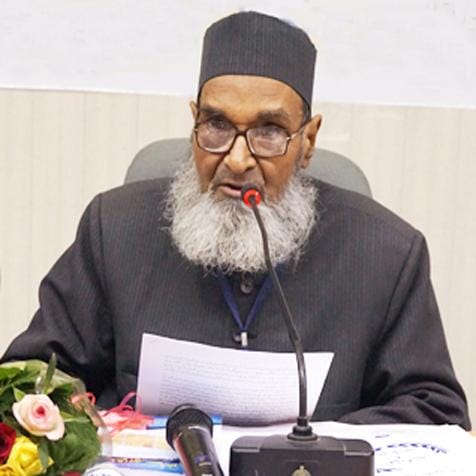
Dr Maulana Saeed-ur-Rahman Azmi Nadvi, eminent Islamic scholar, Arabic language expert, author, journalist and rector of Darul Uloom Nadwatul Ulama, Lucknow, died on Wednesday, October 7, at the age of 92. His death marks the passing of one of the most respected figures associated with the institution and with the promotion of Arabic scholarship and journalism in India.
Maulana Nadvi died at his residence in Lucknow on Wednesday afternoon after a prolonged illness. News of his demise sent a wave of grief through academic, religious and literary circles in India and abroad. Scholars, political leaders, teachers, students and former students expressed condolences and paid tribute to his long contribution to education and Islamic scholarship.
Born in 1934 in Mau in Uttar Pradesh, Maulana Saeed-ur-Rahman Azmi Nadvi began his formal education at Jamia Miftahul Uloom, Mau. He later joined Darul Uloom Nadwatul Ulama in Lucknow in 1952 for higher studies. His association with Nadwa subsequently continued for more than seven decades—as a student, teacher, scholar and administrator.
He gradually emerged as one of the institution’s senior teachers and scholars and played a major role in strengthening its academic activities. He served as head of its Arabic department and later assumed the responsibility of its administration. He became the principal or Mohtamim of Darul Uloom Nadwatul Ulama in 2000 and remained one of the institution’s most prominent academic figures.
Champion of Arabic scholarship
Maulana Nadvi’s contribution extended well beyond classroom teaching. He was widely recognised for his expertise in Arabic language and literature and played an important role in Arabic journalism in India.
He was closely associated with Al-Ba’sul Islami, the influential Arabic monthly published from Nadwatul Ulama, and became its editor in 1979. Through the journal, he helped present Indian Islamic scholarship, intellectual debates and contemporary issues to Arabic-speaking readers in India and abroad.
He was also associated with Al-Raid, another important Arabic publication, and authored and edited several works in Arabic and Urdu. His writings covered Islamic thought, contemporary intellectual questions and relations between Islam and the West. His work became the subject of academic research, particularly in the fields of Arabic journalism and literature.
His contribution to Arabic literature was recognised with the Presidential Award in 1994. He was also awarded an honorary D.Litt in 2019.
A teacher and institution builder
For generations of students at Nadwa, however, Maulana Nadvi was remembered primarily as a teacher and mentor. His approach combined traditional Islamic scholarship with a strong emphasis on Arabic language, literature, discipline and contemporary intellectual awareness.
He also served as Chancellor of Integral University, Lucknow, and remained involved in several educational and academic initiatives. He was among the founding members of the All India Muslim Personal Law Board, which honoured him with a Lifetime Achievement Award earlier this year.
His contribution was not confined to formal academic institutions. He remained involved in religious and educational activities and was respected across a wide section of the scholarly community.
His death leaves a significant void at Nadwatul Ulama and in the wider world of Arabic scholarship and Islamic education. For more than seven decades, his life remained closely intertwined with the institution, where he contributed as a student, teacher, editor, scholar and administrator.
The loss of Maulana Saeed-ur-Rahman Azmi Nadvi is therefore being seen not merely as the death of an individual scholar but as the end of an important chapter in the modern history of Nadwatul Ulama and Indian Arabic scholarship.
He leaves behind generations of students, readers and scholars who were influenced by his teaching, writings and intellectual work.