
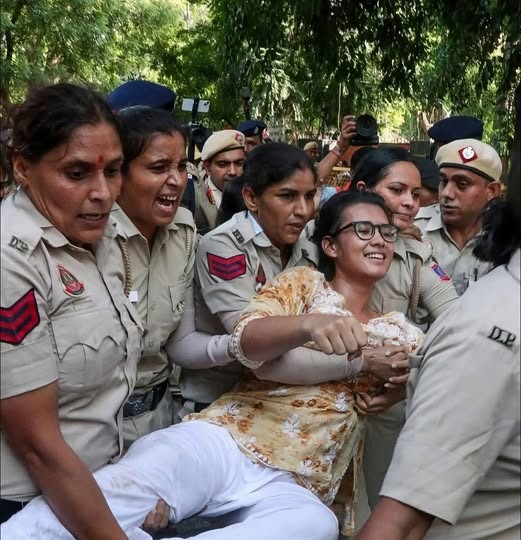
While Delhi witnessed confrontation between protesters and police, Mumbai saw one of the biggest political mobilisations against the CEC
Our Correspondents
The political confrontation over the Election Commission’s voter-roll revision intensified sharply on Sunday, with protests demanding the resignation of Chief Election Commissioner Gyanesh Kumar entering their third consecutive day in Delhi and drawing a major Opposition mobilisation in Mumbai. Student organisations, civil society activists and opposition parties accused the Election Commission of undermining electoral transparency through the Special Intensive Revision (SIR) of electoral rolls, while the Commission and the BJP rejected the allegations.
In Delhi, protesters attempted to march towards Jantar Mantar from different points, but heavy police deployment, barricades and restrictions on gatherings prevented the demonstrations from turning into a larger march. The day’s protests involved the All India Students’ Association (AISA), the Aam Aadmi Party (AAP) and other groups, with several protesters and political leaders detained.
AISA protesters confront police
Sunday’s AISA demonstration began near Andhra Bhawan Circle on Ashoka Road, from where activists attempted to proceed towards Jantar Mantar. Police had erected barricades along the route, leading to brief clashes as demonstrators tried to cross them.
AISA national president Neha Bora was among those detained. Videos circulated during the protest showed protesters attempting to climb or cross barricades as police personnel tried to stop them. The organisation later alleged that Bora had been taken away in a private vehicle. Delhi Police rejected the allegation, saying she was transported in a government vehicle accompanied by two women police personnel. She was subsequently released.
The AISA protest was the third consecutive day of demonstrations by the student group against Kumar. Activists have linked their demand for his resignation to allegations of irregularities in SIR and concerns over the deletion or exclusion of eligible voters from electoral rolls.
The agitation followed two days of protests in the capital during which hundreds of people were detained. According to reports, more than 500 protesters were detained on Friday, while over 150 were detained on Saturday. The protesters included AAP leaders, student activists, Left leaders and civil society figures.
AAP workers detained at India Gate
A separate AAP demonstration was organised at India Gate, with party workers demanding Kumar’s resignation. Delhi AAP chief Saurabh Bharadwaj and party MLA Sanjeev Jha were among those detained. Police said at least 25 AAP workers were taken into custody during the protest.
Bharadwaj alleged that police used excessive force while detaining him. He later posted a photograph on social media claiming that Delhi Police had turned him upside down while taking him into custody. Police have not accepted the allegation as established fact.
The AAP said concerns over voting rights should be addressed through transparency rather than what it described as pressure and police action. The party has made the Election Commission controversy a major part of its current political campaign against the Centre.
Police restrictions dominate Delhi protests
The Delhi Police had refused permission for the larger protests and imposed restrictions on public assembly in parts of central Delhi. Roads leading towards Jantar Mantar were barricaded, while substantial police and paramilitary deployments were made to prevent protesters from moving towards restricted areas.
The police action has itself become an important issue in the political confrontation. Opposition leaders have accused the authorities of attempting to suppress peaceful demonstrations, while the police have maintained that protesters were violating restrictions and that action was necessary to maintain law and order.
The protests have already resulted in multiple FIRs. Police have cited alleged disobedience of official orders, obstruction of public servants and other offences in cases registered following Friday’s demonstrations.
Journalists’ complaints add to controversy
The situation became more contentious on Saturday after three women journalists complained that they were manhandled and subjected to alleged sexual misconduct by Delhi Police personnel while covering the protests near Jantar Mantar.
The journalists filed complaints with the police, following which the allegations were transferred to the Crime Branch for investigation. Delhi Police said the complaints would be examined through a fair and impartial inquiry and that CCTV footage and other available evidence would be reviewed.
The allegations triggered fresh criticism from Opposition leaders and journalists’ groups. Several journalists subsequently gathered outside Parliament Street police station demanding action against the personnel named in the complaints.
The episode has widened the controversy from the conduct of the Election Commission to the handling of protests by the Delhi Police, which comes under the Union Home Ministry.
Opposition prepares wider Delhi mobilisation
The protests are part of a broader campaign announced by the INDIA bloc following a meeting of Opposition parties in New Delhi on September 30. The parties have planned a series of demonstrations between October 2 and 8, followed by further nationwide action.
The Opposition has announced that its MPs will march towards the Election Commission’s office in Delhi on October 6. The grouping has also announced a larger rally in the national capital later in the month.
The Opposition’s campaign goes beyond the demand for Kumar’s resignation. It includes allegations of voter deletions, questions over the conduct of SIR, demands for greater transparency in electoral-roll revision and concerns over the functioning and independence of the Election Commission.
The controversy gained further momentum following reports that Election Commissioners Sukhbir Singh Sandhu and Vivek Joshi had raised objections on several occasions to decisions relating to SIR. An investigation published by The Indian Express reported at least 14 such objections over a 10-month period. The Election Commission has said that differences of view are normal in institutional deliberations and maintained that its orders have legal sanction.
Major mobilisation in Mumbai
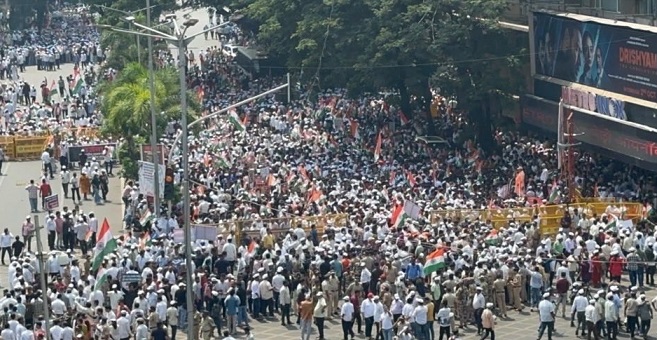
While Delhi witnessed confrontation between protesters and police, Mumbai saw one of the biggest political mobilisations against the CEC.
Shiv Sena (UBT) chief Uddhav Thackeray and Maharashtra Navnirman Sena chief Raj Thackeray joined hands for the Virat Garjana Morcha, a joint march against Kumar and the SIR exercise in Maharashtra. Congress and Sharad Pawar-led NCP (SP) leaders also participated.
The march began at Metro Cinema in south Mumbai and proceeded towards the Brihanmumbai Municipal Corporation headquarters. In an unusual political display, participants were asked to carry the national tricolour instead of party flags, with organisers seeking to portray the agitation as a broader campaign over electoral rights.
The two principal demands were Kumar’s resignation and cancellation of SIR in Maharashtra. Raj Thackeray also demanded that electronic voting machines be replaced by ballot papers.
Uddhav Thackeray accused the Election Commission of facilitating what he described as large-scale voter deletions, while Raj Thackeray questioned the basis of the SIR exercise. Their allegations, however, remain contested by the Election Commission and the BJP.
The Mumbai mobilisation was significant because it brought the estranged Thackeray cousins together on a common political platform after years of political separation.
Government and Election Commission reject allegations
The BJP and Election Commission have strongly rejected the Opposition’s allegations that SIR is designed to favour the ruling party.
The Commission has maintained that electoral-roll revision is necessary to identify and remove duplicate, deceased and otherwise ineligible entries, while ensuring that eligible voters are not excluded. The poll panel has also argued that electoral-roll decisions are taken within the statutory framework.
The BJP, meanwhile, has accused the Opposition of attacking an independent constitutional institution after suffering electoral setbacks.
The central political dispute therefore centres on two competing narratives: the Opposition argues that SIR and other recent electoral measures risk excluding genuine voters, while the government and Election Commission maintain that the exercise is aimed at improving the accuracy and integrity of electoral rolls.
Kerala probe adds another dimension
The controversy also acquired a new dimension on Sunday after the Kerala Home Department ordered the reopening of a Vigilance and Anti-Corruption Bureau inquiry concerning alleged irregularities in a road-related project from 2006, when Kumar was serving as Kerala’s Public Works Department secretary.
Kerala Home Minister Ramesh Chennithala, who also handles the Vigilance portfolio, said the decision followed a fresh complaint alleging that the earlier investigation had been compromised. The state government has indicated that the decision is based on the fresh complaint and is separate from the present political controversy surrounding SIR.
Agitation set to continue
With further Opposition protests scheduled in Delhi and elsewhere, the confrontation over the Election Commission is unlikely to subside soon.
The immediate flashpoint will be the proposed October 6 march by Opposition MPs to the Election Commission’s office, while civil society and youth groups are expected to continue their independent mobilisation.
The Cockroach Janta Party has also announced another protest in Delhi on October 10 if Kumar does not resign.
What began as a dispute over the voter-roll revision has now developed into a wider political confrontation involving the Election Commission, the Central government, Opposition parties, student organisations and civil society groups. With allegations of voter exclusion being met by official denials and an increasingly forceful police response to demonstrations, the Gyanesh Kumar controversy is emerging as a major national political issue centred on the larger question of electoral transparency and institutional credibility.