
Last Updated on August 21, 2026 11:03 pm by INDIAN AWAAZ
By Our Correspondent
The Delhi Police has registered an FIR against unknown persons in connection with the alleged pellet-gun injuries suffered by 19-year-old student protester Sahil Lochab during a July 20 demonstration in the national capital, following a day-long sit-in by Leader of Opposition in the Lok Sabha Rahul Gandhi outside a Delhi police station.
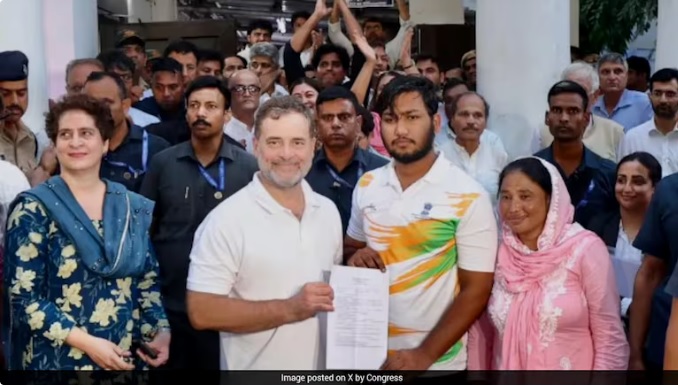
Gandhi, accompanied by Lochab and his family, had staged a dharna demanding that the police formally register a case into the alleged use of a pellet gun during the student protest at Jantar Mantar. He had said he would remain outside the police station for as long as necessary until an FIR was registered.
The police subsequently collected Lochab’s medical report and other relevant documents before registering the case on the basis of his complaint. The FIR has been filed against unidentified persons.
“This is the first step towards justice,” Gandhi told reporters after the FIR was registered. He said the incident had taken place nearly a month earlier and alleged that pellets remained lodged in Lochab’s body, including three in his eye.
Gandhi questioned the delay in registering the case and said the development demonstrated the difficulties faced by ordinary citizens in seeking justice.
“We came here at around 11:30 this morning… Now it is 6:30, almost 7 pm, and only then has the FIR been registered,” Gandhi said, adding that the police station was located in the heart of New Delhi.
He argued that if it could take several hours to register a complaint in the national capital, the situation could be even more difficult for people approaching police stations in villages and smaller towns.
Gandhi maintained that his presence outside the police station was aimed solely at seeking justice for Lochab and his family.
“We have done nothing wrong here. We have only sought justice for an Indian citizen, for his mother and for his father,” he said.
The Congress leader also spoke directly to Lochab’s mother, who had joined the protest, asking whether she was satisfied after the FIR was finally registered.
Lochab, speaking to reporters, said he had retained faith that the complaint would eventually be registered. He thanked Gandhi for accompanying him and said citizens should not allow themselves to be silenced when seeking justice.
The FIR marks a significant development in a controversy surrounding the July 20 student protest and allegations of excessive use of force by security personnel.
Police Had Cited Supreme Court Panel
Before registering the FIR, the Delhi Police had informed Gandhi that the Supreme Court had constituted a High-Powered Expert Committee (HPEC) to examine allegations concerning excessive and disproportionate use of force by police and paramilitary personnel during student protests.
The police had cited the committee while declining to immediately register an FIR, prompting Gandhi to continue his protest outside the police station.
The Supreme Court panel has been tasked with examining allegations surrounding the handling of the protests, including claims of excessive force against demonstrators as well as allegations of violence against security personnel.
The issue has consequently acquired a wider legal and political dimension, with questions being raised over the conduct of security forces and the manner in which complaints from protesters should be investigated.
Gandhi Raises Concern Over Pellet Injuries
During his dharna, Gandhi alleged that Lochab had been peacefully protesting at Jantar Mantar on July 20 when police personnel used a pellet gun against him.
In a post on X, the Congress leader said the alleged firing had put Lochab’s vision in one eye at risk.
The allegations made by Gandhi and Lochab form the basis of the complaint, while the police investigation will determine the circumstances in which the injuries were sustained and identify those responsible.
The registration of an FIR does not by itself establish the allegations as proven. The investigation will have to establish the sequence of events, identify the alleged perpetrators and determine whether the use of force was lawful and proportionate.
Political Controversy Intensifies
The episode has added another flashpoint to the continuing political dispute over the student protests and the government’s handling of demonstrations in the capital.
The Congress has accused the authorities of using excessive force against students and protesters, while the government and security agencies have maintained that law enforcement personnel had to respond to situations involving public order and security.
Gandhi’s decision to personally accompany Lochab to the police station and stage a prolonged protest has given the issue additional political visibility.
The Congress leader said the delay in registering the FIR raised broader questions about access to justice and accountability within the police system.
The development also comes against the backdrop of the Supreme Court’s decision to constitute a high-powered panel to examine allegations relating to the use of force during the protests. The committee’s findings could therefore become important in determining the broader circumstances surrounding the clashes and the alleged injuries suffered by protesters.
For Lochab and his family, however, the registration of the FIR represents the beginning rather than the conclusion of the process. The investigation will now determine the circumstances behind his injuries, the source of the alleged pellet firing and whether any police personnel or other individuals were responsible.
The case is likely to remain under close political and judicial scrutiny as the investigation progresses and the Supreme Court-appointed panel examines the wider allegations surrounding the July 20 student demonstrations.