
Last Updated on June 17, 2026 11:57 pm by INDIAN AWAAZ
Staff Reporter / WEB DESK
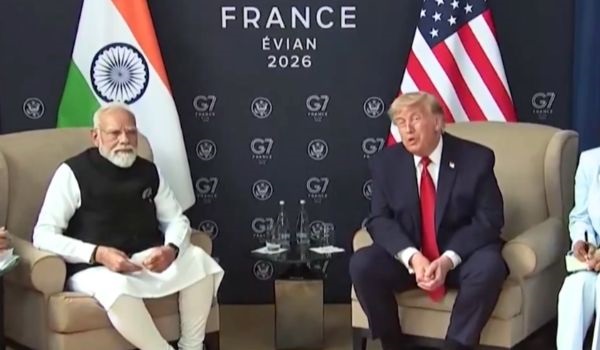
Prime Minister Narendra Modi underlined the strategic importance of keeping the Strait of Hormuz open for global economic stability during his bilateral meeting with US President Donald Trump on the sidelines of the G7 Summit in Evian. Emphasising the need to safeguard freedom of navigation, Mr Modi said uninterrupted maritime movement remains critical for international trade and energy security.
Highlighting India’s global maritime presence, the Prime Minister noted that lakhs of Indian seafarers are serving across international shipping routes and stressed that their safety and security must remain a priority amid regional uncertainties.
Mr Modi also welcomed the progress in diplomatic efforts aimed at restoring peace in West Asia and expressed hope for lasting stability in the region. Referring to India-US economic engagement, he said discussions on trade cooperation are moving forward positively and reflected confidence in continued momentum in bilateral ties.
Earlier, on the margins of the meeting in Evian, Prime Minister Modi and German Chancellor Friedrich Merz today exchanged views on regional and global developments, including the situation in West Asia and the Russia-Ukraine conflict. The two leaders also reviewed the progress in bilateral engagements and expressed satisfaction at the renewed momentum in the India-Germany Strategic Partnership, with the successful visit of Mr Merz to India and the conclusion of the India-EU FTA negotiations earlier this year.
As India and Germany celebrate the 75th anniversary of diplomatic ties in 2026, the two leaders reaffirmed their commitment to further strengthen cooperation across diverse sectors, including trade and investment, defence and security, green and sustainable development, technology, innovation, education and mobility.
They welcomed the signing of the Defence Industrial Cooperation Roadmap and the operationalisation of a transit visa waiver for Indian nationals transiting through Germany. Mr Merz invited the Prime Minister for the 8th India-Germany Inter-Governmental Consultations (IGC) scheduled to be held later this year in Germany.
Prime Minister Modi also held a meeting with President of the European Commission Ursula von der Leyen and President of the European Council António Costa on the sidelines of the Summit. The leaders exchanged views on regional and global issues of mutual interest and welcomed recent developments in West Asia.
They reaffirmed their shared commitment to promoting a resilient multipolar global order that supports peace, stability, prosperity and sustainable development. The leaders noted the recent conclusion of negotiations on the India-European Union Free Trade Agreement, describing it as a historic achievement.
Earlier in the day, Prime Minister Modi also addressed a crucial working session themed “Promoting balanced, inclusive and sustainable economic growth for the benefit of all” at the ongoing G7 Summit in Evian, France. In his address, the Prime Minister underscored the need for international financial institutions to develop mechanisms that impart economic resilience to developing countries.
He also proposed connectivity projects linking Africa, Latin America and the Pacific Island countries. He also suggested the creation of International Mobilization Partnership for Accelerating Connectivity and Trade (IMPACT), in which G7’s capital, India’s talent and Global South’s ownership could be combined. During the session Mr Modi also highlighted that tangible growth leads to inclusion and well-being of the people and spoke about India’s growth story underpinned by “Sabka Sath, Sabka Vikas, Sabka Vishwas, Sabka Prayas”.
The high-level session was attended by G7 member nations, partner countries, and key representatives from the International Monetary Fund and the OECD. PM Modi also participated in a working lunch focused on “Ensuring the safe, rapid and effective deployment of artificial intelligence. The meeting brought together G7 member countries, partner nations, and the CEOs of leading AI companies to discuss the future of digital innovation. inputs from Parsar Bharti