

Last Updated on March 6, 2026 2:23 pm by INDIAN AWAAZ
Andalib Akhter / New Delhi
Accusing the Indian government of “complicity” in the escalating U.S.-Israel conflict with Iran, the All India Kisan Sabha (AIKS) has said that India’s economic and agricultural interests have been severely affected by the ongoing war. In a statement the farmers’ organisation demanded an immediate and comprehensive relief package for farmers, agricultural labourers and exporters who, it said, are bearing the brunt of disruptions caused by the conflict.
In a strongly worded statement issued in New Delhi, AIKS claimed that the escalating conflict in West Asia has triggered a chain reaction affecting crude oil supply, international trade routes and agricultural exports from India. The organisation accused the government of failing to respond adequately to the crisis and called for urgent intervention to prevent severe economic losses in the farming sector.
Rising Oil Prices and Currency Pressure
According to the farmers’ body, the war has led to a sharp increase in global crude oil prices. Brent crude prices have reportedly surged to around $84 per barrel in the past week amid growing concerns over supply disruptions.
Economists note that for India—one of the world’s largest crude importers—even a $1 increase in oil prices can raise the country’s import bill by nearly $2 billion annually. The increase in energy costs, AIKS said, is likely to affect agriculture directly by raising transportation costs and the price of key inputs.
The organisation also pointed to volatility in the Reserve Bank of India-managed currency market. The Indian rupee on March 5 was hovering around ₹91.82 per US dollar, after central bank intervention helped stabilise the currency amid global uncertainty.
Higher import costs and currency pressure could significantly impact fertilizer production and availability, AIKS warned. Since fertilizer manufacturing relies heavily on petroleum derivatives, rising crude prices may push up fertilizer costs during the upcoming agricultural season unless the government expands subsidy allocations.
Strait of Hormuz Disruptions Impact Exports
Another major concern raised by the farmers’ organisation is the disruption of shipping through the Strait of Hormuz, a crucial maritime corridor connecting the Persian Gulf with international markets.
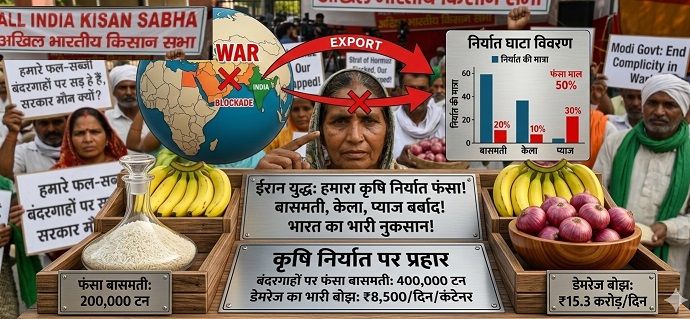
India’s agricultural exports to Gulf countries depend heavily on this route. AIKS estimates that nearly 56% of India’s merchandise exports to West Asia pass through this corridor, and the ongoing conflict has severely slowed shipping operations.
As a result, thousands of tonnes of agricultural produce destined for Gulf markets are currently stranded at ports or in transit, threatening the incomes of farmers and exporters.
Export Disruptions Across Key Crops
AIKS released data compiled from farmer groups and exporters to highlight the scale of the crisis affecting several agricultural commodities:
Basmati Rice:
Nearly 400,000 tonnes of Basmati rice, valued at approximately ₹3,200 crore, are reportedly stuck in the export pipeline—half at Indian ports and half in transit at sea. Farm-gate prices have fallen by nearly 6% within four days, affecting an estimated 2.5 to 3 million farming households, particularly in Haryana and parts of Punjab.
Bananas:
Around 1,200 export containers from Solapur in Maharashtra are currently stuck in cold storage facilities as shipments to Gulf markets remain suspended. Farmers are reportedly facing demurrage charges of about ₹8,500 per container per day, adding to their financial burden.
Grapes:
Exporters estimate that nearly 6,000 tonnes of grapes are at risk of spoilage. About 300 containers originally prepared for export may now be forced into domestic markets, where prices are significantly lower.
Onions:
Approximately 5,400 tonnes of onions from Nashik are reportedly lying stranded at Jawaharlal Nehru Port Trust near Mumbai. With Gulf markets such as Dubai disrupted, exporters fear substantial losses due to spoilage and falling domestic prices.
Poultry:
The poultry sector has also been affected, with nearly 8 million eggs per day meant for Gulf markets unable to be exported. The surplus supply in domestic markets has reportedly led to a sharp fall in prices.
Employment Impact:
AIKS estimates that in the Basmati-producing regions alone, approximately 1.6 crore person-days of work for landless agricultural labourers could be lost if the export crisis continues.
AIKS Demands Immediate Relief Package
In response to the crisis, the farmers’ organisation has demanded a multi-pronged emergency relief package from the central government.
Among the key demands are:
1. Direct Financial Assistance:
A one-time emergency compensation of ₹50,000 per hectare for farmers cultivating export-oriented crops such as Basmati rice, bananas, grapes, pomegranates and mangoes.
2. Government Procurement:
Central agencies such as NAFED and the Food Corporation of India should immediately procure stranded perishable produce to prevent distress sales. AIKS suggested procurement prices of ₹35 per kg for onions and ₹25 per kg for bananas.
3. Subsidy for Stranded Produce:
An immediate ₹2,500 per quintal subsidy for commodities affected by export disruptions.
4. Waiver of Port Charges:
All demurrage, warehousing and storage charges resulting from the crisis should be waived or compensated by the government.
5. Loan Moratorium:
AIKS called for a complete waiver of agricultural loan repayments and interest for affected farmers to prevent them from falling into a debt trap.
6. Support for Workers:
The organisation proposed a special compensation fund providing ₹10,000 per month to port workers, loaders and agricultural labourers who have lost employment due to halted export operations.
Policy Concerns and Political Demands
Beyond immediate relief measures, AIKS also urged the government to review trade and foreign policy decisions that it claims have exposed Indian agriculture to global geopolitical shocks.
The organisation demanded reconsideration of recent trade agreements with the United States and called for agriculture to be kept outside future international trade negotiations.
AIKS also urged India to avoid participation in geopolitical alliances such as I2U2 and the Quadrilateral Security Dialogue, arguing that such arrangements could draw India deeper into geopolitical conflicts.
Warning of Farmer Protests
Concluding its statement, AIKS warned that the crisis has already begun to affect rural livelihoods across several states and could trigger widespread discontent if not addressed quickly.
“The economic shock caused by disruptions in the Strait of Hormuz is now being felt in villages across India,” the organisation said. It cautioned that if the government fails to provide relief, farmers could launch protests similar to—or larger than—the nationwide 2020–2021 Indian farmers’ protest.
The government has not yet issued an official response to the AIKS statement. Economists, however, say the evolving situation in West Asia could have far-reaching implications for India’s agriculture, trade and energy security if the conflict continues.