
Last Updated on January 4, 2026 11:41 pm by INDIAN AWAAZ
Is this a comeback—or a quiet admission of a leadership vacuum ahead of 2026?
Aafreen Hussain / Kolkata
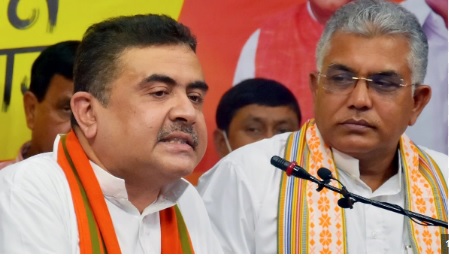
Dilip Ghosh is back—and his return has triggered more unease than celebration within West Bengal’s political landscape.
After months of political silence, organisational marginalisation and successive electoral setbacks, the former state BJP president has suddenly been brought back to the forefront. Notably, this move came immediately after Union Home Minister Amit Shah’s recent visit to Bengal. The timing appears far too precise to be coincidental, raising an uncomfortable question: if all was well within the Bengal BJP, why was Dilip Ghosh urgently needed again?
While the party projects this as a “comeback,” politically it looks less like a revival and more like a compulsion.
A Return That Raises Questions
Dilip Ghosh was gradually sidelined after being denied a ticket from Medinipur, followed by his defeat in Bardhaman–Durgapur and his near-disappearance from organisational visibility. For a considerable period, the Bengal BJP functioned as though the Ghosh chapter had definitively closed.
Yet, as the 2026 Assembly elections draw closer, the same leadership has turned back to him. The obvious question is: why now?
Is the party struggling to nurture a new mass leader? Has the current leadership failed to energise the grassroots? Or does this signal a tacit admission that the BJP’s electoral firepower in Bengal is thinning?
A stable organisation does not usually need to resurrect its old warhorses.
Three Faces or Strategic Confusion?
The BJP is now reportedly heading into the 2026 battle with what insiders describe as a “trifocal strategy,” revolving around Shamik Bhattacharya, Suvendu Adhikari and Dilip Ghosh. But is this a well-thought-out plan—or a symptom of uncertainty?
If the party had a clear chief ministerial face, why three leaders? If leadership was settled, why the sudden redistribution of roles?
Multiple faces often mean multiple power centres—and multiple power centres rarely translate into electoral clarity.
The Grassroots Question
Dilip Ghosh continues to enjoy acceptance among grassroots workers, particularly in North Bengal. However, this itself highlights a deeper concern: has the BJP failed to cultivate a second-rung mass leader over the years?
If Ghosh remains the party’s most reliable bridge to the cadre base, it prompts an uncomfortable reflection on what the organisation-building exercises have actually achieved. Is the party returning to its past because it is unable to clearly imagine its future?
Respectful Revival or Electoral Firefighting?
Is Dilip Ghosh being positioned as a future chief ministerial contender—or merely deployed as an emergency measure to revive morale ahead of the elections?
The real test will come after 2026. If the BJP falls short again, will Ghosh once more be quietly eased out? Or is he now being groomed as a long-term anchor for the party in Bengal?
The Unanswered Question
Ultimately, is this the revival of Dilip Ghosh—or a silent confession by the Bengal BJP? A confession of the absence of a new mass leader. A lack of a clear leadership roadmap. And uncertainty about the path beyond recycling familiar faces.
Sometimes, political comebacks do not signal strength. They reveal desperation. And Bengal is watching closely.