
Last Updated on January 4, 2026 11:27 pm by INDIAN AWAAZ
Kolkata | Shankar Jalan
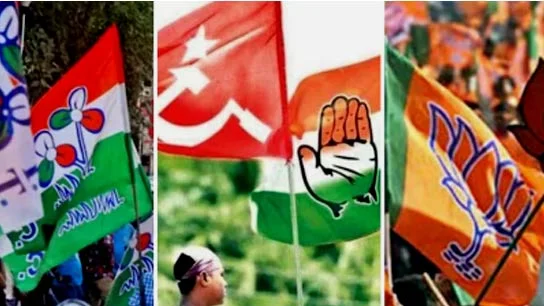
With West Bengal Assembly elections expected in the next four to five months, the political landscape in the state is shaping up for what could be a rare four-way contest. The ruling Trinamool Congress (TMC), led by Chief Minister Mamata Banerjee, is aiming for a decisive mandate in the April–May polls, while the Bharatiya Janata Party (BJP) is determined to form its first government in the state. At the same time, both the Congress and the Left Front are seeking to reclaim the political ground they have steadily lost over the past decade.
The Congress has further complicated the electoral arithmetic by announcing that it will contest the elections on its own, ruling out any alliance with the Left Front. State Congress president Shubhankar Sarkar said public sentiment favours an independent Congress campaign and claimed the party has sufficient organisational strength to go solo. He added that the party’s decision has been conveyed to the central leadership.
The Trinamool Congress has remained in power since 2011, winning three consecutive Assembly elections under Mamata Banerjee. In the 2021 polls, the TMC contested alone and secured a resounding victory, while the Congress–Left alliance failed to make an impact. The BJP, however, emerged as the principal opposition, registering a historic performance by winning 77 seats.
Ahead of the upcoming elections, there was speculation about a possible revival of the Congress–Left alliance. However, the Congress’s clear rejection of such a tie-up has made a four-cornered contest increasingly likely, with the TMC, BJP, Congress and Left Front all fighting independently.
In addition to these major players, several smaller parties — including Mayawati’s Bahujan Samaj Party (BSP), Humayun Kabir’s Janata Unnayan Party (JUP), Asaduddin Owaisi’s All India Majlis-e-Ittehadul Muslimeen (AIMIM) and Pirzada Qasim’s Indian Secular Front (ISF) — are also expected to field candidates. While these parties may not secure significant representation, their presence could influence vote shares and alter the outcome in closely contested constituencies, making the upcoming election one of the most unpredictable in recent years.