
Last Updated on December 30, 2025 1:12 am by INDIAN AWAAZ
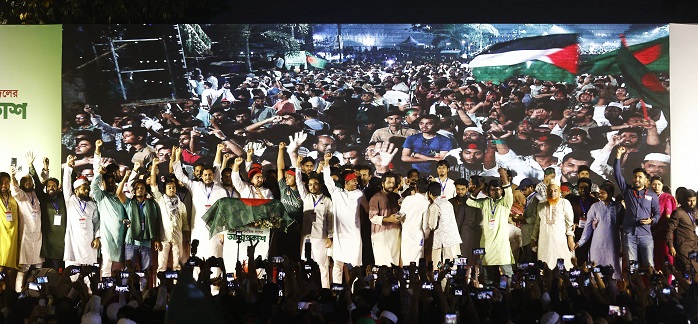
Zakir Hossain from Dhaka
Bangladesh’s youth-driven National Citizen Party (NCP), born out of the 2024 July uprising that toppled Sheikh Hasina’s government, is facing its biggest internal crisis after entering an electoral alliance with Islamist party Jamaat-e-Islami, a move that has triggered open rebellion within its ranks.
At least 30 senior NCP leaders have publicly opposed the alliance announced on Sunday, with several resigning in protest. Bangladesh is scheduled to go to the polls on February 12 in an election widely seen as a direct contest between the BNP and Jamaat, following the banning of the Awami League after Hasina’s ouster.
Before the alliance, opinion polls had predicted Jamaat to finish a close second behind the BNP, while the NCP lagged in third place. Analysts say the tie-up risks diluting the NCP’s core identity as a centrist, youth-led alternative to Bangladesh’s traditional power blocs.
“The NCP presented itself as a youth-driven alternative to entrenched politics. That identity is now under serious strain,” said academic HM Nazmul Alam. “Youth movements don’t collapse just by losing elections. They collapse when they lose clarity and internal unity.”
Defending the alliance, NCP convenor Nahid Islam said escalating violence and the killing of July uprising leader Sharif Osman Hadi forced the party to seek broader political unity. “The dictatorship we overthrew is trying to sabotage the election through violence. For the sake of greater unity, we have reached an electoral understanding with Jamaat,” Nahid told reporters, adding that the decision was taken by a majority within the party.
Hadi, 32, was shot in the head by masked assailants in Dhaka earlier this month while launching his election campaign as an independent candidate. Police say they have identified the attackers, though no arrests have yet been made. The backlash has been particularly strong among the party’s senior and female leaders. Tasnim Jara, a senior NCP leader and UK-trained doctor, resigned over the decision and announced she would contest the election as an independent. “I promised the people that I would fight to build a new political culture,” she wrote on Facebook. “Whatever the circumstances, I am determined to keep that promise.”
Political analyst Asif Shahan of Dhaka University warned the alliance would primarily benefit Jamaat. “If you go with Jamaat, it helps Jamaat, not you,” he said. “It gives them a liberal cover, while your centrist idea and ideology, already poorly defined, will simply vanish.”
The NCP was formed earlier this year by leaders of the Students Against Discrimination movement, a Gen-Z-led platform that spearheaded the July protests. While the party says it aims to dismantle decades of nepotism dominated by the Awami League and BNP, analysts say limited organisational depth, funding constraints and unclear positions on women’s and minority rights have weakened its electoral prospects.
The crisis underscores the difficulty of translating street power into electoral success, a challenge that observers say offers lessons for neighbouring Nepal, where youth-led protests recently unseated the government and elections are due in March.
July uprising strategist Mahfuj Alam distances himself from NCP over Jamaat-e-Islami alliance
Mahfuj Alam, a key strategist behind Bangladesh’s 2024 July uprising, has distanced himself from the National Citizen Party (NCP) amid internal discord over its alliance with Jamaat-e-Islami.
In a Facebook post, Alam said he would not be “part of this NCP,” following resignations by senior leaders and a memorandum signed by 30 party officials opposing the alliance. “Under the prevailing circumstances, my respect and affection for my July comrades remain, but I am not becoming part of this NCP,” Alam wrote, rejecting speculation about contesting elections under the Jamaat-NCP banner.
Alam, a former information and broadcasting adviser, was earlier described by interim chief Muhammad Yunus as the “brain behind the whole revolution” during a US visit in 2024. Though he holds no formal post, Alam is widely seen as NCP’s ideological guide. The memorandum opposing the alliance cited Jamaat’s role during the 1971 Liberation War and alleged infiltration by its student wing, Chhatra Shibir, as incompatible with NCP’s values.