
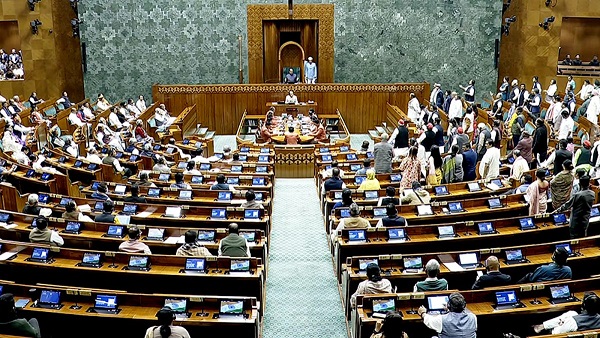
ANDALIB AKHTER / NEW DELHI
In a major step aimed at reshaping India’s nuclear power landscape, the Lok Sabha on Wednesday passed the Sustainable Harnessing and Advancement of Nuclear Energy for Transforming India (SHANTI) Bill, 2025, bringing to an end more than six decades of exclusive state control over the sector. The Bill was approved through a voice vote, even as the Opposition staged a walkout, alleging dilution of nuclear liability norms.
The Opposition argued that the legislation weakens key provisions of the Civil Liability for Nuclear Damage Act (CLNDA), 2010, which had placed liability for nuclear accidents on suppliers of nuclear equipment. The government, however, maintained that the changes are essential to unlock investment, attract global technology providers and accelerate capacity addition.
A defining feature of the SHANTI Bill is the removal of the government’s monopoly, allowing Indian private companies to build, own and operate nuclear power plants for the first time. The Bill also addresses long-standing concerns of international equipment suppliers by removing the ‘right of recourse’ against them for defects, unless such liability is explicitly provided for in contractual agreements.
Under the new framework, operator liability has been capped at the rupee equivalent of 300 million Special Drawing Rights (SDR), or a higher amount as may be notified by the Central government. This cap is seen as a critical reform to bring India’s liability regime closer to global standards.
The SHANTI Bill repeals and replaces the Atomic Energy Act, 1962, and the CLNDA, 2010, creating a single, unified legal framework for the nuclear sector. The government said the legislation will play a pivotal role in helping India achieve its ambitious target of 100 GW of nuclear power capacity by 2047, while strengthening energy security and supporting the country’s clean energy transition.
Replying to a debate on the Bill, Minister of State for Atomic Energy, Dr Jitendra Singh, said the Bill strengthens mechanisms related to safety, security, safeguards, quality assurance and emergency preparedness. He said the government has given more authorisation and independence to private parties involved.
Dr Singh said the entire world is moving towards clean energy, and the government has set a target of achieving 100 gigawatts of nuclear energy capacity by 2047. He said, to achieve the target of Net Zero Emissions, to meet the country’s growing energy needs and realise the vision of Aatmanirbhar Bharat, it is essential to reduce dependence on fossil fuels and petroleum.
Dr Singh said, this is not a new Bill, but the Government has modified certain aspects. He said, this Bill will give a new direction to the country’s developmental journey. Dr Singh said the Bill was necessary to address India’s growing energy needs and increase the share of nuclear power up to 10 per cent of the energy mix. The Minister said, nuclear energy will be a more reliable source of energy.
Participating in the discussion, Manish Tewari of Congress opposed the Bill and raised concerns over several new clauses in the Bill, including the exemption of liability of suppliers of nuclear products. He noted that India is still not a member of the Nuclear Supplier Group. Mr Tewari also said that this bill needs to be re-examined and demanded that it should be sent to the Joint Parliamentary committee.
Shashank Mani of BJP said, this bill will give a new impetus to the country and propel the chariot of a Developed India forward. He said the new legislation will benefit the countrymen, taking the nation ahead in energy security.
Opposing the Bill, Sougata Ray of Trinamool Congress said that it seeks to give an entry for private players into the nuclear energy space.
DMK’s Arun Nehru opposed the Bill and spoke about the disadvantages of allowing the private sector to enter sensitive fields such as nuclear energy.
Supporting the Bill, Dr Alok Kumar Suman of JD (U) said, this legislation is a significant step towards controlled and sustainable use of nuclear energy in the country.
Supporting the Bill, Krishna Prasad Tenneti of TDP said, the Sustainable Harnessing and Advancement of Nuclear Energy for Transforming India, SHANTI Bill, 2025, the very name of the Bill reflects the Nation’s resolve to harness nuclear energy responsibly and strategically.
He said, the country’s journey in atomic energy is deeply rooted in scientific temperament and national foresight. Remembering the architect of India’s nuclear programme, Dr Homi Jehangir Bhabha, Mr Tenneti said, Dr Bhabha viewed atomic energy as a driver of development and self-reliance.
Shashi Tharoor of Congress said a provision in the bill allows the central government to exempt any plant from license or liability if the risk is insignificant. Terming the provision of the Bill as dangerous, Mr Tharoor said it creates a backdoor through which any facility can escape oversight if the government deems it convenient.
Dr Rabindra Narayan Behera of BJP said, with strong Research and Development, the country has been able to achieve self-reliance in nuclear technology. He said, India has been carrying out the Nuclear Programme in a responsible manner.
Sudama Prasad of CPI (ML) termed the legislation as anti-public and anti-environment. He alleged that it goes against national security. He said the Bill will lead to monopolisation of the energy sector leading to a hike in electricity rates and trouble for people.
Abdussamad Samadani of IUML said, the bill is conspicuously silent on long-term radioactive waste management. He said, by handing over such a sensitive sector to corporate hands, the legislation opens the door to regulatory capture and erosion of sovereign control.
Opposing the Bill, Pushpendra Saroj of Samajwadi Party said, nuclear power should never be used, keeping national and people’s security at stake. He said, the Bill is against what India stands for.