
Last Updated on August 19, 2025 10:40 pm by INDIAN AWAAZ
Staff Reporter / New Delhi
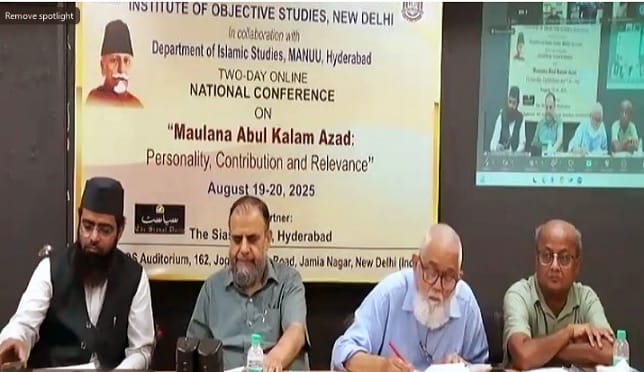
— A two-day national conference on the life and legacy of Maulana Abul Kalam Azad, jointly organized by the Institute of Objective Studies (IOS) and the Department of Islamic Studies at Maulana Azad National Urdu University, concluded with speakers paying rich tributes to his multifaceted personality.
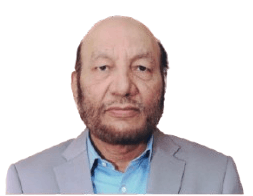
In his inaugural address, the university’s Vice-Chancellor, Professor Ainul Hasan, stated that while “no single person possesses everything, Maulana Abul Kalam Azad’s personality was such that you could say he had it all.” Professor Haq described him as “a king whose voice was not heard” and “the voice of diversity in unity.” He highlighted Maulana’s profound influence on great personalities like Allama Shibli and Mahatma Gandhi.
Contributions to Nation-Building
Professor Aftab Kamal Pasha, former Director of the Gulf Studies Program at JNU, called Maulana “a true nation-builder” and a “selfless advocate and fighter for freedom and national unity.” He emphasized that Maulana’s greatest contribution was establishing a robust framework for primary and secondary education and promoting a research culture in higher education. Professor Pasha added that Maulana’s sacrifices for the preservation of the country’s tolerant social fabric and cultural values will always be remembered.
Professor Afshar Alam, Vice-Chancellor of Jamia Hamdard, described Maulana as a “multi-faceted personality,” a freedom fighter, and a national leader. He noted that Maulana was the youngest freedom fighter and the youngest president of the Indian National Congress.
The Power of Ideals
The conference’s distinguished guest, Maulana Asghar Ali Imam Mehdi Salafi, the leader of Markazi Jamiat Ahle Hadees, hailed Maulana Azad as one of the greatest personalities of his century, someone who is not born again and again. He advocated for Maulana’s “five principles” for ending conflicts among world religions, calling him a true “Mujaddid” (reviver) of his time.
In his presidential address, Professor Mohammad Afzal Wani, Chairman of IOS, stressed the need to focus on two key aspects of Maulana’s life: his role in shaping the Indian Constitution and his contribution to promoting a scientific temperament in the nation. He emphasized that merely calling him a great man is not enough; his ideals must be integrated into social and political discourse. Professor Wani argued that the real test lies in how much we adopt his ideals and asked whether a leader’s identity built on weapons can survive or if it is ideals that will endure. He concluded by asserting that the Preamble of the Constitution is, in fact, the voice of Maulana Azad.
