
Last Updated on September 6, 2025 5:58 pm by INDIAN AWAAZ
Zakir Hossain from Dhaka
In a chilling act of mob violence, at least one person was killed and more than 100 others injured when Islamist protesters stormed the shrine of Nurul Haque Molla — popularly known as Nural Pagla — in Rajbari’s Goalanda upazila on Friday, exhumed his body and set it on fire on a highway.
The deceased was identified as Md Rasel Molla, 28, of Pochajut Mistipara. He succumbed while undergoing treatment at Faridpur Medical College Hospital, officials confirmed.
Violence erupted after Friday prayers when hundreds of people under the banner of “Tawhidi Janata” marched towards the shrine in Mollapara. The protesters accused Nural Pagla, who had claimed to be the prophesied Imam Mahdi, an end times religious figure in Islam, of violating Islamic principles. His grave— painted in the style of the Kaaba and marked “Darbar Sharif of Hazrat Imam Mahdi (AS)”— had fuelled resentment since his death on August 23.
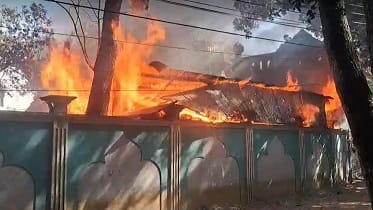
Eyewitnesses said the mob vandalised and set fire to the shrine, nearby homes and several vehicles, including two police cars and the upazila nirbahi officer’s (UNO) car. “The agitated mob vandalised my vehicle as well as the additional SP’s car and the OC’s vehicle. Later, they attacked the shrine, exhumed the body and burned it,” Goalanda UNO Md Nahidul Rahman said.
Police initially tried to contain the situation but were quickly overpowered, forcing the deployment of army and Rapid Action Battalion (RAB) units. The crowd carried the body in a procession to the Dhaka–Khulna highway and set it ablaze at Padma intersection, witnesses said. Fire service teams were also deployed to douse flames and treat the injured.
Md Al Amin, a member of Tawhidi Janata, told reporters: “At one time, Nural Pagla claimed he was Imam Mahdi. He even claimed to be a god. His actions were against Shariah. Pious Muslims cannot accept this. That is why we vandalised and burnt his house and dug out his body.”
Police in Rajbari later filed a case against around 3,500 unidentified individuals— one of the largest such filings in recent years— for attacking law enforcers and damaging public property.
The interim government strongly condemned the desecration, calling it “inhuman and despicable”. “This act is a direct affront to our values, our laws, and the very fabric of a just and civilised society. Such acts of barbarity will not be tolerated,” it said in a statement, vowing that “immediate and tough legal action” would follow.
Analysts warned that the incident reflects a dangerous rise in religious vigilantism. “Such acts cannot be dismissed as local skirmishes— they reveal an erosion of rule-based governance and growing mob rule,” one observer noted.