
Last Updated on July 28, 2026 12:13 am by INDIAN AWAAZ
Staff Reporter | New Delhi
The Welfare Party of India (WPI) has called for an immediate freeze on the proposed delimitation exercise, greater transparency in the Election Commission’s Special Intensive Revision (SIR) of electoral rolls, and the withdrawal of cases against students arrested during recent protests, following a two-day meeting of its Federal Working Committee in New Delhi.
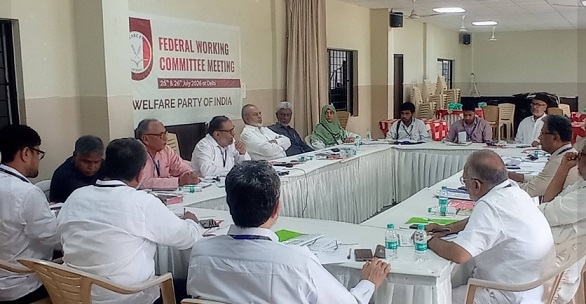
The meeting, held on July 25 and 26 under the chairmanship of National President Dr. Raisuddin, adopted a series of resolutions on electoral reforms, education, civil liberties and minority rights.
On the Election Commission’s Special Intensive Revision of electoral rolls, the party alleged that arbitrary deletions and a lack of transparency were disenfranchising migrants, minorities and other marginalised communities. It claimed the exercise was creating confusion ahead of elections and demanded that the Election Commission ensure a transparent and inclusive revision process, publish district-wise data and carry out door-to-door verification so that no eligible voter is excluded.
The party also opposed any delimitation exercise based on a fresh Census, arguing that it could reduce parliamentary representation for southern states and upset the federal balance. WPI demanded that the Centre freeze the delimitation process and ensure that no state loses its existing Lok Sabha seats without a broad national consensus reached through an all-party meeting.
Referring to the recent student protests over alleged irregularities in competitive examinations, the party praised the students for what it described as their peaceful movement and welcomed the resignation of former Union Education Minister Dharmendra Pradhan. It alleged that the government’s response relied on force rather than dialogue and called for comprehensive reforms in the education system to improve transparency and accountability.
Among its demands, WPI sought compensation for injured students and affected families, the immediate release of all detained students and supporters, and legal action against police personnel accused of using excessive force against peaceful protesters.
The party also criticised a reported Standard Operating Procedure (SOP) of the Gujarat State Intelligence Bureau, alleging that it listed routine religious practices such as keeping a beard, wearing a niqab, using Arabic greetings and observing I’tikaf as indicators of radicalisation. WPI claimed such profiling violated constitutional guarantees of equality and religious freedom and demanded the immediate withdrawal of the SOP.
Reiterating its opposition to the proposed Uniform Civil Code (UCC), the party said the move would undermine religious freedom, cultural diversity and the personal laws of different communities. It argued that any reforms relating to personal laws should emerge through dialogue and consensus rather than legislative imposition.
The Federal Working Committee also condemned the reported demolition order against Jauhar University in Rampur, Uttar Pradesh, alleging that it was politically motivated and contrary to the spirit of recent Supreme Court observations on “bulldozer actions”. The party said the future of more than 2,000 students studying at the institution was at stake and urged the Uttar Pradesh government to withdraw the order and extend full recognition and support to the university.
Expressing concern over reported eviction notices issued to mosques, madrasas and dargahs located within 50 kilometres of the India-Pakistan border in Rajasthan, WPI alleged that the action unfairly targeted religious institutions in the name of national security. It called on the government to halt all evictions and demolitions and ensure that laws are not misused to discriminate against any community.
The resolutions were moved by National General Secretary Sheema Mohsin and unanimously adopted by the Federal Working Committee after detailed deliberations, according to the party.