
Last Updated on September 25, 2026 11:28 pm by INDIAN AWAAZ
Oil, Bond Yields and Financial-Sector Concerns Weigh on Sentiment
Our Business Desk
Indian equities ended the week on a weak note despite a modest recovery on Friday, as elevated crude oil prices, rising US Treasury yields, geopolitical uncertainty and fresh concerns over the financial sector kept investors cautious.
The benchmark indices came under particularly heavy selling pressure on Thursday, when the Sensex plunged 1,247.71 points, or 1.67%, and the Nifty 50 fell 1.64%, erasing much of the gains accumulated earlier in the week. The market recovered partially on Friday on value buying, but the rebound was not sufficient to reverse the weekly decline.
From Monday’s close of 74,858.99 on the Sensex and 23,414.30 on the Nifty, the benchmarks finished Friday at 73,895.74 and 23,140.50, respectively. This translates into a weekly decline of approximately 1.29% for the Sensex and 1.17% for the Nifty.
The week’s performance also extended the market’s losing streak. Reuters reported that Indian equities recorded their longest weekly losing run in six years, with high oil prices contributing to concerns over inflation, bond yields and the domestic import bill.
Monday: Markets begin week with a rebound
The week began on a positive note as investors returned to equities following the preceding period of weakness.
On Monday, September 21, the Sensex gained 564.03 points, or 0.76%, to 74,858.99, while the Nifty 50 rose 67.90 points, or 0.29%, to 23,414.30. The recovery was supported by bargain buying after the recent market decline, while softer crude oil prices and easing global bond yields provided additional relief.
Twelve of the 16 major sectoral indices advanced during the session. Heavyweight stocks including HDFC Bank, ICICI Bank and Reliance Industries supported the benchmarks.
However, the broader market remained relatively subdued. Midcap and smallcap indices declined despite the benchmark recovery, indicating that investors were still selective in their approach.
Welspun Corp gained after its unit secured an order from Saudi Aramco, while logistics company Leap India also advanced. Indian Hotels gained following a brokerage upgrade.
The Monday recovery came against a backdrop of continuing Middle East tensions and elevated crude prices, limiting the extent of the gains.
Tuesday: Nifty snaps four-session winning streak
The recovery failed to continue on Tuesday.
The Sensex fell 329.91 points, or 0.44%, to 74,529.08, while the Nifty declined 85.30 points, or 0.36%, to 23,329.00. The Nifty’s fall ended a four-session winning streak. IT and financial stocks were among the key areas of weakness.
Trent, Tata Consumer Products and TCS were among the major Nifty losers.
The broader market also remained under pressure, with the Nifty MidCap and SmallCap indices declining 0.08% and 0.23%, respectively.
The session demonstrated the fragile nature of the recovery, with investors continuing to assess global interest-rate conditions, crude oil prices and geopolitical developments.
Wednesday: Markets stage a recovery
Equities recovered on Wednesday as concerns over an immediate escalation in oil prices eased and hopes of diplomatic engagement between the US and Iran provided some relief.
The Sensex gained 299.17 points, or 0.40%, to 74,828.25, while the Nifty rose 117.80 points, or 0.50%, to 23,446.80.
The broader market performed better than the benchmarks. The Nifty MidCap and SmallCap indices gained about 0.7% and 0.89%, respectively.
Metals were among the stronger sectors, with Tata Steel and Hindalco among the prominent Nifty gainers. Bajaj Finance also advanced.
IT stocks, however, remained under pressure, declining about 1% as investors continued to monitor the implications of high US yields and changing expectations for global technology spending.
The recovery on Wednesday briefly pushed the Nifty closer to the 23,450 area, but the market could not sustain those gains into Thursday.
Thursday: Sharpest sell-off of the week
Thursday proved to be the most difficult session of the week.
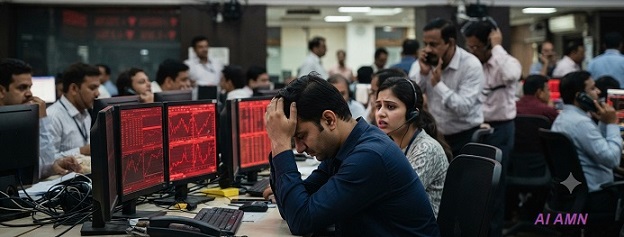
The Sensex crashed 1,247.71 points, or 1.67%, to 73,580.54, while the Nifty plunged 383.70 points, or 1.64%, to 23,063.10. The Nifty slipped below 23,100, marking a sharp deterioration in market sentiment.
The sell-off was broad-based. All 16 major Nifty sectoral indices ended in negative territory, while financial stocks were particularly badly hit.
The Nifty MidCap 50 fell 2.57%, the Nifty MidCap 100 declined 2.25% and the Nifty SmallCap 100 lost 1.53%. India VIX, a measure of market volatility, jumped 22.76% to 12.70.
Several factors converged to pressure the market.
Crude oil prices remained elevated, while the US 10-year Treasury yield moved above 5.10%. Higher oil prices raised concerns over India’s import bill and inflation, while rising US yields increased pressure on global liquidity and risk assets. The rupee also weakened.
Financial stocks faced an additional domestic trigger after proposed changes to insurance commission structures raised concerns over the earnings outlook of companies exposed to the insurance distribution business.
Shares of PB Fintech, L&T Finance and other financial companies came under heavy selling pressure. PB Fintech was among the biggest casualties, with its shares declining sharply.
NSE makes historic market debut
Thursday also witnessed one of the most significant events in India’s capital market—the stock-market debut of the National Stock Exchange of India.
NSE shares listed on the BSE at Rs 1,800, compared with the IPO issue price of Rs 1,785, representing a premium of about 0.84%. The shares later closed at around Rs 1,818, giving the exchange a market capitalisation of approximately Rs 4.5 trillion. (NDTV Profit)
The listing marked the end of a long wait for the exchange to become a publicly traded company and became a major feature of India’s primary and secondary markets during the week.
The significance of the listing was particularly notable because it took place on a day when the broader market was undergoing a sharp sell-off.
Friday: Value buying brings partial recovery
After Thursday’s heavy decline, investors returned to select large-cap stocks on Friday.
The Sensex gained 315.20 points, or 0.43%, to 73,895.74, while the Nifty advanced 77.40 points, or 0.34%, to 23,140.50. The Nifty managed to reclaim the 23,100 level.
Value buying in banking, automobile and other domestic-facing stocks helped the recovery. Axis Bank gained 3.03%, Mahindra & Mahindra rose 1.75% and HDFC Bank advanced 0.92%, providing support to the Nifty.
The recovery remained selective. The BSE 150 MidCap Index declined 0.25%, while the BSE 250 SmallCap Index slipped 0.01%.
Market breadth on the BSE was nevertheless positive, with 2,257 shares advancing against 2,079 declining shares.
Brent crude for November 2026 delivery declined $1.10, or 1.03%, to $105.50 a barrel. The rupee also strengthened marginally to 95.8050 against the dollar. The US 10-year Treasury yield, however, remained elevated at 5.175%.
Crude oil remains the biggest macro trigger
Oil prices emerged as one of the most important variables for Indian equities during the week.
Brent crude remained above the psychologically important $100-a-barrel level for much of the period, raising concerns about inflation and India’s import bill. The sharp rise in oil prices also contributed to the sell-off on Thursday.
For India, sustained high crude prices can have implications for inflation, the current account, corporate costs and the currency. Investors therefore continued to closely track developments in the Middle East and their potential impact on global oil supplies.
The modest decline in Brent on Friday provided some relief, but prices remained high enough to keep the issue firmly on the market’s radar.
Bond yields add pressure
The second major external factor was the rise in US Treasury yields.
The US 10-year yield moved above 5.10% during the week and touched levels not seen in many years. Rising yields increase the cost of capital globally and can affect foreign investment flows into emerging markets.
The combination of higher oil prices and elevated bond yields created a difficult backdrop for Indian equities.
The domestic 10-year government bond yield, meanwhile, remained around the 7.1% area.
Foreign investors remain sellers
Foreign portfolio flows remained a significant source of pressure.
According to market data available through September 24, foreign institutional investors were net sellers in three of the four sessions from Monday through Thursday. Their cumulative net selling over these four sessions amounted to roughly Rs 7,796 crore.
Domestic institutional investors provided an important counterweight, recording cumulative net purchases of approximately Rs 13,560 crore over the same period.
The data indicate that domestic institutional buying helped absorb a substantial part of the foreign selling pressure, although it was not enough to prevent the sharp correction on Thursday. (Business Standard)
Sectoral picture
Financial stocks were among the major areas of weakness during the week, particularly after concerns over proposed insurance commission changes emerged.
IT stocks also remained under pressure amid elevated US yields and concerns about the global technology spending environment.
Metals performed relatively better during Wednesday’s recovery, while auto and select consumer-facing companies attracted buying interest during Friday’s rebound.
The sharp fall on Thursday, however, demonstrated the breadth of the risk-off move, with all major sectoral indices ending lower.
Primary market remains active
The weakness in the secondary market did not translate into a complete slowdown in IPO activity.
Several public issues remained open during the week, reflecting continued investor participation in India’s primary market.
Moneyview, A-One Steels India, Swastika Infra, Adroit Industries (India), ArMee Infotech, Elevate Campuses, AceVector, Runwal Enterprises, German Green Steel and Power and Orient Cables (India) were among the issues active during the period.
By Friday, subscription levels varied considerably across issues, highlighting the selective nature of primary-market demand. Official NSE data showed that several issues were still active as of September 25, with their subscription levels changing throughout the day. (NSE India)
The NSE’s own listing also added an unusual dimension to the week’s capital-market activity.
Global backdrop
Global markets remained sensitive to oil prices, US Treasury yields and geopolitical developments.
European equities recovered at points during the week as crude prices eased, while Asian markets delivered mixed signals.
Investors also followed developments surrounding the meeting between US President Donald Trump and Chinese President Xi Jinping in Washington. Trade and artificial intelligence were among the issues discussed, with the US and China agreeing to extend their trade truce by two months.
These developments remained relevant for Indian markets because changes in global trade relations can affect export prospects, supply chains, technology companies and overall risk appetite.
Weekly market scorecard
| Indicator | September 21 close | September 25 close | Weekly change |
|---|---|---|---|
| Sensex | 74,858.99 | 73,895.74 | -1.29% |
| Nifty 50 | 23,414.30 | 23,140.50 | -1.17% |
The calculation uses the closing levels at the beginning and end of the September 21-25 trading week.
What the week tells us
The September 21-25 trading week highlighted the sensitivity of Indian equities to global macroeconomic variables.
The initial recovery on Monday showed that investors were willing to buy after the previous market decline. But the subsequent weakness demonstrated that bargain buying alone was insufficient to overcome concerns surrounding crude oil, US bond yields and geopolitical uncertainty.
Thursday’s sell-off was the week’s defining event. The simultaneous rise in crude prices, bond yields and financial-sector concerns resulted in a broad-based correction and pushed the Nifty below 23,100.
Friday’s rebound provided some stability, but the weekly close remained lower.
The market is therefore entering the next week with several variables in focus: the direction of crude oil, US Treasury yields, the rupee, foreign institutional flows, developments in the Middle East and the response of financial stocks to proposed regulatory changes.
For investors and businesses, the key message from the week was that global macroeconomic conditions continue to exert a significant influence on Indian equities, even as domestic liquidity and selective buying provide support.
The continued strength of domestic institutional buying, alongside active IPO participation, remains an important feature of the Indian capital market. At the same time, sustained foreign selling and elevated global yields could continue to produce bouts of volatility.
The week’s trading pattern also underlined the importance of stock and sector selection, with individual companies responding differently to the changing macroeconomic and regulatory environment.
Market data note: The Friday closing figures and stock-specific data are based on the September 25 market report supplied for this story; FII/DII flow calculations are based on data available through September 24.
Disclaimer: Stock market investments are subject to market risks. Please consult with a certified financial advisor before making any investment decisions.