
Last Updated on May 4, 2026 5:47 pm by INDIAN AWAAZ
Our Correspondent / Chennai
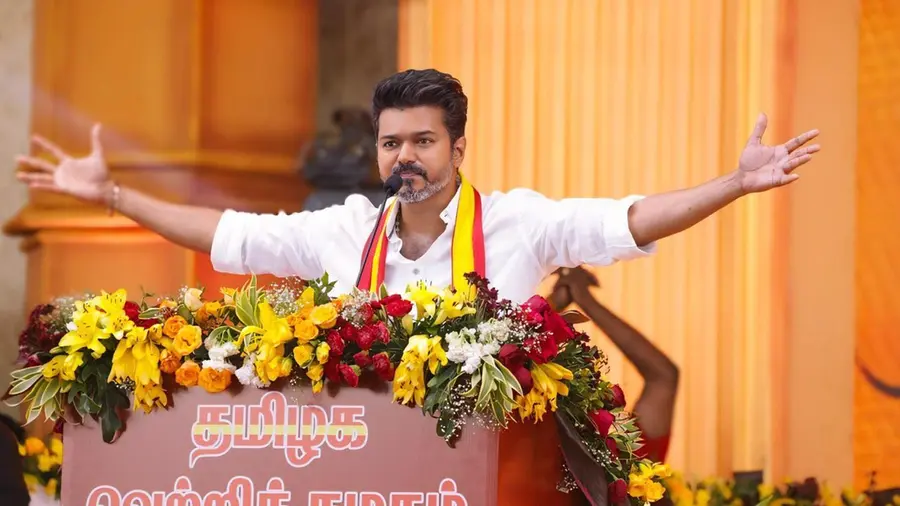
In a landmark moment in Tamil Nadu politics, Tamilaga Vettri Kazhagam TVK has crossed 10 million votes in its very first election, setting a new benchmark in the state’s 50-year political history.
Tamil Nadu has long been a frontrunner not just in development but also in shaping political thought. The 2026 Assembly elections have once again demonstrated this, as the state delivered an unprecedented verdict that redefines its electoral landscape.
Breaking through decades of dominance by Dravidian parties, actor-turned-politician Vijay’s TVK has carved out a new political path. Despite being a relatively new party with only a few years since its formation, this election marked its first major electoral test—and it has emerged with remarkable success.
The party had faced widespread criticism from established political players, who dismissed it as lacking experienced candidates, organizational structure, political vision, and grassroots presence. Yet, in this 2026 maiden electoral battle, TVK has outperformed traditional giants like Dravida Munnetra Kazhagam and All India Anna Dravida Munnetra Kazhagam, living up to the “victory” embedded in its name.
To form a government in Tamil Nadu, a party needs at least 118 MLAs, typically requiring a minimum vote share of around 30%. Entering the elections, TVK was widely expected to fall short due to its lack of seasoned candidates, strong orators, and established voter outreach. Political analysts had largely predicted defeat.

However, defying all expectations, TVK has secured over 12 million votes—approximately 35% of the total vote share. This is an extraordinary achievement, as no party in the past five decades of Tamil Nadu politics has managed to gain such a high vote share and seat count within such a short span of its formation.
Observers note that when M. G. Ramachandran founded the AIADMK and contested elections, the party secured around 33.5% vote share—making TVK’s performance even more noteworthy by comparison.
While TVK’s rise to power has surprised many, the real challenge begins now. With high expectations from voters, the party faces the critical task of translating this massive mandate into effective governance and delivering on public aspirations.
Here is the English version with a clear headline and structure:
Tamil Nadu Chief Ministers Who Lost in Subsequent Elections
– Staff Reporter –
Several leaders who served as Chief Ministers of Tamil Nadu went on to face defeat in later elections. Here’s a look at some notable instances:
- K. Kamaraj
Served as Chief Minister from 1954 to 1963 for three consecutive terms (Congress). In the 1967 elections, he lost from the Virudhunagar constituency to DMK’s Srinivasan by a margin of 1,285 votes. - M. Bhaktavatsalam
Chief Minister from 1963 to 1967 (Congress). He was defeated in the 1967 elections at Sriperumbudur by DMK’s Rajarathinam by 8,926 votes. - Janaki Ramachandran
Served briefly as Chief Minister for 23 days in 1988 (AIADMK). In the 1989 elections, she lost from Andipatti to DMK’s Aasiyan by 4,221 votes. - J. Jayalalithaa
Chief Minister from 1991 to 1996 (AIADMK). She lost the 1996 elections from Bargur to DMK’s Sugavanam by 8,366 votes. - O. Panneerselvam
A three-time Chief Minister (AIADMK). He lost in the 2024 Lok Sabha elections from Ramanathapuram to Indian Union Muslim League’s Nawaz Kani by a margin of 166,785 votes. - M. K. Stalin
Chief Minister from 2021 to 2026 (DMK). In the 2026 Assembly elections, he was defeated in Kolathur by V. S. Babu of Tamilaga Vettri Kazhagam by a margin of 9,116 votes.
These instances highlight that even the most powerful political leaders in Tamil Nadu have not been immune to electoral defeat.