
Last Updated on May 3, 2026 8:50 pm by INDIAN AWAAZ
Aafreen Hussain / Kolkata
— On the eve of the West Bengal Assembly election results, the political atmosphere across the state feels less like a routine democratic exercise and more like the tense silence before an exam result is declared. From tea stalls in North Kolkata to village crossings in Murshidabad, one question echoes everywhere: “What will happen tomorrow?”
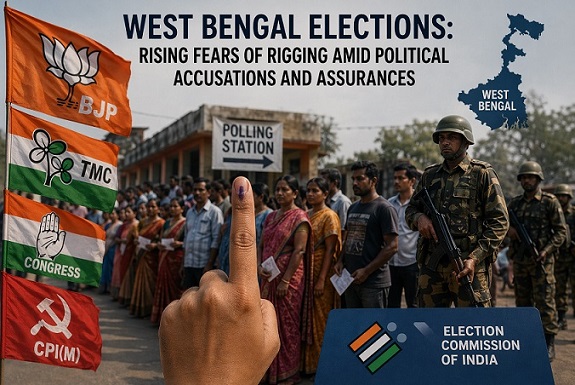
This election has been one of the most closely watched contests in India, with key players including the ruling All India Trinamool Congress (TMC), the challenger Bharatiya Janata Party (BJP), along with Indian National Congress, Communist Party of India (Marxist) (CPIM), and the rising Indian Secular Front (ISF). Each camp is publicly confident, yet privately anxious.
A State Defined by High-Stakes Politics
West Bengal’s political landscape has historically witnessed dramatic shifts. The Left Front, led by the CPIM, ruled the state for an uninterrupted 34 years before being unseated in 2011 by Mamata Banerjee and her TMC. Since then, Mamata Banerjee has remained a dominant force, crafting a strong grassroots network and welfare-driven governance model.
However, over the last decade, the BJP has rapidly expanded its footprint in the state, emerging as the principal challenger. What was once a marginal player in Bengal politics has transformed into a formidable electoral machine.
The Leadership Question: Stakes for Mamata and Abhishek
For Mamata Banerjee, this election is not just about retaining power
it is about legacy. A defeat would inevitably raise questions about her long-standing political dominance.
Similarly, Abhishek Banerjee, often seen as the party’s next-generation leader, would face intense scrutiny if the TMC fails to secure a mandate. Critics within and outside the party may question leadership strategy, organizational decisions, and campaign effectiveness.
Yet, Indian politics has repeatedly shown that a single electoral defeat does not necessarily end political careers. Leaders and parties often stage comebacks, especially in states with strong regional identities like West Bengal.
If TMC Loses: End or Intermission?
A potential loss for TMC would be significant, but not necessarily final. Regional parties in India have demonstrated resilience. The TMC’s deep-rooted presence at the grassroots level—particularly in rural and semi-urban area
means it would likely remain a powerful opposition force.
History suggests that voter sentiment in West Bengal can shift dramatically. The same electorate that brought down the Left Front after decades could also reshape the political map again in future elections.
If BJP Wins: A New Political Chapter?
If the BJP manages to form the government, it would mark a historic breakthrough in a state where it has never held power independently. It would also signal a broader expansion of national politics into a region traditionally dominated by regional forces.
However, the idea of a permanent “capture” of Bengal is far from certain. West Bengal’s electorate is known for its independent and often unpredictable voting behavior. Governments here are judged continuously, and power is never guaranteed beyond one election cycle.
The Role of Congress, CPIM, ISF and Others
While the main contest is widely perceived as a TMC vs BJP battle, parties like Congress, CPIM, and ISF continue to play a crucial role in shaping outcomes, especially in closely contested constituencies. Their vote shares can influence margins, alliances, and long-term political equations.
Independent candidates and smaller parties, though often overlooked, also contribute to the complex electoral arithmetic.
A Psychological Battle Before the Numbers
The current mood mirrors the anxiety of students awaiting exam results. Candidates, party workers, and voters alike are caught in a mix of hope and fear:
Will we pass or fail?
Will the margin be decisive or razor-thin?
Will expectations match reality?
Exit polls have only added to the confusion, offering conflicting predictions and fueling debates rather than settling them.
Democracy in Motion
Ultimately, elections in West Bengal are not just about victory or defeat
they are about the evolving will of the people. Governments may change, leaders may rise or fall, but the democratic process continues to renew itself with each vote.
As the state waits for the final verdict, one thing remains certain: by this time tomorrow, West Bengal will not just have a result
it will have a new political narrative.
Whether it brings continuity or change, reassurance or upheaval, is a question only the ballot boxes can answer.