
Last Updated on June 5, 2026 1:39 am by INDIAN AWAAZ
“Hamari baaten hi baaten hain, Sayyad kaam karta hai” (While we merely talk, Syed acts/works)
Staff Reporter /New Delhi
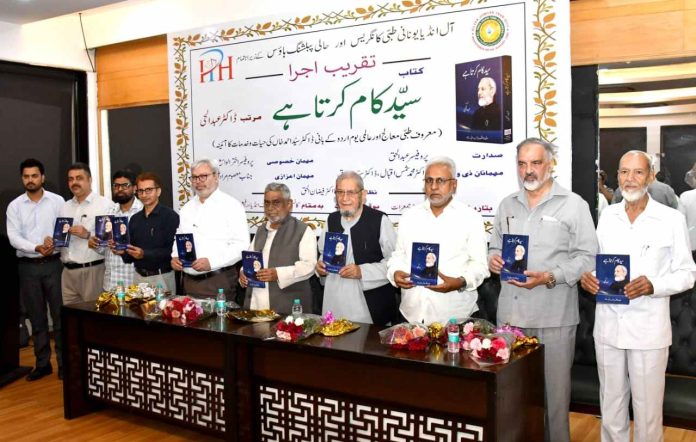
Literary Fraternity on Thursday applauded noted Hakeem and social thinker Dr. Syed Ahmad Khan for his lifelong contribution to Urdu language, literature, Unani medicine and intellectual discourse at a grand literary gathering held at the Constitution Club of India. Speakers described him as a visionary institution-builder, a tireless worker and a personality whose services have left a lasting imprint on academic and cultural life.
The occasion also witnessed the formal release of the book “Syed Kaam Karta Hai”, edited by Dr. Abdul Hai, and jointly organised by All India Unani Tibbi Congress and Hali Publishing House. The programme was chaired by Professor Abdul Haq, while Faiz Haq conducted the proceedings.
Introducing the book, editor Dr. Abdul Hai said that although he came to edit the volume by chance, he considered it a privilege to work on documenting the life and contributions of a person who had devoted himself selflessly to the promotion of Urdu language and literature. He noted that compiling the work became an enriching intellectual journey in itself.
Delivering the keynote address, Professor Akhtarul Wase said the publication of a book dedicated to Dr. Syed Ahmad Khan’s life and achievements may have come later than expected, but it remains an important literary and academic milestone. He observed that such recognition should have arrived much earlier considering Dr. Khan’s outstanding and enduring contributions to Unani medicine, Iqbal studies, and Urdu language and literature.
Professor Wase particularly highlighted Dr. Khan’s pioneering role in conceptualising and institutionalising the celebration of World Urdu Day alongside Iqbal Day at the national level. He said the widespread observance of World Urdu Day across India today stands as testimony to Dr. Khan’s foresight, commitment and sustained efforts over many years.
In his presidential remarks, Professor Abdul Haq described the initiative of observing World Urdu Day on 9 November, the birth anniversary of Allama Iqbal, as a historic cultural movement. He said its influence has expanded beyond India and gained recognition internationally. Referring to the journey of the campaign, he noted that even those who had initially questioned the idea eventually embraced it. He credited Dr. Syed Ahmad Khan’s determination and perseverance for transforming a vision into a nationally recognised observance and appreciated Dr. Abdul Hai for preserving this legacy through the publication.
Senior journalist Masoom Moradabadi said the title “Syed Kaam Karta Hai” was inspired by a celebrated verse of poet Akbar Allahabadi, originally written in appreciation of Sir Syed Ahmad Khan. According to him, the title perfectly captures Dr. Syed Ahmad Khan’s energetic, action-oriented and multi-dimensional personality.
Moradabadi said Dr. Khan’s life has been defined by service, dedication and relentless work. In a lighter moment, he remarked that after observing him closely, he found only one “shortcoming” — his impatience to convert ideas into action immediately, a trait that reflects his deep commitment to public causes.
Speaking on the occasion, Sheikh Aleemuddin Asadi emphasised that Dr. Khan’s contributions extend far beyond Unani medicine and include meaningful service to Urdu language and literary culture, making him deserving of wider recognition and appreciation.
Several scholars and literary figures including Dr. Syed Farooq, Qamaruddin, Professor Saleem Qidwai, Ashraf Mewati and Khurshid Hayat also addressed the gathering. The speakers unanimously praised the significance of the book and acknowledged Dr. Syed Ahmad Khan’s enduring services to education, literature and society, while commending Dr. Abdul Hai’s editorial effort in bringing these contributions to a wider audience.
The event was attended by a large number of academics, writers, intellectuals and admirers of Urdu literature, including Dr. Mirza Asif Beg, Dr. Mohammad Arshad Ghiyas, Dr. Shakeel Ahmad, Dr. Shamsuddin Azad, Dr. Altaf Ahmad, Athar Ansari, Saleem Aligarhi, Dr. Shamim Akhtar, Hamid Ali Akhtar, Advocate Shahjabeen Qazi, Professor Arif Zaidi, Dr. Khurshid Ahmad Azmi and Munawwar Hasan Kamal.