
Last Updated on September 29, 2025 12:00 am by INDIAN AWAAZ
AMN / New Delhi
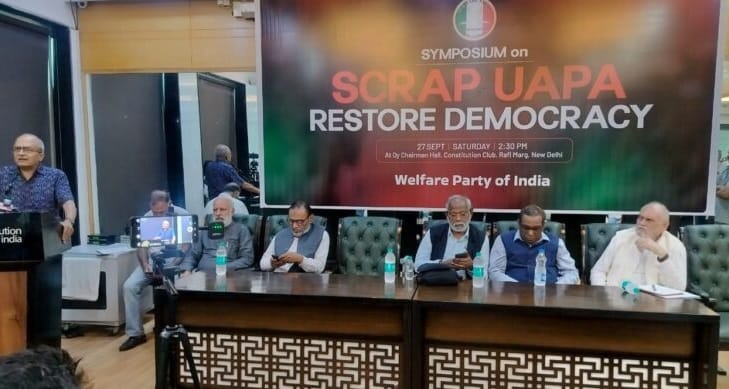
The Welfare Party of India on Saturday organized a seminar at the Constitution Club of India under the theme “Remove UAPA, Restore Democracy.” The event brought together senior lawyers, activists, historians, and academics who delivered sharp critiques of the Unlawful Activities (Prevention) Act (UAPA) and similar legislations, calling them draconian, unconstitutional, and contrary to the spirit of Indian democracy. Speakers unanimously urged for their repeal to restore fundamental freedoms.
Zafar-ul-Islam Khan, President of the All India Muslim Majlis-e-Mushawarat, criticized the proliferation of harsh laws after independence. He recalled that while draconian legislations like MISA, TADA, and POTA were repealed after widespread abuse, UAPA is even more stringent. He pointed out that many states have introduced their own versions of such laws, allowing prolonged detention without trial. “From Kashmir to Gujarat, these laws are used not for security but for intimidation,” he said, regretting that while Indians praise the Constitution abroad, they seldom demand its full implementation at home.
Supreme Court advocate Prashant Bhushan warned that judicial independence in India faces an “unprecedented threat.” Turning to electoral practices, Bhushan accused the Election Commission of enabling voter suppression in Bihar and Uttar Pradesh by deleting names and adopting discriminatory practices. He argued that only strong and non-violent public opinion can keep democratic institutions accountable.
SQR Ilyas, national general secretary of the Welfare Party and chair of the session, labeled UAPA a “black law” that reverses the principle of justice. He argued that while earlier Congress governments framed repressive laws, the current regime has weaponized them against movements like the anti-CAA protests. “Under UAPA, the accused is treated as guilty until proven innocent and can languish in jail for years without trial,” he said, adding that wrongful incarceration destroys countless lives with no accountability for false charges.
Delhi University professor Shashi Shekhar Singh emphasized the academic responsibility to safeguard constitutional freedoms, while senior journalist Prashant Tandon moderated the discussions.
The seminar concluded with a strong consensus: UAPA and similar laws are incompatible with democracy, and their repeal is essential to restore justice, accountability, and pluralism. Speakers underscored that citizens must reclaim their rights through collective, peaceful, and sustained resistance, warning that silence in the face of repression only strengthens authoritarianism.