
Last Updated on August 27, 2026 3:16 pm by INDIAN AWAAZ
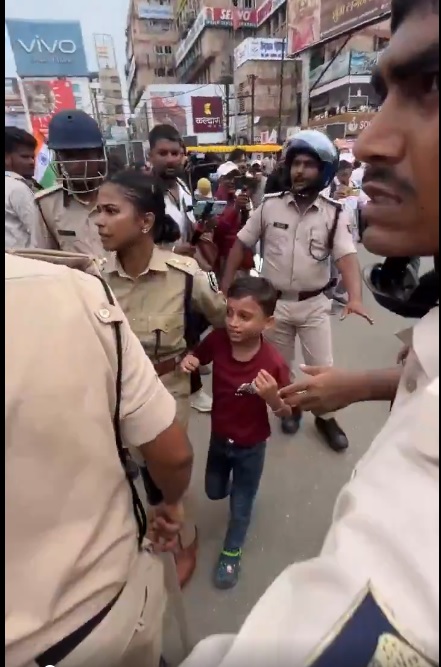
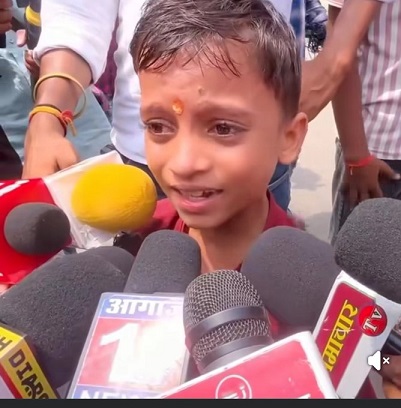
6-year-old Aditya Kumar in his interview with News24 on Instagram, alleged that after an IPS officer detained him, a Superintendent of Police (SP) beat his parent.
By Our Correspondent / PATNA
A six-year-old boy, Aditya Kumar, unexpectedly became one of the most talked-about faces of Bihar’s latest student agitation after he appeared at a protest in Patna and delivered unusually pointed remarks on unemployment, police action and government accountability.
Aditya, a Class 1 student from a financially disadvantaged family, was present during the August 25 demonstration by students and job aspirants over issues surrounding recruitment examinations conducted by the Bihar Public Service Commission (BPSC). Videos of the child speaking to journalists quickly spread across social media, turning what began as a student agitation into a wider debate over the involvement and safety of children at politically charged demonstrations.
The episode also generated confusion over whether the child had been “arrested” by police. Authorities subsequently clarified that Aditya was not formally arrested. He was taken away from the protest area and later handed over to his mother after police said they were concerned about his safety amid clashes between demonstrators and security personnel.
Child’s remarks capture public attention
Aditya attracted attention after telling reporters that Bihar Chief Minister Samrat Choudhary should resign and that action should be taken against those responsible for the alleged lathi-charge on protesters.
His comments, delivered in the middle of a tense demonstration, struck a chord with protesters and social-media users. The child appeared to be expressing concerns about jobs and the future of young people, issues that have increasingly become central to political debate in Bihar.
His appearance also prompted a second, more uncomfortable question: why was a six-year-old present at a protest that subsequently witnessed confrontation between students and police?
Police officials maintained that their action was intended to ensure the child’s safety rather than punish him for participating in the demonstration. Reports said he was subsequently reunited with his mother, who works as a domestic worker.
Protest turns tense in Patna
Aditya’s appearance came against the backdrop of a major mobilisation by BPSC aspirants and other student groups in Patna on August 25. Hundreds of protesters marched from Gandhi Maidan towards the Bihar Chief Minister’s residence and Raj Bhavan, raising demands relating to recruitment examinations and alleged irregularities in the selection process.
The situation became tense near Dak Bungalow Chowk when protesters attempted to cross police barricades. Security personnel used water cannons to disperse the crowd, while a mild baton charge was also reported. Several protesters were detained and at least two policemen were reported injured during the confrontation.
The agitation has involved several student organisations and groups of job aspirants. Their demands include changes to the proposed format of the fourth phase of the Teacher Recruitment Examination (TRE-4), including opposition to a two-stage examination process. Protesters have also demanded action over alleged irregularities in earlier BPSC examinations, including calls for cancellation of the 70th BPSC examination.
Larger recruitment crisis behind agitation
The protest is not limited to a single examination. For thousands of young people preparing for government jobs, recruitment delays, examination procedures, alleged paper leaks and questions over transparency have become recurring concerns.
Student groups have argued that the proposed two-tier format for TRE-4 could make the recruitment process more complicated and have demanded a single-stage written examination. Another major demand has been the release of the official notification for TRE-4, which reportedly involves more than 32,000 teaching posts.
The controversy comes at a time when government employment remains particularly important in Bihar, where competitive examinations for teaching and other public-sector positions attract large numbers of candidates.
The recent protests have also revived memories of earlier confrontations between BPSC aspirants and authorities over alleged irregularities and examination-related grievances.
Political battle intensifies
The student agitation has also acquired a political dimension. Opposition leaders have criticised the Bihar government’s handling of the demonstrations and questioned whether the administration is doing enough to address allegations surrounding recruitment examinations.
Congress leader Rahul Gandhi accused the BJP-led Bihar government of using police action to avoid accountability to students and questioned why adequate action had not been taken over allegations of examination irregularities and paper leaks.
The government and ruling-party leaders, however, have maintained that students’ concerns should be addressed through dialogue and established procedures rather than confrontation on the streets.
The administration has also moved towards institutional mechanisms for addressing student grievances, with the Bihar government announcing monthly student support camps aimed at providing a platform for young people to raise recruitment and examination-related issues.
Aditya’s viral moment opens a larger debate
While the political arguments surrounding the BPSC controversy continue, Aditya’s brief appearance has added an emotional dimension to the agitation.
His presence has divided public opinion. Some have praised the boy’s confidence and his ability to articulate concerns about unemployment and police action. Others have questioned why a child of his age was brought into an environment where police intervention, water cannons and clashes were taking place.
For the authorities, the episode is primarily a child-safety issue. For many protesters and political opponents, however, the image of a six-year-old speaking about unemployment and government accountability has become a powerful symbol of the wider frustration among families struggling with the lack of stable employment opportunities.
Importantly, the available reports indicate that Aditya was not arrested, despite social-media claims suggesting otherwise. Police said he was taken away from the volatile protest area and later returned to his family.
The incident therefore goes beyond the viral video. It has brought together three sensitive issues confronting Bihar at the same time — the aspirations of young people for government jobs, growing demands for transparency in competitive examinations, and the responsibility of authorities and families to protect children from potentially dangerous situations.
As the BPSC recruitment controversy continues, Aditya’s unexpected moment in the spotlight has ensured that the debate is no longer confined to examination halls and protest sites. It has also become a striking reminder of how deeply questions of jobs, education and the future of Bihar’s youth resonate beyond the candidates directly preparing for government examinations.