
Last Updated on November 24, 2026 1:46 pm by INDIAN AWAAZ
Our Correspondent / New Delhi
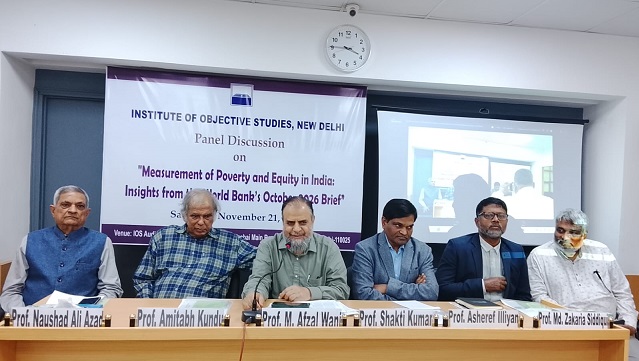
The Institute of Objective Studies (IOS) hosted a panel discussion on Saturday titled “Measuring Poverty and Equality in India: Insights from the World Bank’s October 2026 Brief.” The event brought together leading economists and academics to examine the changing dimensions of poverty, the methodology used to assess poverty levels, and the broader issue of economic inequality in India.
The discussion was based on the World Bank’s India Poverty and Equity Brief (October 2026), which highlights a significant decline in poverty over the past decade while drawing attention to persistent disparities in income, employment, and access to economic opportunities. According to the report, the share of India’s population living below the lower-middle-income poverty line of US$4.20 per day fell from 57.7 percent in 2011 to 16.1 percent in 2023. Extreme poverty, measured at US$3 per day, also declined sharply from 27.1 percent to 2.6 percent over the same period.
However, panelists questioned whether these improvements adequately reflect the realities of economic well-being and social justice.
Economist Prof. Amitabh Kundu argued that while poverty indicators show progress, important questions remain regarding the sustainability of these gains and their distribution across society. He noted that a reduction in poverty does not necessarily imply greater economic equality. Referring to the World Bank data, he pointed out that the average income of workers in the top 10 percent remained nearly 13 times higher than that of workers in the bottom 10 percent in 2023. He also questioned the methodology used to estimate poverty, especially the inclusion of government welfare transfers as part of household income. Prof. Kundu further highlighted evidence of discrimination faced by minorities, particularly Muslims, in urban labour markets.
Prof. Shakti Kumar questioned the comparability of survey data used by the World Bank, arguing that methodological differences between the 2011 and 2023 surveys may affect the conclusions. He also noted that many individuals officially counted as having moved above the poverty line continue to earn less than prevailing minimum wage levels. Stressing regional disparities, he observed that poverty remains concentrated in several eastern and northern states and is significantly higher in rural areas than in urban centres.
Prof. Ashraf Elyan expressed concern over what he described as a dilution of living-standard benchmarks. He argued that improvements in poverty estimates appear inconsistent with reduced public spending on sectors such as education and healthcare. Emphasizing the concentration of wealth, he said that sustainable employment and regular income opportunities would be more effective than dependence on free welfare schemes.
Similarly, Prof. Zakaria Siddiqui and Prof. Naushad Ali Azad stressed that the quality of employment remains a critical challenge. They called for stronger job creation, better vocational and higher education, support for labour-intensive industries, and greater employment opportunities for women and youth to ensure that poverty reduction remains sustainable and inclusive.
Chairing the session, Prof. M. Afzal Wani remarked that while the World Bank’s findings offer reassurance, India still remains far from fulfilling the constitutional promises of social and economic justice for its poor and working populations.